







Question: Please write a summary for article above for around 1 and a half page. Thank you! 9 A Smarter Grid Operation New Energy Management Systems
Please write a summary for article above for around 1 and a half page. Thank you!
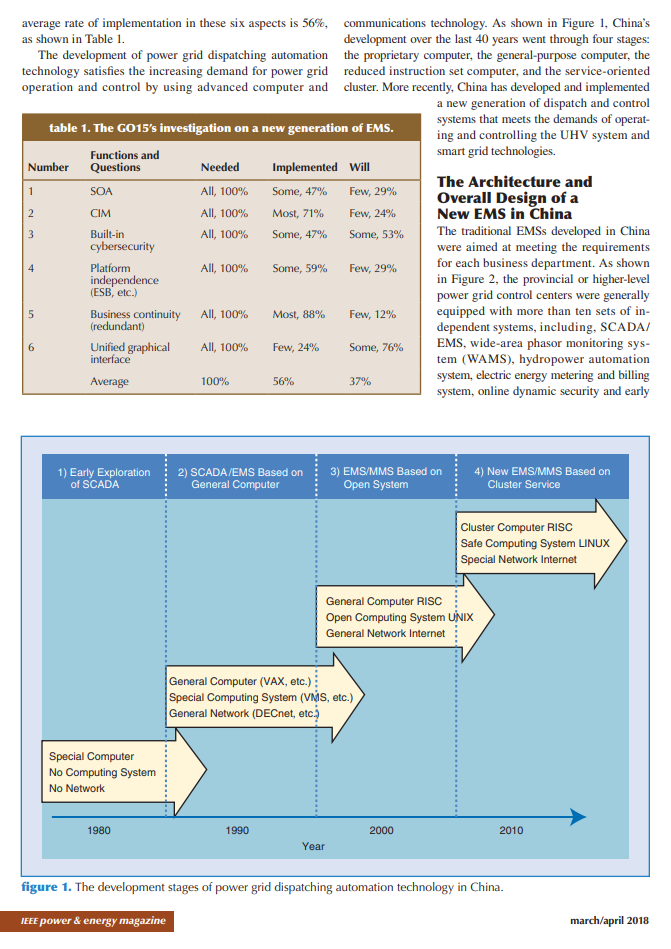
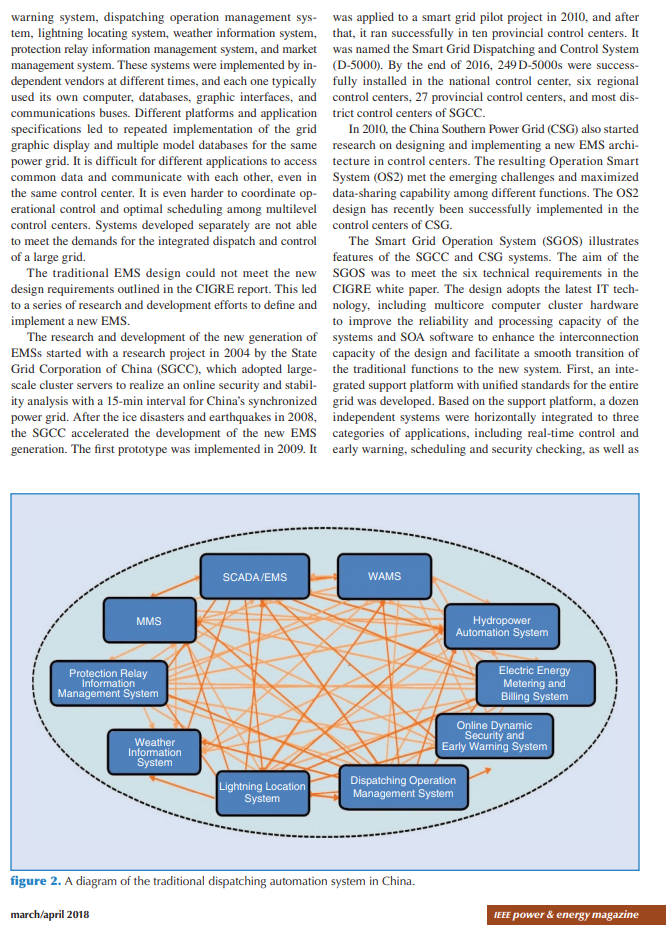
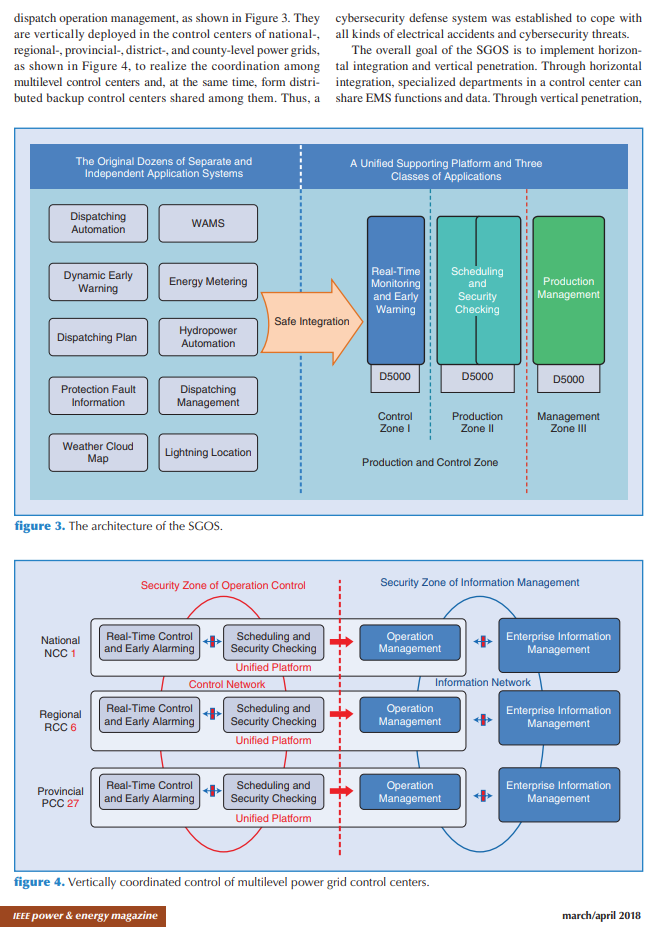
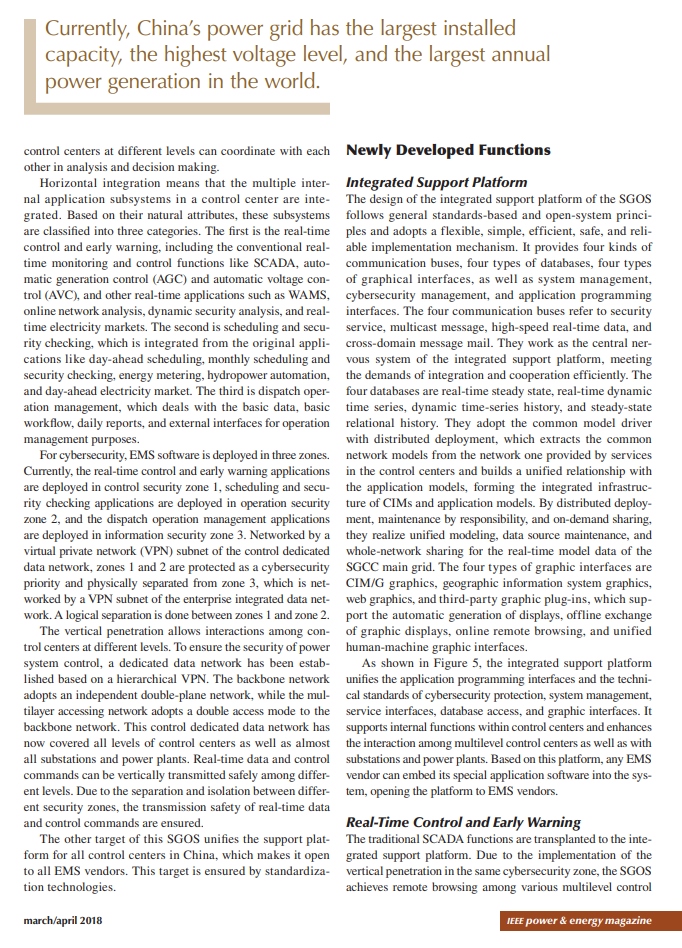
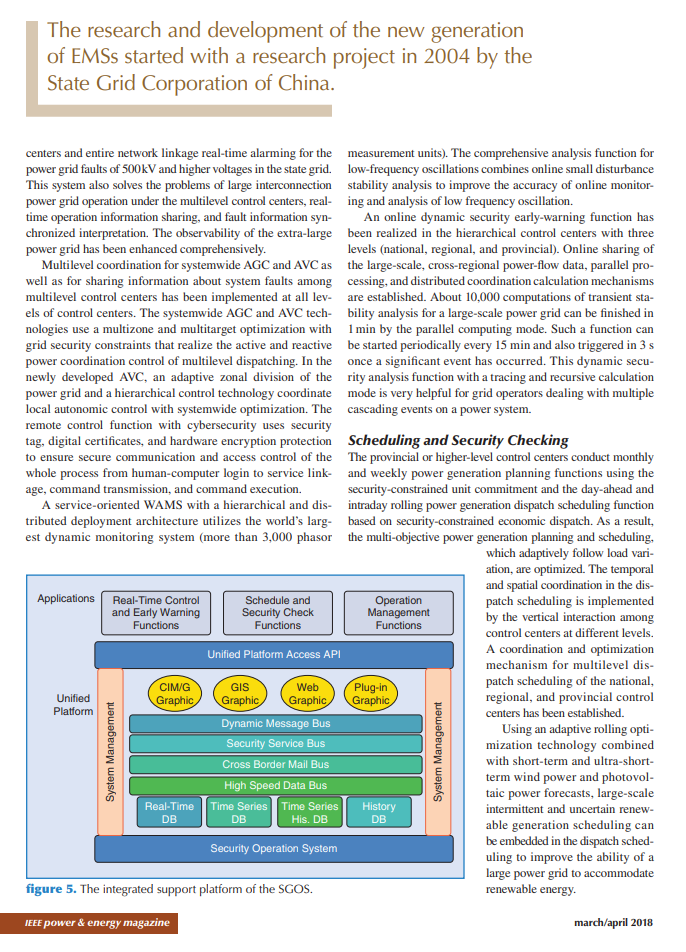
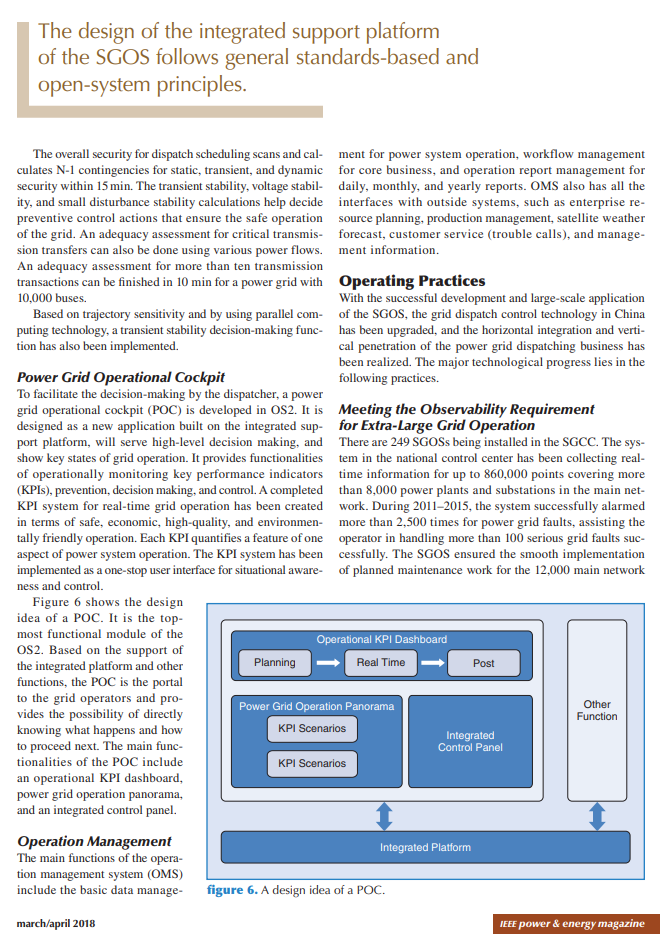
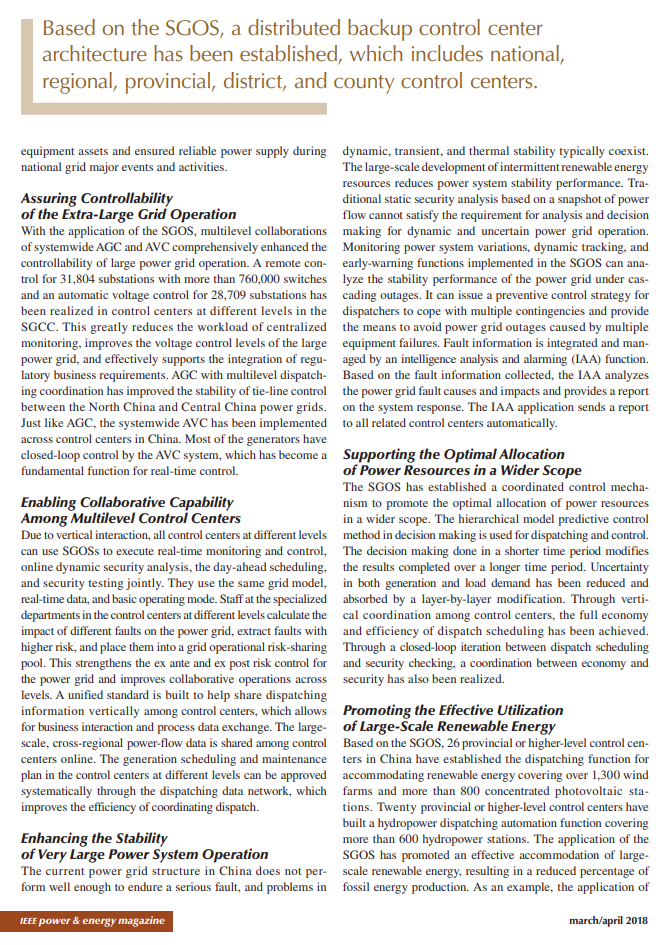
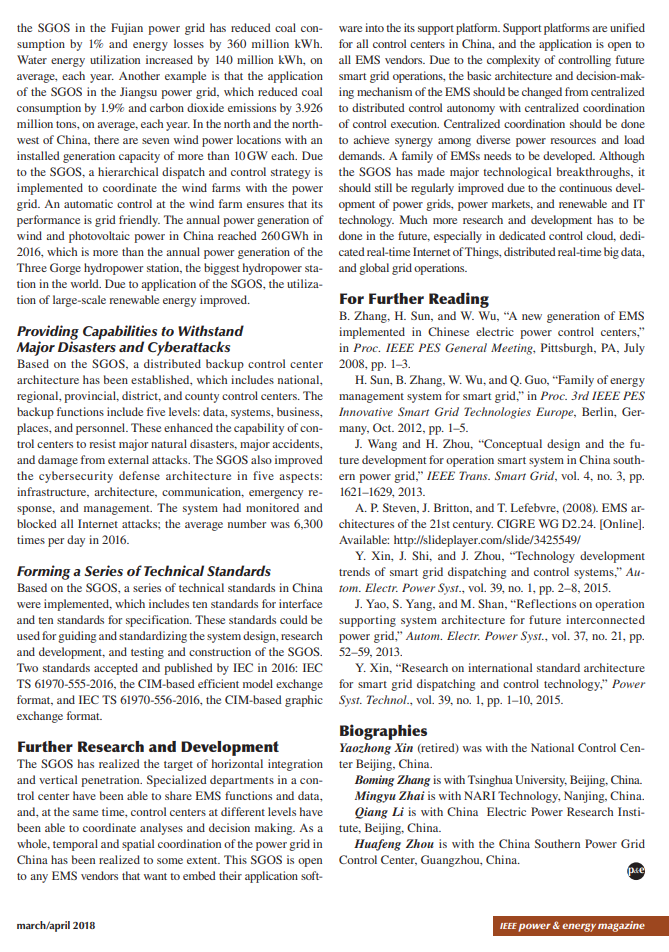
9 A Smarter Grid Operation New Energy Management Systems in China THE POWER GRID IN CHINA HAS BEEN DEVELOP- be affected by natural disasters, such as earthquakes, ing rapidly with the improvement of the national economy typhoons, lightning, bush fires, and frosting fogs. The and standard of living. By the end of 2016, China's installed ice storm in early 2008 affected the power systems of power generation capacity had reached 1,646GW. Currently, 14 provinces in China. The Wenchuan earthquakes in China's power grid has the largest installed capacity, the Sichuan province on 12 May 2008 caused major dam- highest voltage level [1,000-kV ultra-high voltage (UHV)], age to electric facilities. Immediately after these disas- and the largest annual power generation in the world. The ters, the independent multilevel automation systems in operation of such a large-scale power grid poses many major China had trouble performing normal control functions. challenges for electric power control centers. The lack of coordination between the supervisory con- 1) How to protect the security and stability of the very- trol and data acquisition (SCADA) system and energy large-scale power grid operation. There are several management systems (EMSs) among multiple control features of this kind of grid, including wide geo- centers was of serious concem. graphical distribution, complex dynamic time-varying 4) How to deal with cyberattacks and terrorist attacks. structural parameters, intensive and multi-infeed de The modern power grid control system is highly de- points, concentrations of large-capacity transmission pendent on computer and communication technology. corridors, large-scale grid connections of intermittent Cybersecurity threats to the electric power network renewable power resources, strong couplings between have become increasingly serious in recent years. The the sending and receiving sides, and strong interactions Ertan hydro power station in Sichuan province re- between the ac and de systems. There is an urgent need ceived abnormal orders that led to an outage event on to improve the observability and controllability of the 13 October 2000. Power grid control urgently requires whole power system and implement the coordinated the establishment of cybersecurity defense systems. control of the multilevel grids. The international very-large-power Grid Operators (G015) 2) How to ensure the effective accommodation of large- was formed in 2004 to focus on the challenges faced by scale renewable energy resources. By the end of power grid operators from all over the world. G015 cooper- 2016, the installed capacity of wind power and pho- ated with CIGRE to prepare the white paper EMS Architec- tovoltaic capacity reached 148 GW and 77 GW, tures of the 21st Century," which was officially released by respectively. The sum of these renewable resources CIGRE in 2011. The white paper put forward six requirements accounted for 13.7% of China's total installed capac- for the new generation of EMSs: 1) adopting a service-oriented ity. The penetration of wind power and photovoltaic architecture (SOA), 2) using the Common Information Model power has reached 30% in some northern provinces (CIM), 3) implementing cybersecurity protection measures, dominated by coal-fired generation. The randomness 4) using an independent supporting platform, 5) building and intermittency of large-scale renewable power a redundant backup control center, and 6) employing uni- production and the reduction of the system spinning fied graphic human-machine interfaces. This white paper inertia greatly affect the security and stability of has become a technical guide for developing a new gen- power grid operation. eration of EMSs throughout the power industry. According 3) How to cope with the impact of major natural disas- to the G015's investigation of 18 members, which were ters on power grid operation. The grid operation will the world's largest power grid operators in early 2016, the By Yaozhong Xin, Boming Zhang, Mingyu Zhai, Qiang Li, and Huafeng Zhou march/april 2018 IEEE power & energy magazine 37 1 average rate of implementation in these six aspects is 56%, communications technology. As shown in Figure 1, China's as shown in Table 1. development over the last 40 years went through four stages: The development of power grid dispatching automation the proprietary computer, the general-purpose computer, the technology satisfies the increasing demand for power grid reduced instruction set computer, and the service-oriented operation and control by using advanced computer and cluster. More recently, China has developed and implemented a new generation of dispatch and control table 1. The G015's investigation on a new generation of EMS. systems that meets the demands of operat- ing and controlling the UHV system and Functions and smart grid technologies. Number Questions Needed Implemented Will SOA The Architecture and All, 100% Some, 47% Few, 29% Overall Design of a All, 100% Most, 71% Few, 24% New EMS in China Built-in All, 100% Some, 47% Some, 53% The traditional EMSs developed in China cybersecurity were aimed at meeting the requirements Platform All, 100% Some, 59% Few, 29% for each business department. As shown independence in Figure 2, the provincial or higher-level (ESB, etc.) power grid control centers were generally Business continuity All, 100% Most, 88% Few, 12% equipped with more than ten sets of in- (redundant) dependent systems, including, SCADA/ Unified graphical All, 100% Few, 24% Some, 76% EMS, wide-area phasor monitoring sys- interface tem (WAMS), hydropower automation Average system, electric energy metering and billing 100% 56% 37% system, online dynamic security and early 2 CIM 1) Early Exploration of SCADA 2) SCADA/EMS Based on General Computer 3) EMS/MMS Based on Open System 4) New EMS/MMS Based on Cluster Service Cluster Computer RISC Safe Computing System LINUX Special Network Internet General Computer RISC Open Computing System UNIX General Network Internet General Computer (VAX, etc.) Special Computing System (VMS, etc.) General Network (DECnet, etc. ) Special Computer No Computing System No Network 1980 1990 2000 2010 Year figure 1. The development stages of power grid dispatching automation technology in China. IEEE power & energy magazine march/april 2018 warning system, dispatching operation management sys- was applied to a smart grid pilot project in 2010, and after tem, lightning locating system, weather information system, that, it ran successfully in ten provincial control centers. It protection relay information management system, and market was named the Smart Grid Dispatching and Control System management system. These systems were implemented by in- (D-5000). By the end of 2016, 249D-5000s were success- dependent vendors at different times, and each one typically fully installed in the national control center, six regional used its own computer, databases, graphic interfaces, and control centers, 27 provincial control centers, and most dis- communications buses. Different platforms and application trict control centers of SGCC. specifications led to repeated implementation of the grid In 2010, the China Southern Power Grid (CSG) also started graphic display and multiple model databases for the same research on designing and implementing a new EMS archi- power grid. It is difficult for different applications to access tecture in control centers. The resulting Operation Smart common data and communicate with each other, even in System (OS2) met the emerging challenges and maximized the same control center. It is even harder to coordinate op- data-sharing capability among different functions. The OS2 erational control and optimal scheduling among multilevel design has recently been successfully implemented in the control centers. Systems developed separately are not able control centers of CSG. to meet the demands for the integrated dispatch and control The Smart Grid Operation System (SGOS) illustrates of a large grid. features of the SGCC and CSG systems. The aim of the The traditional EMS design could not meet the new SGOs was to meet the six technical requirements in the design requirements outlined in the CIGRE report. This led CIGRE white paper. The design adopts the latest IT tech- to a series of research and development efforts to define and nology, including multicore computer cluster hardware implement a new EMS. to improve the reliability and processing capacity of the The research and development of the new generation of systems and SOA software to enhance the interconnection EMSs started with a research project in 2004 by the State capacity of the design and facilitate a smooth transition of Grid Corporation of China (SGCC), which adopted large- the traditional functions to the new system. First, an inte- scale cluster servers to realize an online security and stabil- grated support platform with unified standards for the entire ity analysis with a 15-min interval for China's synchronized grid was developed. Based on the support platform, a dozen power grid. After the ice disasters and earthquakes in 2008, independent systems were horizontally integrated to three the SGCC accelerated the development of the new EMS categories of applications, including real-time control and generation. The first prototype was implemented in 2009. It early warning, scheduling and security checking, as well as SCADA/EMS WAMS MMS Hydropower Automation System Protection Relay Information Management System Electric Energy Metering and Billing System Weather Information System Online Dynamic Security and Early Waming System Lightning Location System Dispatching Operation Management System figure 2. A diagram of the traditional dispatching automation system in China. march/april 2018 IEEE power & energy magazine dispatch operation management, as shown in Figure 3. They cybersecurity defense system was established to cope with are vertically deployed in the control centers of national-, all kinds of electrical accidents and cybersecurity threats. regional-, provincial-, district-, and county-level power grids, The overall goal of the SGOS is to implement horizon- as shown in Figure 4, to realize the coordination among tal integration and vertical penetration. Through horizontal multilevel control centers and, at the same time, form distri- integration, specialized departments in a control center can buted backup control centers shared among them. Thus, a share EMS functions and data. Through vertical penetration, The Original Dozens of Separate and Independent Application Systems A Unified Supporting Platform and Three Classes of Applications Dispatching Automation WAMS Dynamic Early Warning Energy Metering Real-Time Monitoring and Early Warning Scheduling and Security Checking Production Management Safe Integration Dispatching Plan Hydropower Automation D5000 D5000 D5000 Protection Fault Information Dispatching Management Control Zone Production Zone 11 Management Zone III Weather Cloud Map Lightning Location Production and Control Zone figure 3. The architecture of the SGOS. Security Zone of Operation Control Security Zone of Information Management National NCC 1 Operation Management Enterprise Information Management Real-Time Control Scheduling and and Early Alarming Security Checking Unified Platform Control Network Real-Time Control Scheduling and and Early Alarming Security Checking Unified Platform Information Network Operation Enterprise Information Management Management Regional RCC 6 Provincial PCC 27 Real-Time Control and Early Alarming Scheduling and Security Checking Unified Platform Operation Management Enterprise Information Management figure 4. Vertically coordinated control of multilevel power grid control centers. IEEE power & energy magazine march/april 2018 Currently, China's power grid has the largest installed capacity, the highest voltage level, and the largest annual power generation in the world. control centers at different levels can coordinate with each Newly Developed Functions other in analysis and decision making. Horizontal integration means that the multiple inter- Integrated Support Platform nal application subsystems in a control center are inte- The design of the integrated support platform of the SGOS grated. Based on their natural attributes, these subsystems follows general standards-based and open-system princi- are classified into three categories. The first is the real-time ples and adopts a flexible, simple, efficient, safe, and reli- control and early warning, including the conventional real- able implementation mechanism. It provides four kinds of time monitoring and control functions like SCADA, auto- communication buses, four types of databases, four types matic generation control (AGC) and automatic voltage con- of graphical interfaces, as well as system management, trol (AVC), and other real-time applications such as WAMS, cybersecurity management, and application programming online network analysis, dynamic security analysis, and real- interfaces. The four communication buses refer to security time electricity markets. The second is scheduling and secu- service, multicast message, high-speed real-time data, and rity checking, which is integrated from the original appli- cross-domain message mail. They work as the central ner- cations like day-ahead scheduling, monthly scheduling and vous system of the integrated support platform, meeting security checking, energy metering, hydropower automation, the demands of integration and cooperation efficiently. The and day-ahead electricity market. The third is dispatch oper- four databases are real-time steady state, real-time dynamic ation management, which deals with the basic data, basic time series, dynamic time-series history, and steady-state workflow, daily reports, and external interfaces for operation relational history. They adopt the common model driver management purposes. with distributed deployment, which extracts the common For cybersecurity, EMS software is deployed in three zones. network models from the network one provided by services Currently, the real-time control and early warning applications in the control centers and builds a unified relationship with are deployed in control security zone 1, scheduling and secu- the application models, forming the integrated infrastruc- rity checking applications are deployed in operation security ture of CIMs and application models. By distributed deploy- zone 2, and the dispatch operation management applications ment, maintenance by responsibility, and on-demand sharing, are deployed in information security zone 3. Networked by a they realize unified modeling, data source maintenance, and virtual private network (VPN) subnet of the control dedicated whole-network sharing for the real-time model data of the data network, zones 1 and 2 are protected as a cybersecurity SGCC main grid. The four types of graphic interfaces are priority and physically separated from zone 3, which is net- CIM/G graphics, geographic information system graphics, worked by a VPN subnet of the enterprise integrated data net- web graphics, and third-party graphic plug-ins, which sup- work. A logical separation is done between zones 1 and zone 2. port the automatic generation of displays, offline exchange The vertical penetration allows interactions among con- of graphic displays, online remote browsing, and unified trol centers at different levels. To ensure the security of power human-machine graphic interfaces. system control, a dedicated data network has been estab- As shown in Figure 5, the integrated support platform lished based on a hierarchical VPN. The backbone network unifies the application programming interfaces and the techni- adopts an independent double-plane network, while the mul- cal standards of cybersecurity protection, system management, tilayer accessing network adopts a double access mode to the service interfaces, database access, and graphic interfaces. It backbone network. This control dedicated data network has supports internal functions within control centers and enhances now covered all levels of control centers as well as almost the interaction among multilevel control centers as well as with all substations and power plants. Real-time data and control substations and power plants. Based on this platform, any EMS commands can be vertically transmitted safely among differ- vendor can embed its special application software into the sys- ent levels. Due to the separation and isolation between differ- tem, opening the platform to EMS vendors. ent security zones, the transmission safety of real-time data and control commands are ensured. Real-Time Control and Early Warning The other target of this SGOS unifies the support plat- The traditional SCADA functions are transplanted to the inte- form for all control centers in China, which makes it open grated support platform. Due to the implementation of the to all EMS vendors. This target is ensured by standardiza- vertical penetration in the same cybersecurity zone, the SGOS tion technologies. achieves remote browsing among various multilevel control march/april 2018 IEEE power & energy magazine The research and development of the new generation of EMSs started with a research project in 2004 by the State Grid Corporation of China. centers and entire network linkage real-time alarming for the measurement units). The comprehensive analysis function for power grid faults of 500kV and higher voltages in the state grid. low-frequency oscillations combines online small disturbance This system also solves the problems of large interconnection stability analysis to improve the accuracy of online monitor- power grid operation under the multilevel control centers, real- ing and analysis of low frequency oscillation. time operation information sharing, and fault information syn- An online dynamic security early-warning function has chronized interpretation. The observability of the extra-large been realized in the hierarchical control centers with three power grid has been enhanced comprehensively. levels (national, regional, and provincial). Online sharing of Multilevel coordination for systemwide AGC and AVC as the large-scale, cross-regional power-flow data, parallel pro- well as for sharing information about system faults among cessing, and distributed coordination calculation mechanisms multilevel control centers has been implemented at all lev- are established. About 10,000 computations of transient sta- els of control centers. The systemwide AGC and AVC tech-bility analysis for a large-scale power grid can be finished in nologies use a multizone and multitarget optimization with 1 min by the parallel computing mode. Such a function can grid security constraints that realize the active and reactive be started periodically every 15 min and also triggered in 3 s power coordination control of multilevel dispatching. In the once a significant event has occurred. This dynamic secu- newly developed AVC, an adaptive zonal division of the rity analysis function with a tracing and recursive calculation power grid and a hierarchical control technology coordinate mode is very helpful for grid operators dealing with multiple local autonomic control with systemwide optimization. The cascading events on a power system. remote control function with cybersecurity uses security tag, digital certificates, and hardware encryption protection Scheduling and Security Checking to ensure secure communication and access control of the The provincial or higher-level control centers conduct monthly whole process from human-computer login to service link- and weekly power generation planning functions using the age, command transmission, and command execution. security-constrained unit commitment and the day-ahead and A service-oriented WAMS with a hierarchical and dis- intraday rolling power generation dispatch scheduling function tributed deployment architecture utilizes the world's larg- based on security-constrained economic dispatch. As a result, est dynamic monitoring system (more than 3,000 phasor the multi-objective power generation planning and scheduling, which adaptively follow load vari- ation, are optimized. The temporal and spatial coordination in the dis- Applications Real-Time Control Schedule and Operation patch scheduling is implemented and Early Warning Security Check Management by the vertical interaction among Functions Functions Functions control centers at different levels. Unified Platform Access API A coordination and optimization mechanism for multilevel dis- GIS Plug-in patch scheduling of the national, Unified Graphic Graphic Graphic Graphic regional, and provincial control centers has been established. Dynamic Message Bus Using an adaptive rolling opti- Security Service Bus mization technology combined Cross Border Mail Bus with short-term and ultra-short- term wind power and photovol- High Speed Data Bus taic power forecasts, large-scale Time Series Time Series intermittent and uncertain renew- able generation scheduling can Security Operation System be embedded in the dispatch sched- uling to improve the ability of a large power grid to accommodate figure 5. The integrated support platform of the SGOS. renewable energy. CIM/G Web Platform System Management System Management Real-Time DB History DB DB His. DB IEEE power & energy magazine march/april 2018 The design of the integrated support platform of the SGOS follows general standards-based and open-system principles. The overall security for dispatch scheduling scans and cal- ment for power system operation, workflow management culates N-1 contingencies for static, transient, and dynamic for core business, and operation report management for security within 15 min. The transient stability, voltage stabil daily, monthly, and yearly reports. OMS also has all the ity, and small disturbance stability calculations help decide interfaces with outside systems, such as enterprise re- preventive control actions that ensure the safe operation source planning, production management, satellite weather of the grid. An adequacy assessment for critical transmis- forecast, customer service (trouble calls), and manage- sion transfers can also be done using various power flows. ment information. An adequacy assessment for more than ten transmission transactions can be finished in 10 min for a power grid with Operating Practices 10,000 buses. With the successful development and large-scale application Based on trajectory sensitivity and by using parallel com- of the SGOS, the grid dispatch control technology in China puting technology, a transient stability decision-making func- has been upgraded, and the horizontal integration and verti- tion has also been implemented. cal penetration of the power grid dispatching business has been realized. The major technological progress lies in the Power Grid Operational Cockpit following practices. To facilitate the decision-making by the dispatcher, a power grid operational cockpit (POC) is developed in OS2. It is Meeting the Observability Requirement designed as a new application built on the integrated sup- for Extra-Large Grid Operation port platform, will serve high-level decision making, and There are 249 SGOSs being installed in the SGCC. The sys- show key states of grid operation. It provides functionalities tem in the national control center has been collecting real- of operationally monitoring key performance indicators time information for up to 860,000 points covering more (KPIS), prevention, decision making, and control. A completed than 8,000 power plants and substations in the main net- KPI system for real-time grid operation has been created work. During 2011-2015, the system successfully alarmed in terms of safe, economic, high-quality, and environmen- more than 2,500 times for power grid faults, assisting the tally friendly operation. Each KPI quantifies a feature of one operator in handling more than 100 serious grid faults suc- aspect of power system operation. The KPI system has been cessfully. The SGOS ensured the smooth implementation implemented as a one-stop user interface for situational aware- of planned maintenance work for the 12,000 main network ness and control. Figure 6 shows the design idea of a POC. It is the top- most functional module of the Operational KPI Dashboard OS2. Based on the support of the integrated platform and other Planning Real Time Post functions, the POC is the portal to the grid operators and pro- Power Grid Operation Panorama Other vides the possibility of directly Function knowing what happens and how KPI Scenarios Integrated to proceed next. The main func- tionalities of the POC include KPI Scenarios an operational KPI dashboard, power grid operation panorama, and an integrated control panel. Control Panel Integrated Platform Operation Management The main functions of the opera- tion management system (OMS) include the basic data manage- figure 6. A design idea of a POC. march/april 2018 IEEE power & energy magazine Based on the SGOS, a distributed backup control center architecture has been established, which includes national, regional, provincial, district, and county control centers. equipment assets and ensured reliable power supply during dynamic, transient, and thermal stability typically coexist. national grid major events and activities. The large-scale development of intermittent renewable energy resources reduces power system stability performance. Tra- Assuring Controllability ditional static security analysis based on a snapshot of power of the Extra-Large Grid Operation flow cannot satisfy the requirement for analysis and decision With the application of the SGOS, multilevel collaborations making for dynamic and uncertain power grid operation. of systemwide AGC and AVC comprehensively enhanced the Monitoring power system variations, dynamic tracking, and controllability of large power grid operation. A remote con- early-warning functions implemented in the SGOS can ana- trol for 31,804 substations with more than 760,000 switches lyze the stability performance of the power grid under cas- and an automatic voltage control for 28,709 substations has cading outages. It can issue a preventive control strategy for been realized in control centers at different levels in the dispatchers to cope with multiple contingencies and provide SGCC. This greatly reduces the workload of centralized the means to avoid power grid outages caused by multiple monitoring, improves the voltage control levels of the large equipment failures. Fault information is integrated and man- power grid, and effectively supports the integration of regu- aged by an intelligence analysis and alarming (IAA) function. latory business requirements. AGC with multilevel dispatch- Based on the fault information collected, the IAA analyzes ing coordination has improved the stability of tie-line control the power grid fault causes and impacts and provides a report between the North China and Central China power grids on the system response. The IAA application sends a report Just like AGC, the systemwide AVC has been implemented to all related control centers automatically. across control centers in China. Most of the generators have closed-loop control by the AVC system, which has become a Supporting the optimal Allocation fundamental function for real-time control. of Power Resources in a wider Scope The SGOS has established a coordinated control mecha- Enabling Collaborative Capability nism to promote the optimal allocation of power resources Among Multilevel Control Centers in a wider scope. The hierarchical model predictive control Due to vertical interaction, all control centers at different levels method in decision making is used for dispatching and control. can use SGOSs to execute real-time monitoring and control, The decision making done in a shorter time period modifies online dynamic security analysis, the day-ahead scheduling, the results completed over a longer time period. Uncertainty and security testing jointly. They use the same grid model, in both generation and load demand has been reduced and real-time data, and basic operating mode. Staff at the specialized absorbed by a layer-by-layer modification. Through verti- departments in the control centers at different levels calculate the cal coordination among control centers, the full economy impact of different faults on the power grid, extract faults with and efficiency of dispatch scheduling has been achieved. higher risk, and place them into a grid operational risk-sharing Through a closed-loop iteration between dispatch scheduling pool. This strengthens the ex ante and ex post risk control for and security checking, a coordination between economy and the power grid and improves collaborative operations across security has also been realized. levels. A unified standard is built to help share dispatching information vertically among control centers, which allows Promoting the Effective Utilization for business interaction and process data exchange. The large- of Large-Scale Renewable Energy scale, cross-regional power-flow data is shared among control Based on the SGOS, 26 provincial or higher-level control cen- centers online. The generation scheduling and maintenance ters in China have established the dispatching function for plan in the control centers at different levels can be approved accommodating renewable energy covering over 1,300 wind systematically through the dispatching data network, which farms and more than 800 concentrated photovoltaic sta- improves the efficiency of coordinating dispatch. tions. Twenty provincial or higher-level control centers have built a hydropower dispatching automation function covering Enhancing the Stability more than 600 hydropower stations. The application of the of Very Large Power System Operation SGOS has promoted an effective accommodation of large- The current power grid structure in China does not per- scale renewable energy, resulting in a reduced percentage of form well enough to endure a serious fault, and problems in fossil energy production. As an example, the application of IEEE power & energy magazine march/april 2018 the SGOS in the Fujian power grid has reduced coal con- ware into the its support platform. Support platforms are unified sumption by 1% and energy losses by 360 million kWh. for all control centers in China, and the application is open to Water energy utilization increased by 140 million kWh, on all EMS vendors. Due to the complexity of controlling future average, each year. Another example is that the application smart grid operations, the basic architecture and decision-mak- of the SGOS in the Jiangsu power grid, which reduced coal ing mechanism of the EMS should be changed from centralized consumption by 1.9% and carbon dioxide emissions by 3.926 to distributed control autonomy with centralized coordination million tons, on average, each year. In the north and the north- of control execution. Centralized coordination should be done west of China, there are seven wind power locations with an to achieve synergy among diverse power resources and load installed generation capacity of more than 10 GW each. Due demands. A family of EMSs needs to be developed. Although to the SGOS, a hierarchical dispatch and control strategy is the SGOS has made major technological breakthroughs, it implemented to coordinate the wind farms with the power should still be regularly improved due to the continuous devel- grid. An automatic control at the wind farm ensures that its opment of power grids, power markets, and renewable and IT performance is grid friendly. The annual power generation of technology. Much more research and development has to be wind and photovoltaic power in China reached 260GWh in done in the future, especially in dedicated control cloud, dedi- 2016, which is more than the annual power generation of the cated real-time Internet of Things, distributed real-time big data, Three Gorge hydropower station, the biggest hydropower sta- and global grid operations. tion in the world. Due to application of the SGOS, the utiliza- tion of large-scale renewable energy improved. For Further Reading B. Zhang, H. Sun, and W. Wu, A new generation of EMS Providing Capabilities to withstand implemented in Chinese electric power control centers," Major Disasters and Cyberattacks in Proc. IEEE PES General Meeting, Pittsburgh, PA, July Based on the SGOS, a distributed backup control center 2008, pp. 1-3. architecture has been established, which includes national, H. Sun, B. Zhang, W. Wu, and Q. Guo, "Family of energy regional, provincial, district, and county control centers. The management system for smart grid, in Proc. 3rd IEEE PES backup functions include five levels: data, systems, business, Innovative Smart Grid Technologies Europe, Berlin, Ger- places, and personnel. These enhanced the capability of con- many, Oct. 2012, pp. 1-5. trol centers to resist major natural disasters, major accidents, J. Wang and H. Zhou, "Conceptual design and the fu- and damage from external attacks. The SGOS also improved ture development for operation smart system in China south- the cybersecurity defense architecture in five aspects: ern power grid," IEEE Trans. Smart Grid, vol. 4, no. 3, pp. infrastructure, architecture, communication, emergency re- 1621-1629, 2013. sponse, and management. The system had monitored and A. P. Steven, J. Britton, and T. Lefebvre, (2008). EMS ar- blocked all Internet attacks; the average number was 6,300 chitectures of the 21st century. CIGRE WG D2.24. [Online]. times per day in 2016. Available: http://slideplayer.com/slide/3425549/ Y. Xin, J. Shi, and J. Zhou, "Technology development Forming a Series of Technical Standards trends of smart grid dispatching and control systems." Au- Based on the SGOS, a series of technical standards in China tom. Electr. Power Syst., vol. 39, no. 1, pp. 28, 2015. were implemented, which includes ten standards for interface J. Yao, S. Yang, and M. Shan, "Reflections on operation and ten standards for specification. These standards could be supporting system architecture for future interconnected used for guiding and standardizing the system design, research power grid," Autom. Electr. Power Syst., vol. 37, no. 21, pp. and development, and testing and construction of the SGOS. 52-59, 2013. Two standards accepted and published by IEC in 2016: IEC Y. Xin, Research on international standard architecture TS 61970-555-2016, the CIM-based efficient model exchange for smart grid dispatching and control technology," Power format, and IEC TS 61970-556-2016, the CIM-based graphic Syst. Technol., vol. 39, no. 1, pp. 110, 2015. exchange format. Biographies Further Research and Development Yaozhong Xin (retired) was with the National Control Cen- The SGOS has realized the target of horizontal integration ter Beijing, China. and vertical penetration. Specialized departments in a con- Boming Zhang is with Tsinghua University, Beijing, China. trol center have been able to share EMS functions and data, Mingyu Zhai is with NARI Technology, Nanjing, China. and, at the same time, control centers at different levels have Qiang Li is with China Electric Power Research Insti- been able to coordinate analyses and decision making. As a tute, Beijing, China. whole, temporal and spatial coordination of the power grid in Huafeng Zhou is with the China Southern Power Grid China has been realized to some extent. This SGOS is open Control Center, Guangzhou, China. to any EMS vendors that want to embed their application soft- pue march/april 2018 IEEE power & energy magazineStep by Step Solution
There are 3 Steps involved in it
1 Expert Approved Answer
Step: 1 Unlock

Question Has Been Solved by an Expert!
Get step-by-step solutions from verified subject matter experts
Step: 2 Unlock
Step: 3 Unlock
 Study Help