







Question: Please write and post a Matlab code solving this problem. Treatment of familial adenomatous polyposis Formation of adenomatous polyps in the colon is often followed
Please write and post a Matlab code solving this problem.
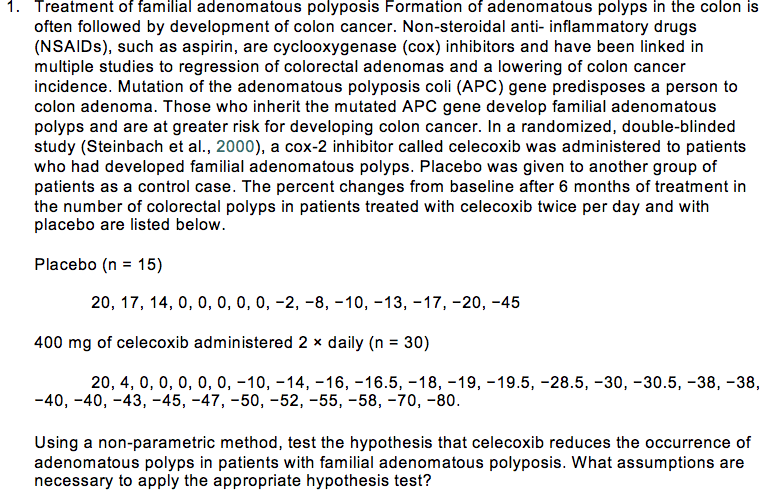
Treatment of familial adenomatous polyposis Formation of adenomatous polyps in the colon is often followed by development of colon cancer. Non-steroidal anti-inflammatory drugs (NSAIDs), such as aspirin, are cyclooxygenase (cox) inhibitors and have been linked in multiple studies to regression of colorectal adenomas and a lowering of colon cancer incidence. Mutation of the adenomatous polyposis coli (APC) gene predisposes a person to colon adenoma. Those who inherit the mutated APC gene develop familial adenomatous polyps and are at greater risk for developing colon cancer. In a randomized, double-blinded study (Steinbach et al., 2000), a cox-2 inhibitor called celecoxib was administered to patients who had developed familial adenomatous polyps. Placebo was given to another group of patients as a control case. The percent changes from baseline after 6 months of treatment in the number of colorectal polyps in patients treated with celecoxib twice per day and with placebo are listed below Placebo (n = 15) 20, 17, 14, 0, 0, 0, 0, 0, -2, -8, -10, -13, -17, -20, -45 400 mg of celecoxib administered 2 times daily (n = 30) 20, 4, 0, 0, 0, 0, 0, -10, -14, -16, -16.5, -18, -19, -19.5, -28.5, -30, -30.5, -38, -38 -40, -40, -43, -45, -47, -50, -52, -55, -58, -70, -80. Using a non-parametric method, test the hypothesis that celecoxib reduces the occurrence of adenomatous polyps in patients with familial adenomatous polyposis. What assumptions are necessary to apply the appropriate hypothesis test
Step by Step Solution
There are 3 Steps involved in it

Get step-by-step solutions from verified subject matter experts
 Study Help