







Question: Please write c++ program! I've already finished (i). Please solve (ii). Thanks in advance! Following is my answer for (i): #include #include using namespace std;
Please write c++ program! I've already finished (i). Please solve (ii). Thanks in advance!
Following is my answer for (i):
#include
#include
using namespace std;
double fun(double x)
{
return pow(x*x*x*x,1.0/3.0);
}
int main()
{
double x=0,h1,h2,h3,e1=1000,e2=1000,e3=1000;
for(int p=3;p
{
double h=pow(10,-p);
double M=(fun(x+h)-fun(x))/h;
if(fabs(M)
{
h1=h;
e1=M;
}
cout
M=(fun(x+h)-fun(x-h))/(2.0*h);
if(fabs(M)
{
h2=h;
e2=M;
}
cout
M=(-fun(x+2.0*h)+4.0*fun(x+h)-3.0*fun(x))/(2.0*h);
cout
if(fabs(M)
{
h3=h;
e3=M;
}
}
cout
3. a. (i) Compare the accuracy of the following three formulas for approxi- mating the derivative, f'(x): Mi(n) = f(x + h) f(x) h ) Mach)-f(x+h)-f( x 2h Mach) -f(x + 2h) + 4f (x + h) - 3f (x) 2h In particular, test the above approximations when f(x) = x/3, x = 0 or r = 1, and h = 10-P, p = 3, 4, 5,..., 20. (ii) As his decreased, the error becomes smaller, until a critical value of h is reached, after which point the error starts to increase as h decreases. Find the critical h, herit, experimentally. Note: in order to avoid problems in evaluating 24/3 when r cout 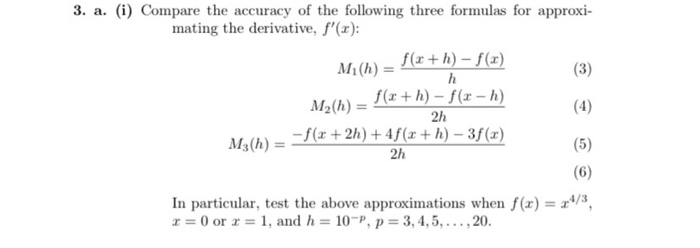

cout
return 0;
}
Step by Step Solution
There are 3 Steps involved in it
1 Expert Approved Answer
Step: 1 Unlock

Question Has Been Solved by an Expert!
Get step-by-step solutions from verified subject matter experts
Step: 2 Unlock
Step: 3 Unlock
 Study Help