







Question: Please write for me the data sources used for this article for my presentation. Supply chain sustainability: A risk management approach, by Mihalis Giannakis and
Please write for me the data sources used for this article for my presentation. "Supply chain sustainability: A risk management approach, by Mihalis Giannakis and Thanos Papadopoulos". I have tried to do it but it is very similar to what my friend wrote for the methodology part
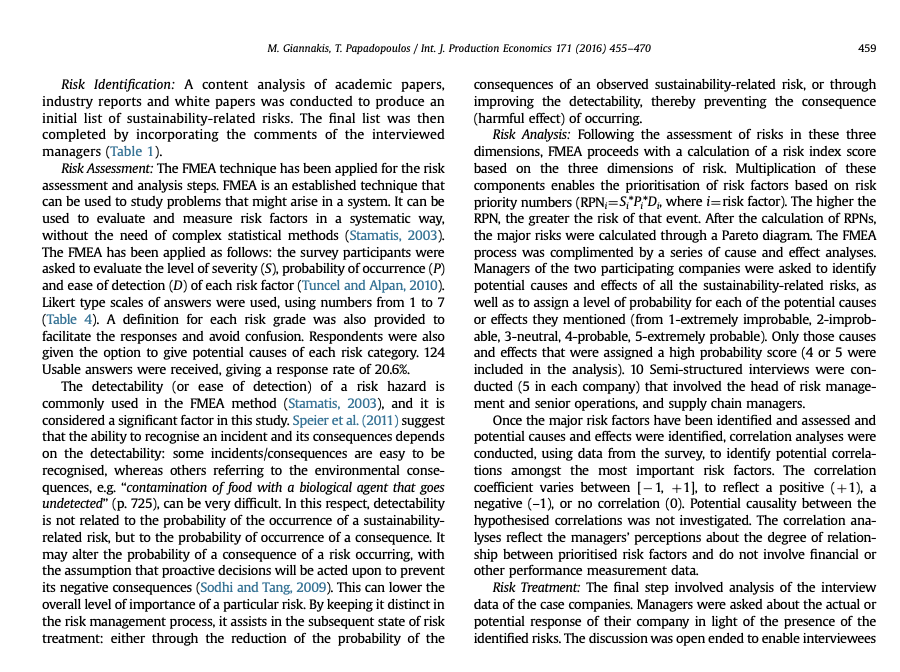
they included the interview, surveryRisk Identification: A content analysis of academic papers,
industry reports and white papers was conducted to produce an
initial list of sustainabilityrelated risks. The final list was then
completed by incorporating the comments of the interviewed
managers Table
Risk Assessment: The FMEA technique has been applied for the risk
assessment and analysis steps. FMEA is an established technique that
can be used to study problems that might arise in a system. It can be
used to evaluate and measure risk factors in a systematic way,
without the need of complex statistical methods Stamatis
The FMEA has been applied as follows: the survey participants were
asked to evaluate the level of severity probability of occurrence
and ease of detection D of each risk factor Tuncel and Alpan,
Likert type scales of answers were used, using numbers from to
Table A definition for each risk grade was also provided to
facilitate the responses and avoid confusion. Respondents were also
given the option to give potential causes of each risk category.
Usable answers were received, giving a response rate of
The detectability or ease of detection of a risk hazard is
commonly used in the FMEA method Stamatis and it is
considered a significant factor in this study. Speier et al suggest
that the ability to recognise an incident and its consequences depends
on the detectability: some incidentsconsequences are easy to be
recognised, whereas others referring to the environmental conse
quences, eg "contamination of food with a biological agent that goes
undetected" p can be very difficult. In this respect, detectability
is not related to the probability of the occurrence of a sustainability
related risk, but to the probability of occurrence of a consequence. It
may alter the probability of a consequence of a risk occurring, with
the assumption that proactive decisions will be acted upon to prevent
its negative consequences Sodhi and Tang, This can lower the
overall level of importance of a particular risk. By keeping it distinct in
the risk management process, it assists in the subsequent state of risk
treatment: either through the reduction of the probability of the
consequences of an observed sustainabilityrelated risk, or through
improving the detectability, thereby preventing the consequence
harmful effect of occurring.
Risk Analysis: Following the assessment of risks in these three
dimensions, FMEA proceeds with a calculation of a risk index score
based on the three dimensions of risk. Multiplication of these
components enables the prioritisation of risk factors based on risk
priority numbers where risk factor The higher the
RPN the greater the risk of that event. After the calculation of RPNs
the major risks were calculated through a Pareto diagram. The FMEA
process was complimented by a series of cause and effect analyses.
Managers of the two participating companies were asked to identify
potential causes and effects of all the sustainabilityrelated risks, as
well as to assign a level of probability for each of the potential causes
or effects they mentioned from extremely improbable, improb
able, neutral, probable, extremely probable Only those causes
and effects that were assigned a high probability score or were
included in the analysis Semistructured interviews were con
ducted in each company that involved the head of risk manage
ment and senior operations, and supply chain managers.
Once the major risk factors have been identified and assessed and
potential causes and effects were identified, correlation analyses were
conducted, using data from the survey, to identify potential correla
tions amongst the most important risk factors. The correlation
coefficient varies between to reflect a positive a
negative or no correlation Potential causality between the
hypothesised correlations was not investigated. The correlation ana
lyses reflect the managers' perceptions about the degree of relation
ship between prioritised risk factors and do not involve financial or
other performance measurement data.
Risk Treatmen
I would really appreciate it if you please opened the article by yourself because it doesnt allow me to post more than one picture and theres more info than what the one page covered, Thank you so much!
Step by Step Solution
There are 3 Steps involved in it
1 Expert Approved Answer
Step: 1 Unlock

Question Has Been Solved by an Expert!
Get step-by-step solutions from verified subject matter experts
Step: 2 Unlock
Step: 3 Unlock
 Study Help