







Question: Please write from your thoughts not course hero sources Thanks a lot Question: Read the case and analyse it and summarizes the case and Briefly
Please write from your thoughts not course hero sources
Thanks a lot
Question: Read the case and analyse it and summarizes the case and Briefly summarize the main points ofthe case
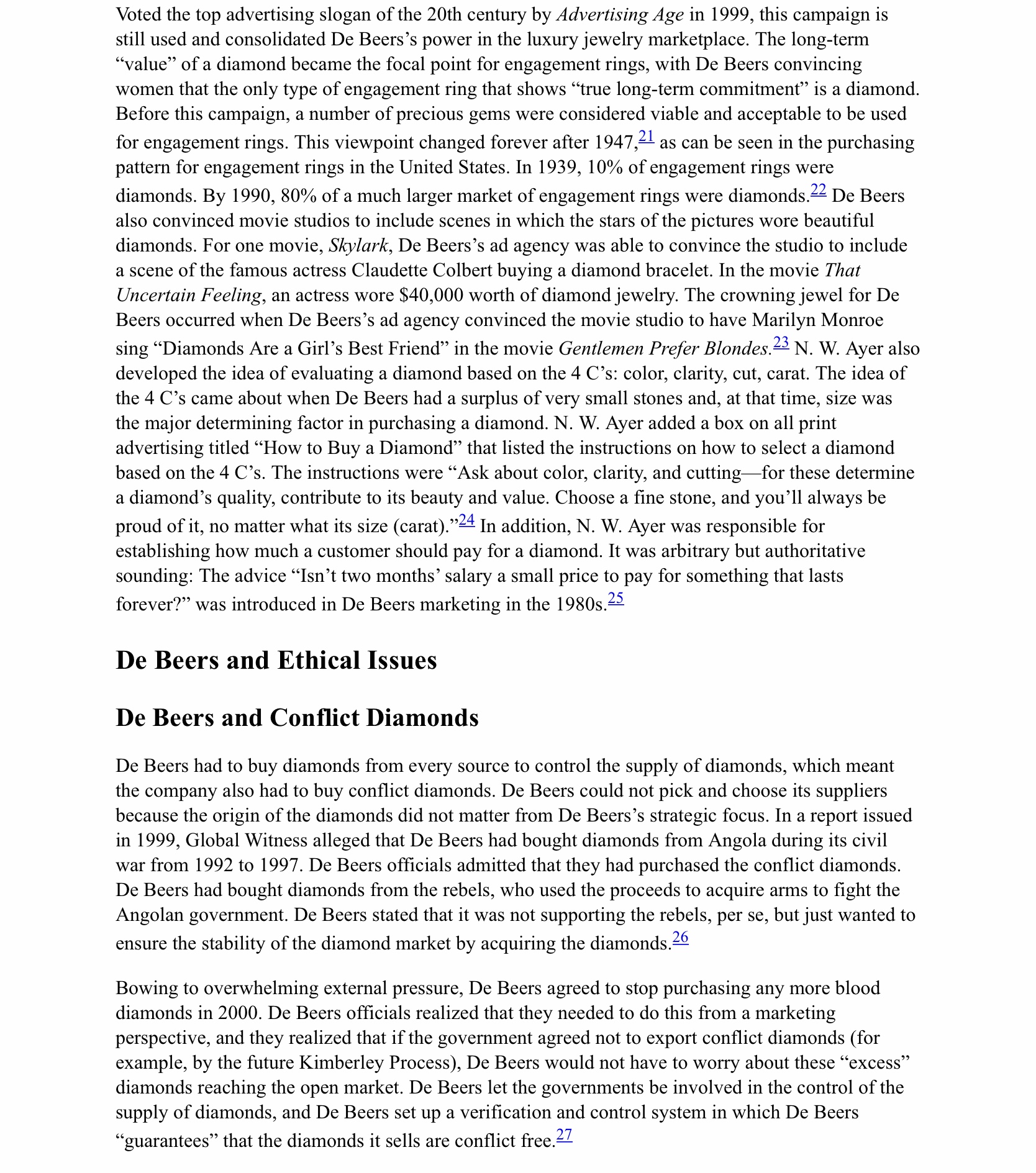
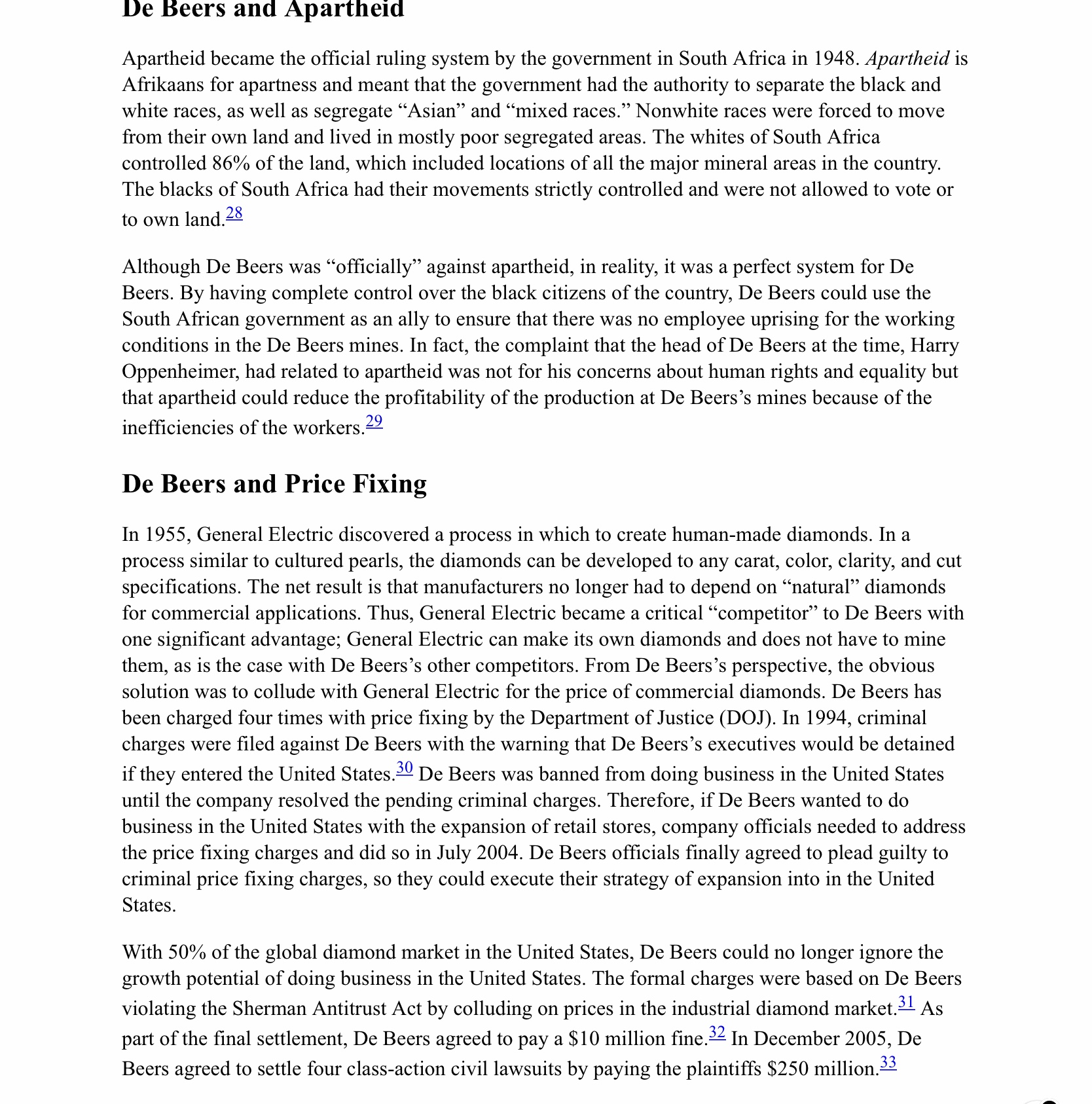
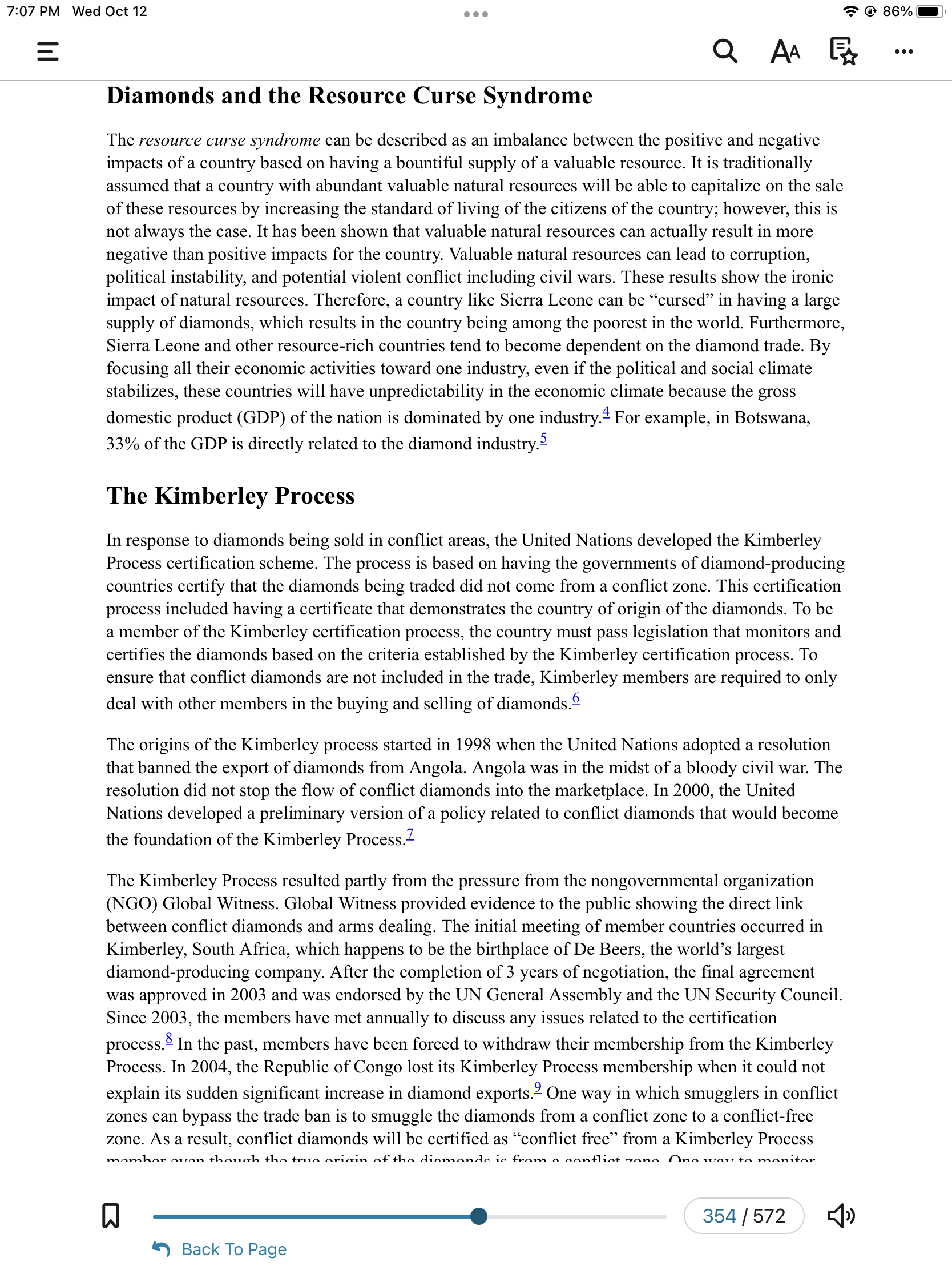
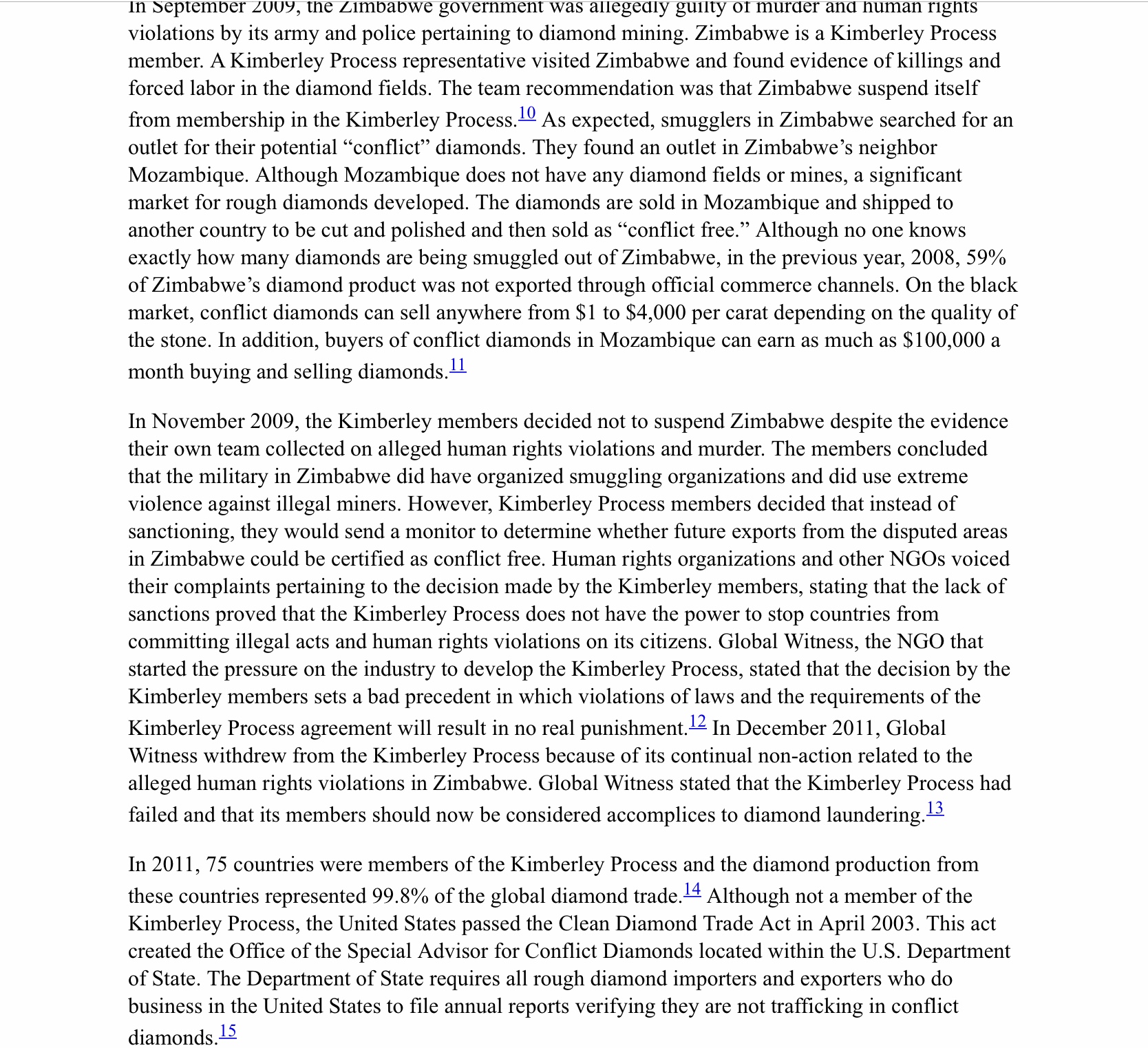
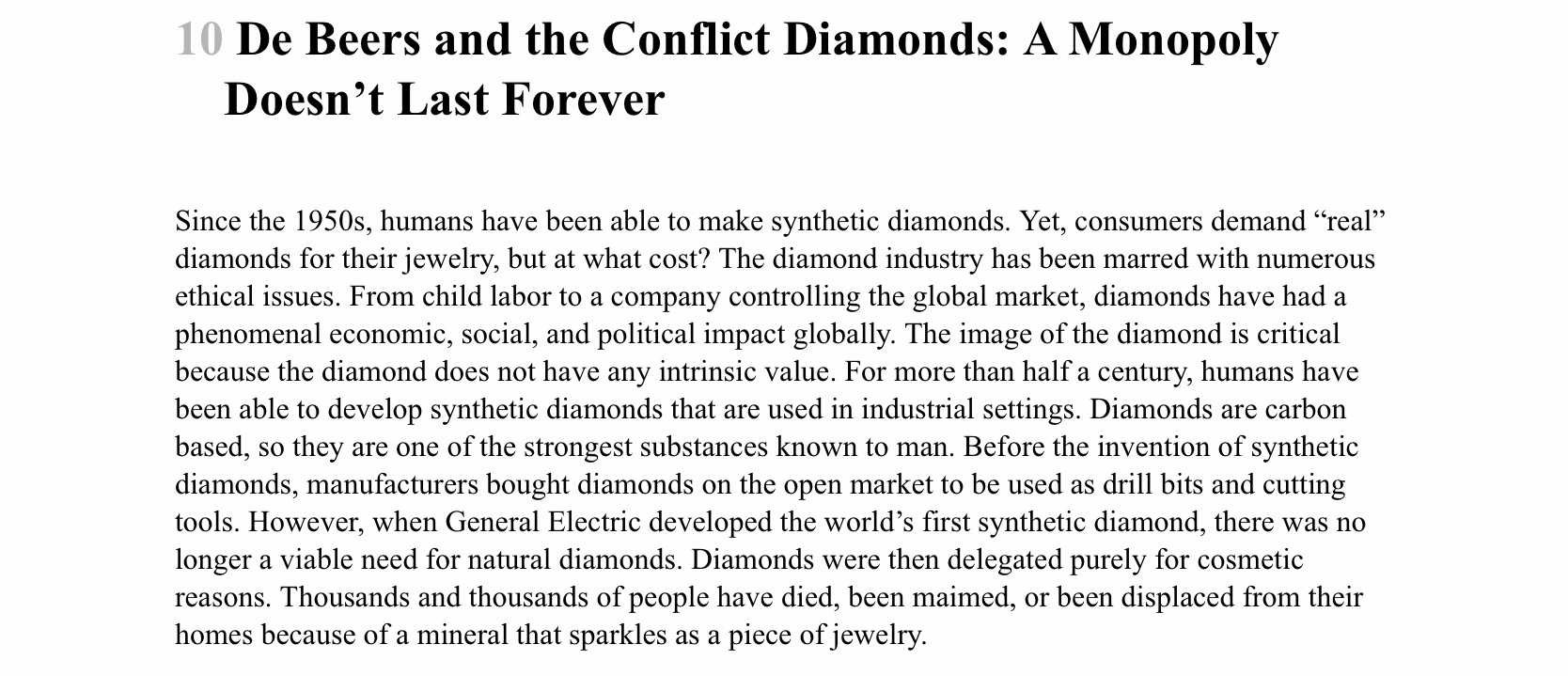
Voted the top advertising slogan of the 20th century by Advertising Age in 1999, this campaign is still used and consolidated De Beers's power in the luxury jewelry marketplace. The long-term \"value\" of a diamond became the focal point for engagement rings, with De Beers convincing women that the only type of engagement ring that shows \"true longterm commitment\" is a diamond. Before this campaign, a number of precious gems were considered viable and acceptable to be used for engagement rings. This viewpoint changed forever after 1947,21 as can be seen in the purchasing pattern for engagement rings in the United States. In 1939, 10% of engagement rings were diamonds. By 1990, 80% of a much larger market of engagement rings were diamonds.2 De Beers also convinced movie studios to include scenes in which the stars of the pictures wore beautiful diamonds. For one movie, Skylark, De Beers's ad agency was able to convince the studio to include a scene of the famous actress Claudette Colbert buying a diamond bracelet. In the movie That Uncertain Feeling, an actress wore $40,000 worth of diamond jewelry. The crowning jewel for De Beers occurred when De Beers's ad agency convinced the movie studio to have Marilyn Monroe sing \"Diamonds Are a Girl's Best Friend\" in the movie Gentlemen Prefer Enemies; N. W. Ayer also developed the idea of evaluating a diamond based on the 4 C's: color, clarity, cut, carat. The idea of the 4 C's came about when De Beers had a surplus of very small stones and, at that time, size was the major determining factor in purchasing a diamond. N. W. Ayer added a box on all print advertising titled \"How to Buy a Diamond\" that listed the instructions on how to select a diamond based on the 4 CS. The instructions were \"Ask about color, clarity, and cuttingifor these determine a diamond's quality, contribute to its beauty and value. Choose a ne stone, and you'll always be proud of it, no matter what its size (carat).\"% In addition, N. W. Ayer was responsible for establishing how much a customer should pay for a diamond. It was arbitrary but authoritative sounding: The advice \"Isn't two months' salary a small price to pay for something that lasts forever?\" was introduced in De Beers marketing in the 1980s.25 De Beers and Ethical Issues De Beers and Conict Diamonds De Beers had to buy diamonds from every source to control the supply of diamonds, which meant the company also had to buy conict diamonds. De Beers could not pick and choose its suppliers because the origin of the diamonds did not matter from De Beers's strategic focus. In a report issued in 1999, Global Witness alleged that De Beers had bought diamonds from Angola during its civil war from 1992 to 1997. De Beers ofcials admitted that they had purchased the conict diamonds. De Beers had bought diamonds from the rebels, who used the proceeds to acquire arms to ght the Angolan government. De Beers stated that it was not supporting the rebels, per se, but just wanted to ensure the stability of the diamond market by acquiring the diamonds?6 Bowing to overwhelming external pressure, De Beers agreed to stop purchasing any more blood diamonds in 2000. De Beers ofcials realized that they needed to do this from a marketing perspective, and they realized that if the government agreed not to export conict diamonds (for example, by the future Kimberley Process), De Beers would not have to worry about these \"excess\" diamonds reaching the open market. De Beers let the governments be involved in the control of the supply of diamonds, and De Beers set up a verication and control system in which De Beers \"guarantees\" that the diamonds it sells are conict free.27 De Beers and Apartheid Apartheid became the ofcial ruling system by the government in South Africa in 1948. Apartheid is Afrikaans for apartness and meant that the government had the authority to separate the black and white races, as well as segregate \"Asian\" and \"mixed races.\" Nonwhite races were forced to move from their own land and lived in mostly poor segregated areas. The whites of South Africa controlled 86% of the land, which included locations of all the major mineral areas in the country. The blacks of South Africa had their movements strictly controlled and were not allowed to vote or to own land?8 Although De Beers was \"ofcially\" against apartheid, in reality, it was a perfect system for De Beers. By having complete control over the black citizens of the country, De Beers could use the South African government as an ally to ensure that there was no employee uprising for the working conditions in the De Beers mines. In fact, the complaint that the head of De Beers at the time, Harry Oppenheimer, had related to apartheid was not for his concerns about human rights and equality but that apartheid could reduce the protability of the production at De Beers's mines because of the inefciencies of the workers?9 De Beers and Price Fixing In 1955, General Electric discovered a process in which to create human-made diamonds. In a process similar to cultured pearls, the diamonds can be developed to any carat, color, clarity, and cut specications. The net result is that manufacturers no longer had to depend on \"natural\" diamonds for commercial applications. Thus, General Electric became a critical \"competitor\" to De Beers with one signicant advantage; General Electric can make its own diamonds and does not have to mine them, as is the case with De Beers's other competitors. From De Beers's perspective, the obvious solution was to collude with General Electric for the price of commercial diamonds. De Beers has been charged four times with price xing by the Department of Justice (DOJ). In 1994, criminal charges were led against De Beers with the warning that De Beers's executives would be detained if they entered the United States. De Beers was banned from doing business in the United States until the company resolved the pending criminal charges. Therefore, if De Beers wanted to do business in the United States with the expansion of retail stores, company ofcials needed to address the price xing charges and did so in July 2004. De Beers ofcials finally agreed to plead guilty to criminal price xing charges, so they could execute their strategy of expansion into in the United States. With 50% of the global diamond market in the United States, De Beers could no longer ignore the growth potential of doing business in the United States. The formal charges were based on De Beers violating the Sherman Antitrust Act by colluding on prices in the industrial diamond market.31 As part ofthe nal settlement, De Beers agreed to pay a $10 million fine.2 In December 2005, De Beers agreed to settle four classaction civil lawsuits by paying the plaintiffs $250 million.g 7:07 PM Wed Oct 12 . . @ 86% = Q AA RX ... Diamonds and the Resource Curse Syndrome The resource curse syndrome can be described as an imbalance between the positive and negative impacts of a country based on having a bountiful supply of a valuable resource. It is traditionally assumed that a country with abundant valuable natural resources will be able to capitalize on the sale of these resources by increasing the standard of living of the citizens of the country; however, this is not always the case. It has been shown that valuable natural resources can actually result in more negative than positive impacts for the country. Valuable natural resources can lead to corruption, political instability, and potential violent conflict including civil wars. These results show the ironic impact of natural resources. Therefore, a country like Sierra Leone can be "cursed" in having a large supply of diamonds, which results in the country being among the poorest in the world. Furthermore, Sierra Leone and other resource-rich countries tend to become dependent on the diamond trade. By focusing all their economic activities toward one industry, even if the political and social climate stabilizes, these countries will have unpredictability in the economic climate because the gross domestic product (GDP) of the nation is dominated by one industry. For example, in Botswana, 33% of the GDP is directly related to the diamond industry.3 The Kimberley Process In response to diamonds being sold in conflict areas, the United Nations developed the Kimberley Process certification scheme. The process is based on having the governments of diamond-producing countries certify that the diamonds being traded did not come from a conflict zone. This certification process included having a certificate that demonstrates the country of origin of the diamonds. To be a member of the Kimberley certification process, the country must pass legislation that monitors and certifies the diamonds based on the criteria established by the Kimberley certification process. To ensure that conflict diamonds are not included in the trade, Kimberley members are required to only deal with other members in the buying and selling of diamonds." The origins of the Kimberley process started in 1998 when the United Nations adopted a resolution that banned the export of diamonds from Angola. Angola was in the midst of a bloody civil war. The resolution did not stop the flow of conflict diamonds into the marketplace. In 2000, the United Nations developed a preliminary version of a policy related to conflict diamonds that would become the foundation of the Kimberley Process.- The Kimberley Process resulted partly from the pressure from the nongovernmental organization NGO) Global Witness. Global Witness provided evidence to the public showing the direct link between conflict diamonds and arms dealing. The initial meeting of member countries occurred in Kimberley, South Africa, which happens to be the birthplace of De Beers, the world's largest diamond-producing company. After the completion of 3 years of negotiation, the final agreement was approved in 2003 and was endorsed by the UN General Assembly and the UN Security Council. Since 2003, the members have met annually to discuss any issues related to the certification process." In the past, members have been forced to withdraw their membership from the Kimberley Process. In 2004, the Republic of Congo lost its Kimberley Process membership when it could not explain its sudden significant increase in diamond exports. One way in which smugglers in conflict zones can bypass the trade ban is to smuggle the diamonds from a conflict zone to a conflict-free zone. As a result, conflict diamonds will be certified as "conflict free" from a Kimberley Process mombar suon though the ten ariain of the diomande is from a conflict zone And way to monitor 354 / 572 Back To PageIn September 2009, the Zimbabwe government was allegedly guilty of murder and human rights violations by its army and police pertaining to diamond mining. Zimbabwe is a Kimberley Process member. A Kimberley Process representative visited Zimbabwe and found evidence of killings and forced labor in the diamond fields. The team recommendation was that Zimbabwe suspend itself from membership in the Kimberley Process. As expected, smugglers in Zimbabwe searched for an outlet for their potential "conflict" diamonds. They found an outlet in Zimbabwe's neighbor Mozambique. Although Mozambique does not have any diamond fields or mines, a significant market for rough diamonds developed. The diamonds are sold in Mozambique and shipped to another country to be cut and polished and then sold as "conflict free." Although no one knows exactly how many diamonds are being smuggled out of Zimbabwe, in the previous year, 2008, 59% of Zimbabwe's diamond product was not exported through official commerce channels. On the black market, conflict diamonds can sell anywhere from $1 to $4,000 per carat depending on the quality of the stone. In addition, buyers of conflict diamonds in Mozambique can earn as much as $100,000 a month buying and selling diamonds. In November 2009, the Kimberley members decided not to suspend Zimbabwe despite the evidence their own team collected on alleged human rights violations and murder. The members concluded that the military in Zimbabwe did have organized smuggling organizations and did use extreme violence against illegal miners. However, Kimberley Process members decided that instead of sanctioning, they would send a monitor to determine whether future exports from the disputed areas in Zimbabwe could be certified as conflict free. Human rights organizations and other NGOs voiced their complaints pertaining to the decision made by the Kimberley members, stating that the lack of sanctions proved that the Kimberley Process does not have the power to stop countries from committing illegal acts and human rights violations on its citizens. Global Witness, the NGO that started the pressure on the industry to develop the Kimberley Process, stated that the decision by the Kimberley members sets a bad precedent in which violations of laws and the requirements of the Kimberley Process agreement will result in no real punishment. In December 2011, Global Witness withdrew from the Kimberley Process because of its continual non-action related to the alleged human rights violations in Zimbabwe. Global Witness stated that the Kimberley Process had failed and that its members should now be considered accomplices to diamond laundering. In 2011, 75 countries were members of the Kimberley Process and the diamond production from these countries represented 99.8% of the global diamond trade. Although not a member of the Kimberley Process, the United States passed the Clean Diamond Trade Act in April 2003. This act created the Office of the Special Advisor for Conflict Diamonds located within the U.S. Department of State. The Department of State requires all rough diamond importers and exporters who do business in the United States to file annual reports verifying they are not trafficking in conflict diamonds. 15Controlling the Supply of Diamonds Of course, this system can only work if De Beers controlled the supply of diamonds. This objective was accomplished through two principal means: land acquisition and contract buyers. De Beers continued to buy more and more land where diamonds were located. As a result, it became the dominant player in the diamond industry. In addition, De Beers had standing contracts with independent buyers such that these buyers would purchase whatever diamonds De Beers had available to sell. Therefore, De Beers could establish an articial \"scarcity\" by controlling the supply of diamonds. For diamonds that were found in dormant volcano tubes, controlling the supply meant buying the land where the diamond deposits are located. The more difficult task was controlling the supply in the countries in which the diamonds were located in marshy, river areas near the surface of the ground. For these diamond deposits, it was much more difficult to control the supply and mining of the diamonds. To attempt to control the supply during the early 20th century, De Beers allegedly sought and received aid from the British government in controlling the diamond mining operations of countries that were British colonies. The government of these countries used intimidation and brute force to enforce the interests of De Beers. As African countries broke away from Britain and became independent countries, De Beers shifted its focus to establishing strong relationships with whoever was in power. Therefore, De Beers controlled vast amounts of diamond deposits and used its inuence to help control supply of diamonds for those areas that De Beers did not own. However, there was still a supply of diamonds that was not connected directly or indirectly with De Beers inuence. For these diamonds, De Beers relied on its contact with the 1,300 independent buyers by offering to purchase whatever diamonds they had to sell. The new result was that De Beers was able to effectively control almost the entire supply of diamonds globally.E De Beers and Marketing De Beers ofcials realized that promoting diamonds had to include a glamorous image so that everyone would want to buy a diamond. In 1947, De Beers started the \"A Diamond ls Forever\" advertising campaign. Frances Gerety of De Beers's ad agency, N. W. Ayer, created the phrase after she had developed a number of ads for De Beers, and the initial response from De Beers was not overwhelmingly positive. However, the phrase helped create a permanent demand for diamond engagement rings. In the 1940s, N. W. Ayer had conducted a number of consumer surveys and discovered that the general perception of the American public was that diamonds were a luxury item only bought by the very wealthy. Most people thought that buying a diamond was a waste of money because it did not have a useful purpose like buying a washing machine or a new car. As a result, N. W. Ayer proposed a marketing campaign for De Beers to create a situation where almost every person pledging marriage feels compelled to acquire a diamond engagement ring. . . . Sentiment is essential to your advertising, as it is to your product. . . for the emotional connotation of the diamond is the one competitive advantage which no other product can claim or dispute Voted the top advertising slogan of the 20th century by Advertising Age in 1999, this campaign is The Challenge of Conflict Diamonds Conflict or "blood" diamonds are diamonds that have been mined in a country that is in a civil war. The United Nations defines conflict diamonds as "diamonds that originate from areas controlled by forces or factions opposed to legitimate and internationally recognized governments, and are used to fund military action in opposition to those governments or in contravention of the decisions of the Security Council." The release of the movie Blood Diamond starring Leonardo Dicaprio as a diamond smuggler brought the issue of conflict diamonds to the forefront. Blood Diamond was set in Sierra Leone during its civil war and showed brutal images of murder, kidnapping, and mutilation. Some scenes included having children selecting which of their limbs would be amputated by the rebels to ensure children obey the commands of the rebels. Furthermore, additional scenes showed men being forced from their villages and being required to mine for diamonds as "slaves" to the rebels. One of the reasons why conflict diamonds can be potentially common in funding civil wars is the location of the diamonds. In Western African countries such as Sierra Leone, Liberia, and the Ivory Coast, diamonds are located in marshy areas and riverbeds. The diamonds are very close to the surface of the ground, so it is very easy for anyone to "mine" the fields. In addition, it is very easy for a rebel group to seize control of the marshy area and force workers to mine the area. In other areas of the continent such as Botswana, the diamonds are found inside dormant volcano tubes. This type of mining and removal requires additional heavy machinery and may be closely protected by the government. In addition, if the country believes there is a threat that these mines will be seized by the rebels, the government can order that the opening of the mine be closed using explosives. As a result, countries with marshy, easy to obtain diamonds fields are more likely to have extended civil wars than are countries that do not have these marshy areas.- For example, in 1999, $200 million in conflict diamonds were smuggled out of Sierra Leone. During the height of the conflict diamonds trade in the 1980s and 1990s, 4% of all global diamond trade involved conflict diamonds. Furthermore, the smuggling of conflict diamonds is a very effective way for terrorists and other criminal organizations to launder money. Ill-gotten gains from illegal activities would be used to buy conflict diamonds illegally and then the conflict diamonds would be smuggled out of the country and sold legally as conflict-free diamonds. This is one method al Qaeda used to fund its operations. The true tragedy of this illegal trade is the needless loss of life. Approximately 3.7 million people have been killed in Africa so others could gain access to conflict diamonds, and another 6 million people have lost their homes because of the forced evaluation of rebels mining for conflict diamonds.3A Monopoly Is Born: De Beers Cecil Rhodes established De Beers in 1888. Rhodes would later be known as only one of a few people in the world to have a country named after him (Rhodesia, which is now called Zimbabwe). In addition, Rhodes is known today as the founder of the Rhodes Scholar program for academically gifted students. The origin of the name De Beers is based on the family name of the owners of the rst discovered diamond mine in South Africa. Located in Kimberley, the land was the starting point for the aggressive growth strategy for De Beers. Rhodes realized that the only way to become more efficient and reduce costs for mining was to acquire large tracks of land that adjoined or was close in proximity to each other. As a result, De Beers quickly bought out numerous landowners in the surrounding areas where they predicted would have additional diamond deposits. One inuential turning point in the early strategy of De Beers was when the company signed an exclusive agreement with the London Diamond Syndicate, which had agreed to purchase all of De Beers's diamonds. De Beers quickly learned that having a guaranteed buyer was critical for the longterrn success of the company. De Beers used this same model when it sold diamonds to dealers through the Central Selling Organization. The Central Selling Organization When De Beers became big enough to control the supply of diamonds, it was rewarded handsomely by serving the demand side of the diamond trade. For a large part of the 20th century, De Beers controlled approximately 90% of the diamond supply. This monopoly power allowed De Beers to establish the \"single channel marketing\" system in which it controlled the supply of diamonds globally. The result is that De Beers also controlled the demand of the diamonds by deciding which customers would be allocated which assortment of diamonds. De Beers justied the single channel marketing system by stating that the system guaranteed stability in the marketplace related to the buying and selling of diamondsl6 The single channel marketing system allowed De Beers to control the supply and the demand for diamonds through its \"sight holders\" system. De Beers invited clients to come to view its diamonds in London 10 times during the year. During each meeting, 125 clients, or sight holders, were allowed to see the diamonds that had been allocated to them by De Beers. These sight holders were required to buy, as is, the lot assigned to them. There was no negotiation on price, quality, or quantity. The client paid for the diamonds through De Beers Central Selling sales unit. If the client refused to buy the diamonds, the client would not be invited back to a future sight holders meeting, and another client would take that place. The Current Status of De Beers Until the early 1980s, De Beers controlled 90% of the global diamond market. By the mid-1980s, this had dropped to 85%. By 2000, De Beers's market share dropped further to 65%, and by 2005, it had dropped to 60%. In 2007, it had fallen to 40%. A number of factors caused this decline, but the major factor is the discovery of major diamond deposits in Canada, Russia, and Australia. The result is that De Beers does not have the power or the resources any more to control the supply of diamonds in the marketplace. Furthermore, De Beers's monopolistic attitude toward its customers made it very easy for suppliers to buy their diamonds from alternative sources. In 2011, De Beers's market share had dropped to 36%, and its diamond production dropped from 33 million carats in 2010 to 31.3 million carats in 2011. Its sales had increased 26% from 2010 to $7.4 billion, while its earnings increased by 21% to $1.7 billion.35 In November 2011, the parent company of De Beers, Anglo American, announced that it would pay $5.1 billion to buy the Oppenheimer family's share of De Beers.36 In 2013, De Beers's sales were $6.4 billion and its earnings were $532 million.37 De De Beers and the Conict Diamonds: A Monopoly Doesn't Last Forever Since the 19505, humans have been able to make synthetic diamonds. Yet, consumers demand \"real\" diamonds for their jewelry, but at what cost? The diamond industry has been marred with numerous ethical issues. From child labor to a company controlling the global market, diamonds have had a phenomenal economic, social, and political impact globally. The image of the diamond is critical because the diamond does not have any intrinsic value. For more than half a century, humans have been able to develop synthetic diamonds that are used in industrial settings. Diamonds are carbon based, so they are one of the strongest substances known to man. Before the invention of synthetic diamonds, manufacturers bought diamonds on the open market to be used as drill bits and cutting tools. However, when General Electric developed the world's first synthetic diamond, there was no longer a viable need for natural diamonds. Diamonds were then delegated purely for cosmetic reasons. Thousands and thousands of people have died, been maimed, or been displaced from their homes because of a mineral that sparkles as a piece of jewelry
Step by Step Solution
There are 3 Steps involved in it

Get step-by-step solutions from verified subject matter experts
 Study Help