







Question: Please write in C++, thank you! #include #include //srand, rand #include //clock_t, clock, CLOCKS_PER_SEC using namespace std; // implementing hash tables as an array of
Please write in C++, thank you!
#include
#include
#include
using namespace std;
// implementing hash tables as an array of linked lists
class Node{
private:
int data;
Node* nextNodePtr;
public:
Node(){}
void setData(int d){
data = d;
}
int getData(){
return data;
}
void setNextNodePtr(Node* nodePtr){
nextNodePtr = nodePtr;
}
Node* getNextNodePtr(){
return nextNodePtr;
}
};
class List{
private:
Node *headPtr;
public:
List(){
headPtr = new Node();
headPtr->setNextNodePtr(0);
}
Node* getHeadPtr(){
return headPtr;
}
bool isEmpty(){
if (headPtr->getNextNodePtr() == 0)
return true;
return false;
}
void insert(int data){
Node* currentNodePtr = headPtr->getNextNodePtr();
Node* prevNodePtr = headPtr;
while (currentNodePtr != 0){
prevNodePtr = currentNodePtr;
currentNodePtr = currentNodePtr->getNextNodePtr();
}
Node* newNodePtr = new Node();
newNodePtr->setData(data);
newNodePtr->setNextNodePtr(0);
prevNodePtr->setNextNodePtr(newNodePtr);
}
bool deleteElement(int deleteData){
Node* currentNodePtr = headPtr->getNextNodePtr();
Node* prevNodePtr = headPtr;
Node* nextNodePtr = headPtr;
while (currentNodePtr != 0){
if (currentNodePtr->getData() == deleteData){
nextNodePtr = currentNodePtr->getNextNodePtr();
prevNodePtr->setNextNodePtr(nextNodePtr);
return true;
}
prevNodePtr = currentNodePtr;
currentNodePtr = currentNodePtr->getNextNodePtr();
}
return false;
}
int countList(){
Node* currentNodePtr = headPtr->getNextNodePtr();
int numElements = 0;
while (currentNodePtr != 0){
numElements++;
currentNodePtr = currentNodePtr->getNextNodePtr();
}
return numElements;
}
void IterativePrint(){
Node* currentNodePtr = headPtr->getNextNodePtr();
while (currentNodePtr != 0){
cout getData()
currentNodePtr = currentNodePtr->getNextNodePtr();
}
cout
}
bool containsElement(int searchData){
Node* currentNodePtr = headPtr->getNextNodePtr();
while (currentNodePtr != 0){
if (currentNodePtr->getData() == searchData)
return true;
currentNodePtr = currentNodePtr->getNextNodePtr();
}
return false;
}
};
class Hashtable{
private:
List* listArray;
int tableSize;
public:
Hashtable(int size){
tableSize = size;
listArray = new List[size];
}
int getTableSize(){
return tableSize;
}
void insert(int data){
int hashIndex = data % tableSize;
listArray[hashIndex].insert(data);
}
void deleteElement(int data){
int hashIndex = data % tableSize;
while (listArray[hashIndex].deleteElement(data));
}
bool hasElement(int data){
int hashIndex = data % tableSize;
return listArray[hashIndex].containsElement(data);
}
void printHashTable(){
for (int hashIndex = 0; hashIndex
cout
listArray[hashIndex].IterativePrint();
}
}
};
int main(){
int numElements;
cout
cin >> numElements;
int maxValue;
cout
cin >> maxValue;
int hashTableSize;
cout
cin >> hashTableSize;
Hashtable hashTable(hashTableSize);
srand(time(NULL));
int array[numElements];
cout
for (int index = 0; index
array[index] = rand() % maxValue;
cout
hashTable.insert(array[index]);
}
cout
return 0;
}
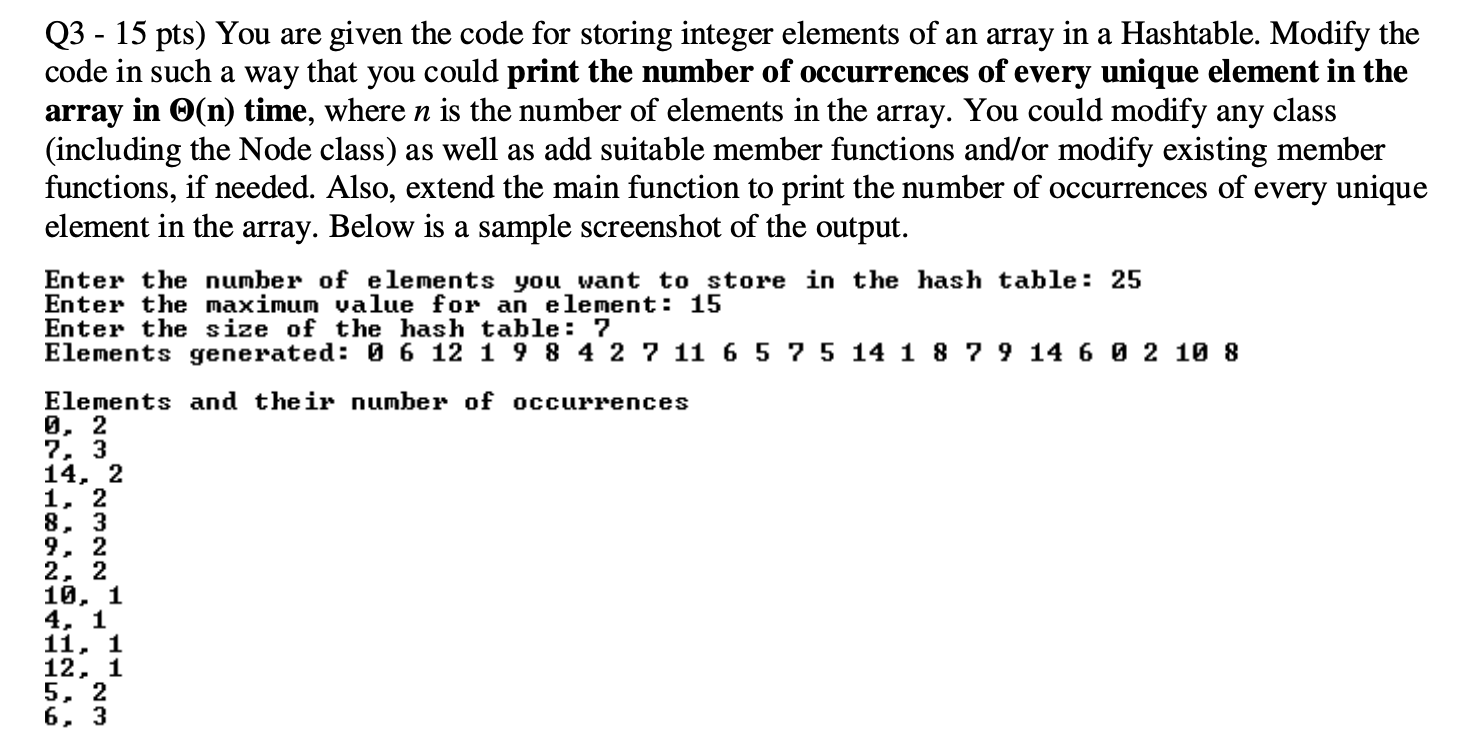
Q3 - 15 pts) You are given the code for storing integer elements of an array in a Hashtable. Modify the code in such a way that you could print the number of occurrences of every unique element in the array in (n) time, where n is the number of elements in the array. You could modify any class (including the Node class) as well as add suitable member functions and/or modify existing member functions, if needed. Also, extend the main function to print the number of occurrences of every unique element in the array. Below is a sample screenshot of the output. Enter the number of elements you want to store in the hash table : 25 Enter the maximum value for an element: 15 Enter the size of the hash table: 7 Elements generated: 0 6 12 1 9 8 4 2 7 11 6 5 7 5 14 1 8 7 9 14 6 0 2 10 8 Elements and their number of occurrences 9, 2 7, 3 2 8, 3 9. 2 2, 2 10, 1 4, 1 11, 1 12, 1 5, 2 6, 3
Step by Step Solution
There are 3 Steps involved in it

Get step-by-step solutions from verified subject matter experts
 Study Help