







Question: Please Write in code in C language Exercise 2.19 .(*****) Two Stacks This problem asks you to determine a stack-generated permutation in a more general
 Please Write in code in C language
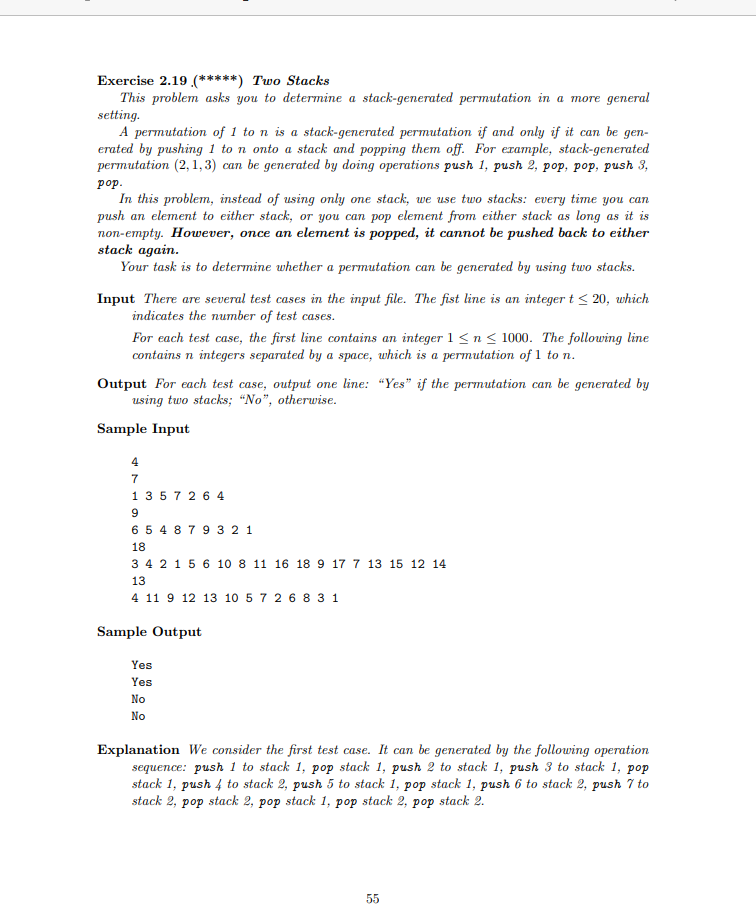
Exercise 2.19 .(*****) Two Stacks This problem asks you to determine a stack-generated permutation in a more general setting. A permutation of 1 to n is a stack-generated permutation if and only if it can be generated by pushing 1 to n onto a stack and popping them off. For example, stack-generated permutation (2,1,3) can be generated by doing operations push 1, push 2, pop, pop, push 3, pop. In this problem, instead of using only one stack, we use two stacks: every time you can push an element to either stack, or you can pop element from either stack as long as it is non-empty. However, once an element is popped, it cannot be pushed back to either stack again. Your task is to determine whether a permutation can be generated by using two stacks. Input There are several test cases in the input file. The fist line is an integer t20, which indicates the number of test cases. For each test case, the first line contains an integer 1n1000. The following line contains n integers separated by a space, which is a permutation of 1 to n. Output For each test case, output one line: "Yes" if the permutation can be generated by using two stacks; "No", otherwise. Sample Input Sample Output Yes Yes No No Explanation We consider the first test case. It can be generated by the following operation sequence: push 1 to stack 1, pop stack 1, push 2 to stack 1, push 3 to stack 1, pop stack 1, push 4 to stack 2, push 5 to stack 1, pop stack 1, push 6 to stack 2, push 7 to stack 2, pop stack 2, pop stack 1, pop stack 2, pop stack 2 . 55
Step by Step Solution
There are 3 Steps involved in it

Get step-by-step solutions from verified subject matter experts
 Study Help