







Question: Please write in python. 1 2 Programming: Password Brute-force Attack (50 pt.) Write a program that performs the brute-force attack to break the password. The
Please write in python.
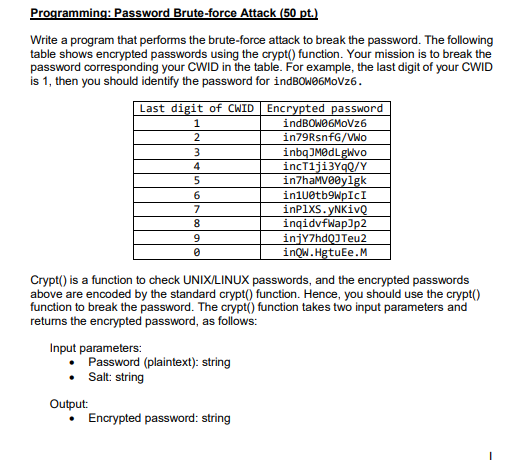

1 2 Programming: Password Brute-force Attack (50 pt.) Write a program that performs the brute-force attack to break the password. The following table shows encrypted passwords using the crypt() function. Your mission is to break the password corresponding your CWID in the table. For example, the last digit of your CWID is 1, then you should identify the password for indBOWO6MOVz6. Last digit of CWID Encrypted password indBOWO6MoVz6 in79RsnfG/VWO 3 inbqJMedLgWvo inctiji3YqQ/Y in7haveylgk inluetb9WpICI inPixs.yNKivQ inqidvfWapJp2 9 injyhdQ]Teu2 inqw.HgtuEe.M Crypt() is a function to check UNIX/LINUX passwords, and the encrypted passwords above are encoded by the standard crypt() function. Hence, you should use the crypt() function to break the password. The crypt() function takes two input parameters and returns the encrypted password, as follows: Input parameters: Password (plaintext): string Salt: string Output: Encrypted password: string 4 5 6 7 8 I The password length is six and the salt is set to 'infosec (without using the quotation mark). For the brute-force attack, you should try 6-character lower case letters of alphabet from 'aaaaaa', 'aaaaab', 'aaaaac', ..., to 'zzzzzz', with the salt. Report the original plaintext password by breaking the encrypted password (one based on your CWID). Also report how many words you tested to find the original password. 1 2 Programming: Password Brute-force Attack (50 pt.) Write a program that performs the brute-force attack to break the password. The following table shows encrypted passwords using the crypt() function. Your mission is to break the password corresponding your CWID in the table. For example, the last digit of your CWID is 1, then you should identify the password for indBOWO6MOVz6. Last digit of CWID Encrypted password indBOWO6MoVz6 in79RsnfG/VWO 3 inbqJMedLgWvo inctiji3YqQ/Y in7haveylgk inluetb9WpICI inPixs.yNKivQ inqidvfWapJp2 9 injyhdQ]Teu2 inqw.HgtuEe.M Crypt() is a function to check UNIX/LINUX passwords, and the encrypted passwords above are encoded by the standard crypt() function. Hence, you should use the crypt() function to break the password. The crypt() function takes two input parameters and returns the encrypted password, as follows: Input parameters: Password (plaintext): string Salt: string Output: Encrypted password: string 4 5 6 7 8 I The password length is six and the salt is set to 'infosec (without using the quotation mark). For the brute-force attack, you should try 6-character lower case letters of alphabet from 'aaaaaa', 'aaaaab', 'aaaaac', ..., to 'zzzzzz', with the salt. Report the original plaintext password by breaking the encrypted password (one based on your CWID). Also report how many words you tested to find the original password
Step by Step Solution
There are 3 Steps involved in it

Get step-by-step solutions from verified subject matter experts
 Study Help