Question: Please write in this order. 1. IRAC D (self defense) 2. IRAC A 3. IRAC B 4.IRAC C (confession) One night, Dobson and Vance were
Please write in this order.
1. IRAC D (self defense)
2. IRAC A
3. IRAC B
4.IRAC C (confession)
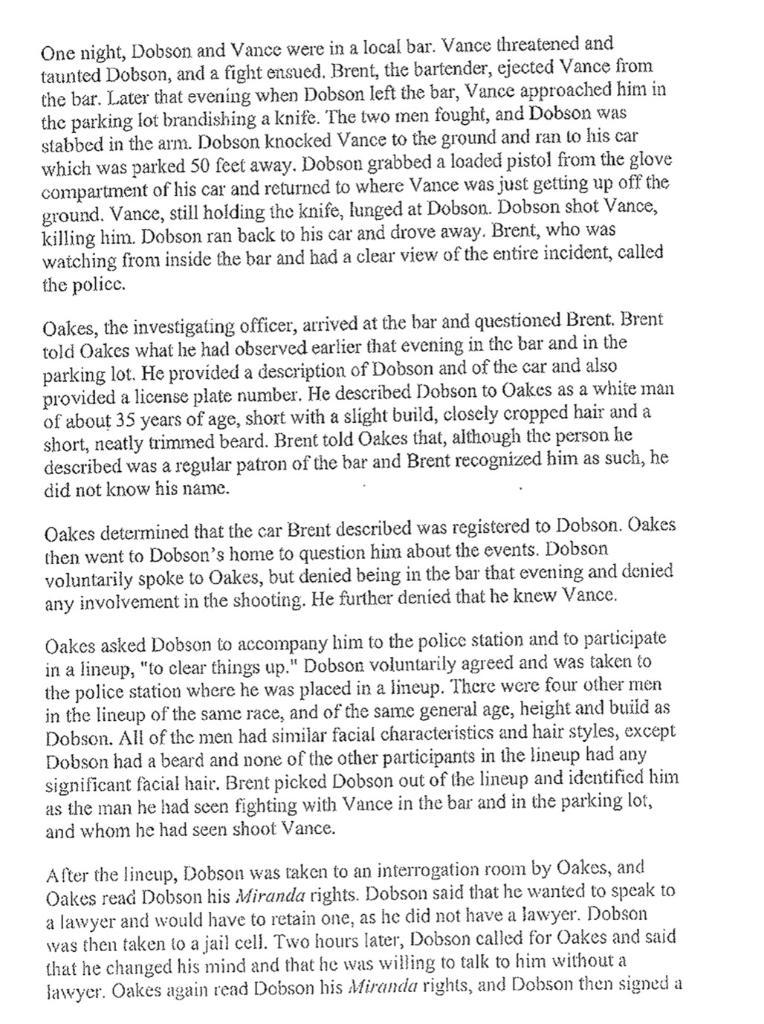
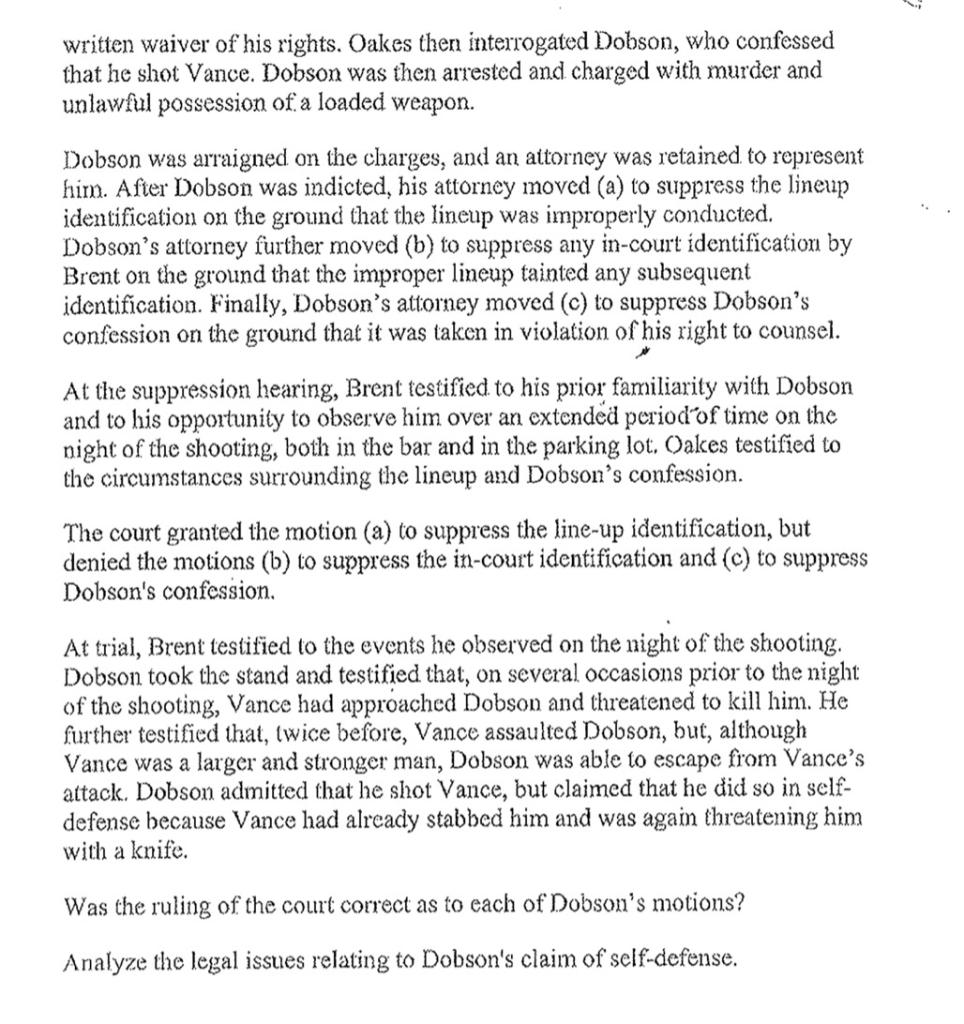
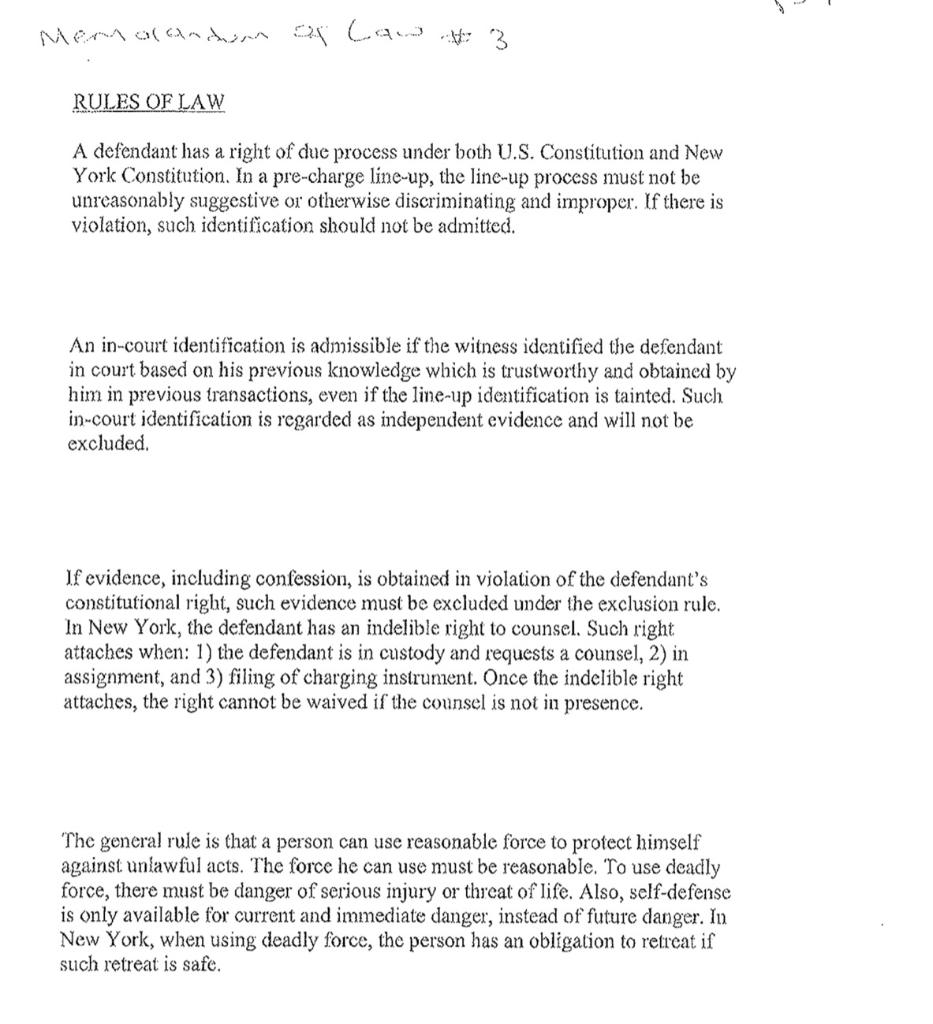
One night, Dobson and Vance were in a local bar. Vance threatened and taunted Dobson, and a fight ensued. Brent, the bartender, ejected Vance from the bar. Later that evening when Dobson left the bar, Vance approached him in the parking lot brandishing a knife. The two men fought, and Dobson was stabbed in the arm. Dobson knocked Vance to the ground and ran to his car which was parked 50 feet away. Dobson grabbed a loaded pistol from the glove compartment of his car and returned to where Vance was just getting up off the ground. Vance, still holding the knife, lunged at Dobson. Dobson shot Vance, killing him. Dobson ran back to his car and drove away. Brent, who was watching from inside the bar and had a clear view of the entire incident, called the police. Oakes, the investigating officer, arrived at the bar and questioned Brent. Brent told Oakes what he had observed earlier that evening in the bar and in the parking lot. He provided a description of Dobson and of the car and also provided a license plate number. He described Dobson to Oakes as a white man of about 35 years of age, short with a slight build, closely cropped hair and a short, neatly trimmed beard. Brent told Oakes that, although the person he described was a regular patron of the bar and Brent recognized him as such, he did not know his name. Oakes determined that the car Brent described was registered to Dobson. Oakes then went to Dobson's home to question him about the events. Dobson voluntarily spoke to Oakes, but denied being in the bar that evening and denied any involvement in the shooting. He further denied that he knew Vance. Oakes asked Dobson to accompany him to the police station and to participate in a lineup, "to clear things up." Dobson voluntarily agreed and was taken to " the police station where he was placed in a lineup. There were four other men in the lineup of the same race, and of the same general age, height and build as Dobson. All of the men had similar facial characteristics and hair styles, except Dobson had a beard and none of the other participants in the lineup had any significant facial hair. Brent picked Dobson out of the lineup and identificd him as the man he had seen fighting with Vance in the bar and in the parking lot, and whom he had seen shoot Vance. After the lineup, Dobson was taken to an interrogation room by Oakes, and Oakes read Dobson his Miranda rights. Dobson said that he wanted to speak to a lawyer and would have to retain one, as he did not have a lawyer. Dobson was then taken to a jail cell. Two hours later, Dobson called for Oakes and said that he changed his mind and that he was willing to talk to him without a fawyer. Oakes again read Dobson his Miranda rights, and Dobson then signed a written waiver of his rights. Oakes then interrogated Dobson, who confessed that he shot Vance. Dobson was then arrested and charged with murder and unlawful possession of a loaded weapon. Dobson was arraigned on the charges, and an attorney was retained to represent him. After Dobson was indicted, his attorney moved (a) to suppress the lineup identification on the ground that the lineup was improperly conducted. Dobson's attorney further moved (b) to suppress any in-court identification by Brent on the ground that the improper lineup tainted any subsequent identification. Finally, Dobson's attorney moved (c) to suppress Dobson's confession on the ground that it was taken in violation of his right to counsel. At the suppression hearing, Brent testified to his prior familiarity with Dobson and to his opportunity to observe him over an extended period of time on the night of the shooting, both in the bar and in the parking lot. Oakes testified to the circumstances surrounding the lineup and Dobson's confession. The court granted the motion (a) to suppress the line-up identification, but denied the motions (b) to suppress the in-court identification and (c) to suppress Dobson's confession At trial, Brent testified to the events he observed on the night of the shooting. Dobson took the stand and testified that, on several occasions prior to the night of the shooting, Vance had approached Dobson and threatened to kill him. He further testified that, twice before, Vance assaulted Dobson, but, although Vance was a larger and stronger man, Dobson was able to escape from Vance's attack. Dobson admitted that he shot Vance, but claimed that he did so in self- defense because Vance had already stabbed him and was again threatening him with a knife. Was the ruling of the court correct as to each of Dobson's motions? Analyze the legal issues relating to Dobson's claim of self-defense. Mennaland of Law RULES OF LAW A defendant has a right of due process under both U.S. Constitution and New York Constitution. In a pre-charge line-up, the line-up process must not be unreasonably suggestive or otherwise discriminating and improper. If there is violation, such identification should not be admitted. An in-court identification is admissible if the witness identified the defendant in court based on his previous knowledge which is trustworthy and obtained by him in previous transactions, even if the line-up identification is tainted. Such in-court identification is regarded as independent evidence and will not be excluded. If evidence, including confession, is obtained in violation of the defendant's constitutional right, such evidence must be excluded under the exclusion rule. In New York, the defendant has an indelible right to counsel. Such right attaches when: 1) the defendant is in custody and requests a counsel, 2) in assignment, and 3) filing of charging instrument. Once the indelible right attaches, the right cannot be waived if the counsel is not in presence. The general rule is that a person can use reasonable force to protect himself against unlawful acts. The force he can use must be reasonable. To use deadly force, there must be danger of serious injury or threat of life. Also, self-defense is only available for current and immediate danger, instead of future danger. In New York, when using deadly force, the person has an obligation to retreat if such retreat is safe









 Study Help