







Question: Please write SQL queries for all questions in the assignment. Also include the number of rows resulting from the query. 1 of 3 HW 1
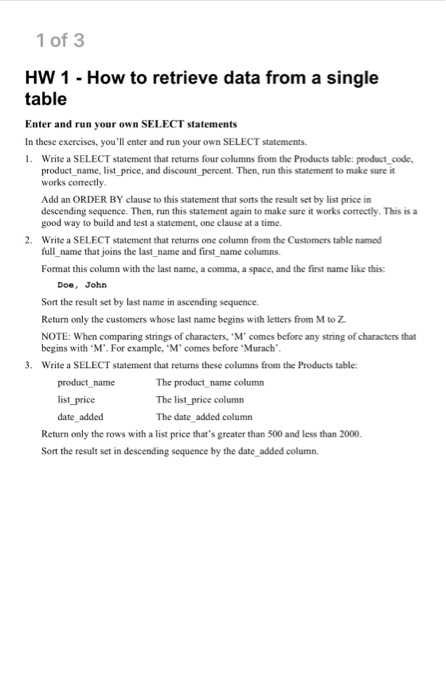
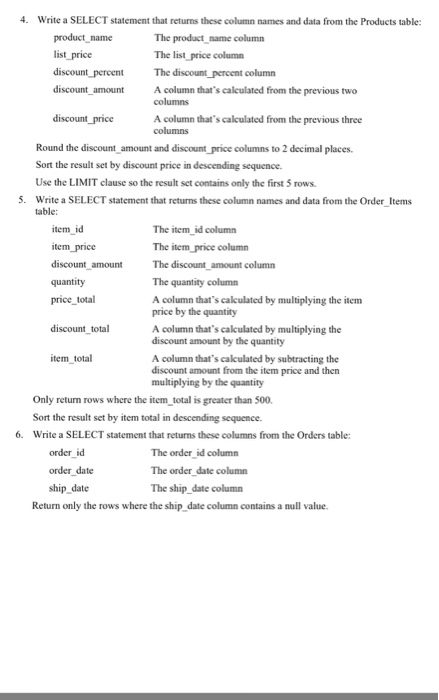
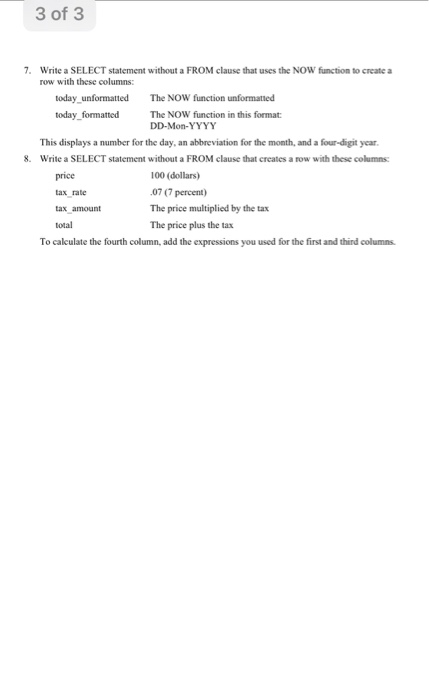
1 of 3 HW 1 How to retrieve data from a single table Enter and run your own SELECT statements In these exercises, you'll enter and run your own SELECT statements. 1. Write a SELECT statement that returns four columns from the Products table: product code, product name, list price, and discount percent. Then, run this statement to make sure it works connectly Add an ORDER BY clause to this statement that sorts the result set by list price in descending sequence. Then, run this statement again to make sure it works correctly. This is a good way to build and test a statement, one clause at a time. 2. Write a SELECT statement that returns one column from the Customers table named full name that joins the last name and first name columns. Format this column with the last name, acomma, a space, and the first name like this: Doe, John Sort the result set by last name in ascending sequence. Return only the customers whose last name begins with letters from M to Z. NOTE: When comparing strings of characters. M' comes before any string of characters that begins with M For example, M' comes before Murach 3. Write a SELECT statement that returns these columns from the Products table: product name The product name column The list price column list price date added The date added column Retum only the rows with a list price that's greater than 500 and less than 2000. Sort the result set in descending sequence by the date added column
Step by Step Solution
There are 3 Steps involved in it

Get step-by-step solutions from verified subject matter experts
 Study Help