







Question: Please write the C++ program using the explanation above. Also, I don't really get how to determine the running time complexity of an algorithm based
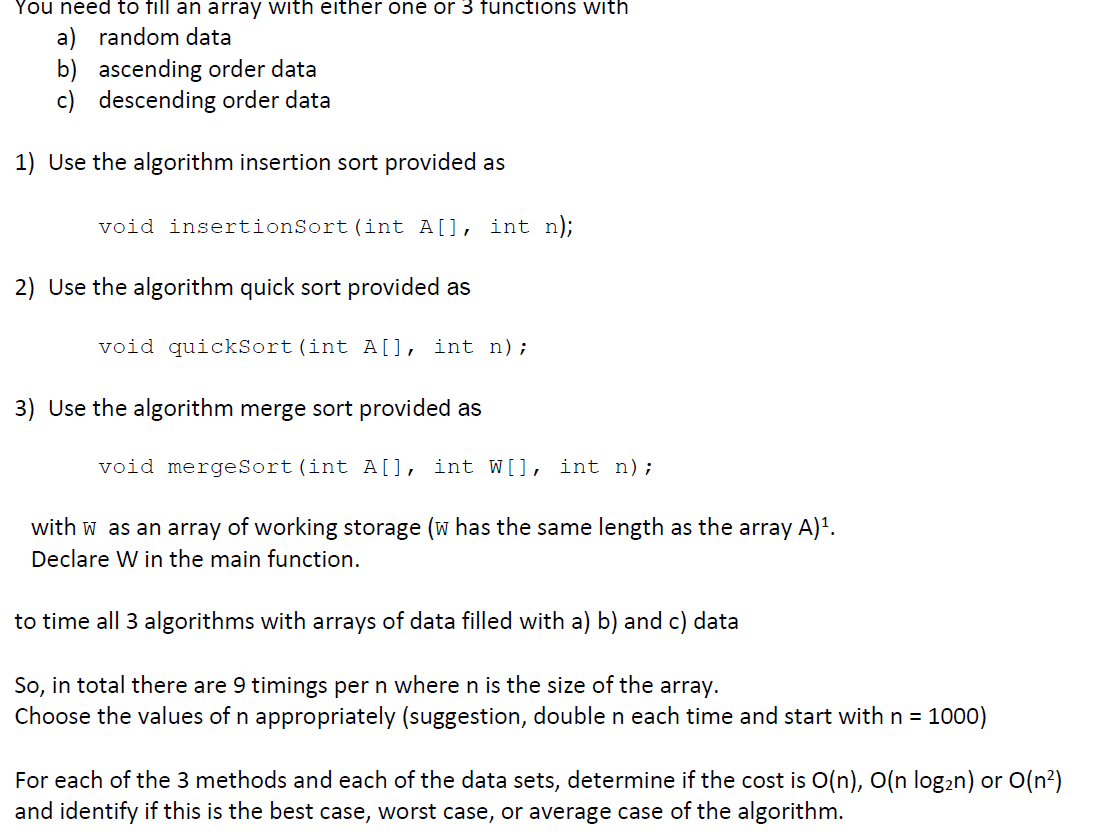

Please write the C++ program using the explanation above. Also, I don't really get how to determine the running time complexity of an algorithm based on empirical data, so please explain how you determined the costs based on timings.
*Please do not use dynamic arrays nor variable length arrays.
If anything missing, please let me know!!
Thanks in advance.
You need to fill an array with either one or 3 functions with a) random data b) ascending order data c) descending order data 1) Use the algorithm insertion sort provided as void insertionsort (int A[], int n); 2) Use the algorithm quick sort provided as void quickSort (int A[], int n); 3) Use the algorithm merge sort provided as void merge Sort (int A[], int W[], int n); with w as an array of working storage (w has the same length as the array A)1. Declare W in the main function. to time all 3 algorithms with arrays of data filled with a) b) and c) data So, in total there are 9 timings per n where n is the size of the array. Choose the values of n appropriately (suggestion, double n each time and start with n = 1000) For each of the 3 methods and each of the data sets, determine if the cost is O(n), O(n log2n) or O(na) and identify if this is the best case, worst case, or average case of the algorithm. To get an accurate measure for the time for small values of n, you will need to repeat the experiment m times, that is, time how long it takes to sort an array of n values m times and then divide the total time T by m. For example, for n=1000, you may need to repeat the experiment m=100 times so that the total time is at least 1 time unit. For the fast algorithms, you may need to use m=1000 or larger, to get an accurate time T. You need to fill an array with either one or 3 functions with a) random data b) ascending order data c) descending order data 1) Use the algorithm insertion sort provided as void insertionsort (int A[], int n); 2) Use the algorithm quick sort provided as void quickSort (int A[], int n); 3) Use the algorithm merge sort provided as void merge Sort (int A[], int W[], int n); with w as an array of working storage (w has the same length as the array A)1. Declare W in the main function. to time all 3 algorithms with arrays of data filled with a) b) and c) data So, in total there are 9 timings per n where n is the size of the array. Choose the values of n appropriately (suggestion, double n each time and start with n = 1000) For each of the 3 methods and each of the data sets, determine if the cost is O(n), O(n log2n) or O(na) and identify if this is the best case, worst case, or average case of the algorithm. To get an accurate measure for the time for small values of n, you will need to repeat the experiment m times, that is, time how long it takes to sort an array of n values m times and then divide the total time T by m. For example, for n=1000, you may need to repeat the experiment m=100 times so that the total time is at least 1 time unit. For the fast algorithms, you may need to use m=1000 or larger, to get an accurate time T
Step by Step Solution
There are 3 Steps involved in it

Get step-by-step solutions from verified subject matter experts
 Study Help