







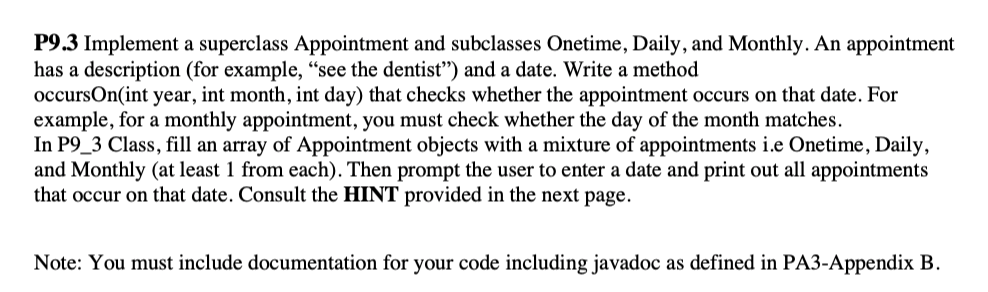
Question: Please write this java class in simplest way P9.3 Implement a superclass Appointment and subclasses Onetime, Daily, and Monthly. An appointment has a description (for
Please write this java class in simplest way
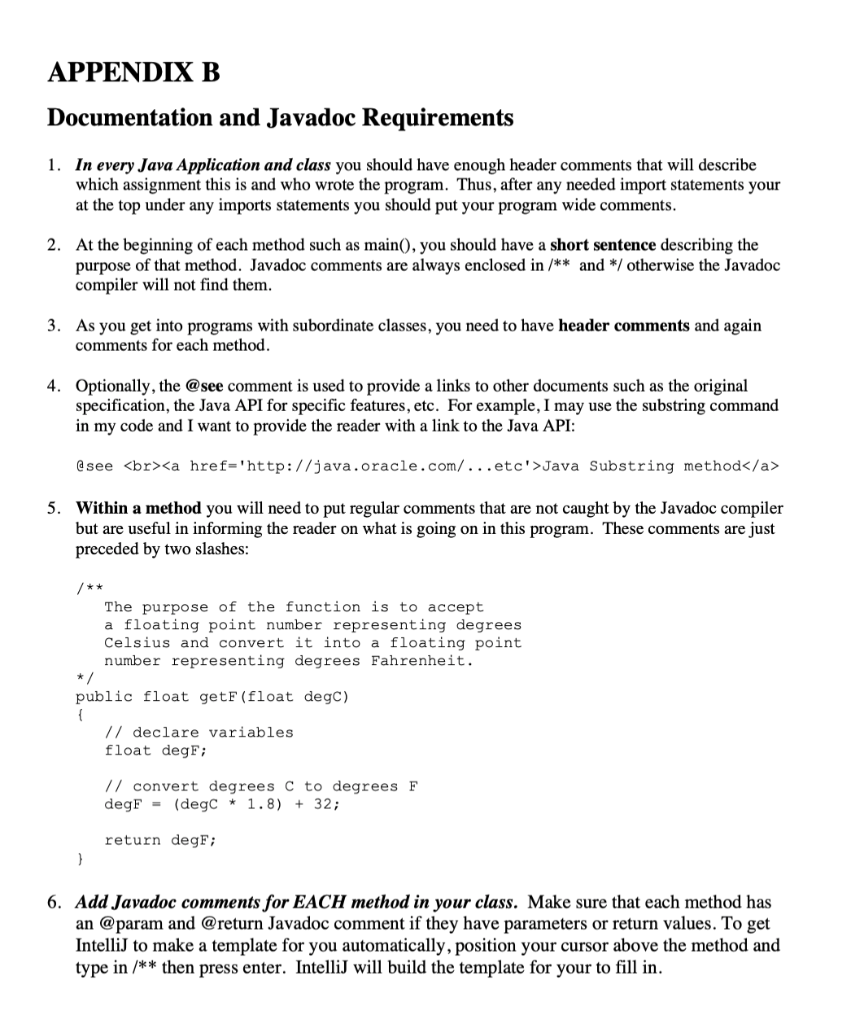
P9.3 Implement a superclass Appointment and subclasses Onetime, Daily, and Monthly. An appointment has a description (for example, "see the dentist") and a date. Write a method occursOn(int year, int month, int day) that checks whether the appointment occurs on that date. For example, for a monthly appointment, you must check whether the day of the month matches. In P9_3 Class, fill an array of Appointment objects with a mixture of appointments i.e Onetime, Daily, and Monthly (at least 1 from each). Then prompt the user to enter a date and print out all appointments that occur on that date. Consult the HINT provided in the next page. Note: You must include documentation for your code including javadoc as defined in PA3-Appendix B. APPENDIX B Documentation and Javadoc Requirements 1. In every Java Application and class you should have enough header comments that will describe which assignment this is and who wrote the program. Thus, after any needed import statements your at the top under any imports statements you should put your program wide comments. 2. At the beginning of each method such as main(), you should have a short sentence describing the purpose of that method. Javadoc comments are always enclosed in /** and */ otherwise the Javadoc compiler will not find them. 3. As you get into programs with subordinate classes, you need to have header comments and again comments for each method. 4. Optionally, the @see comment is used to provide a links to other documents such as the original specification, the Java API for specific features, etc. For example, I may use the substring command in my code and I want to provide the reader with a link to the Java API: @see Java Substring method 5. Within a method you will need to put regular comments that are not caught by the Javadoc compiler but are useful in informing the reader on what is going on in this program. These comments are just preceded by two slashes: The purpose of the function is to accept a floating point number representing degrees Celsius and convert it into a floating point number representing degrees Fahrenheit. public float getF(float degC) { // declare variables float degF; // convert degrees C to degrees F degF - (degC * 1.8) + 32; return degF; } 6. Add Javadoc comments for EACH method in your class. Make sure that each method has an @param and @return Javadoc comment if they have parameters or return values. To get IntelliJ to make a template for you automatically, position your cursor above the method and type in /** then press enter. IntelliJ will build the template for your to fill in
Step by Step Solution
There are 3 Steps involved in it

Get step-by-step solutions from verified subject matter experts
 Study Help