Question: PLEASE WRTIE AS MUCH AS YOU CAN PLEASE!!!!!!! Case Study Question 1 Section B: Case study (10%). This section involves answering 2 questions based on
PLEASE WRTIE AS MUCH AS YOU CAN PLEASE!!!!!!!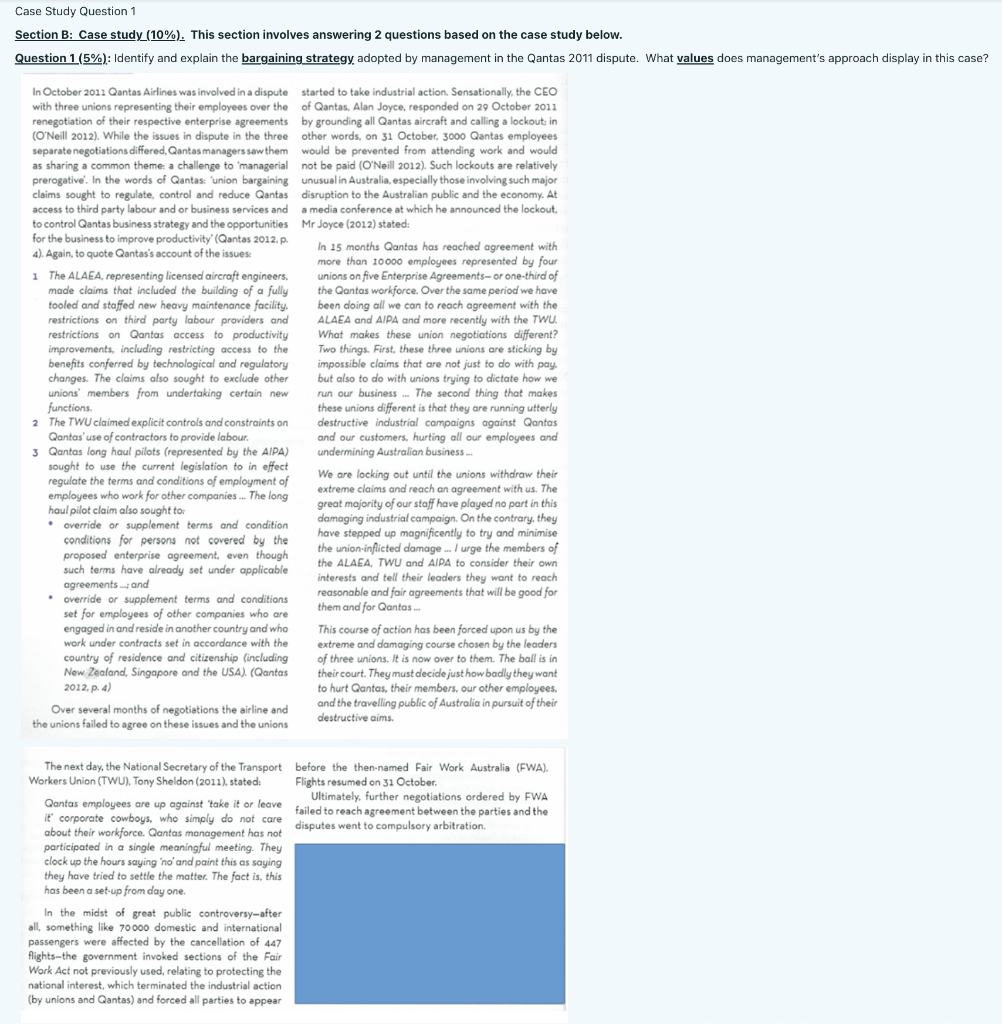
Case Study Question 1 Section B: Case study (10%). This section involves answering 2 questions based on the case study below. Question 1 (5%): Identify and explain the bargaining strategy adopted by management in the Qantas 2011 dispute. What values does management's approach display in this case? In October 2011 Qantas Airlines was involved in a dispute started to take industrial action. Sensationally, the CEO with three unions representing their employees over the of Qantas, Alan Joyce, responded on 29 October 2011 renegotiation of their respective enterprise agreements by grounding all Qantas aircraft and calling a lockout, in (O'Neill 2012). While the issues in dispute in the three other words, on 31 October, 3000 Qantas employees separate negotiations differed, Qantas managers saw them would be prevented from attending work and would as sharing a common theme: a challenge to managerial not be paid (O'Neill 2012). Such lockouts are relatively prerogative'. In the words of Qantas: 'union bargaining unusual in Australia, especially those involving such major claims sought to regulate, control and reduce Qantas disruption to the Australian public and the economy. At access to third party labour and or business services and a media conference at which he announced the lockout. to control Qantas business strategy and the opportunities Mr Joyce (2012) stated: for the business to improve productivity (Qantas 2012, p. In 15 months Qantas has reached agreement with 4). Again, to quote Qantas's account of the issues: more than 10000 employees represented by four i The ALAEA, representing licensed aircraft engineers, unions on five Enterprise Agreements or one-third of made claims that included the building of a fully the Qantas workforce. Over the same period we have tooled and staffed new heavy maintenance facility. been doing all we can to reach agreement with the restrictions on third party labour providers and ALAEA and AIPA and more recently with the TWU. restrictions on Qantas access to productivity What makes these union negotiations different? improvements, including restricting access to the Two things. First, these three unions are sticking by benefits conferred by technological and regulatory impossible claims that are not just to do with pay. changes. The claims also sought to exclude other but also to do with unions trying to dictate how we unions' members from undertaking certain new run our business ... The second thing that makes functions these unions different is that they are running utterly 2 The TWU claimed explicit controls and constraints on destructive industrial campaigns against Qantas Qantas'use of contractors to provide labour. and our customers, hurting all our employees and 3 Qantas long haul pilots (represented by the AIPA) undermining Australian business... sought to use the current legislation to in effect regulate the terms and conditions of employment of We are locking out until the unions withdraw their employees who work for other companies ... The long extreme claims and reach an agreement with us. The haul pilot claim also sought to: great majority of our staff have played no part in this override supplement terms and condition damaging industrial campaign. On the contrary, they conditions for persons not covered by the have stepped up magnificently to try and minimise proposed enterprise agreement, even though the union-inflicted damage ... I urge the members of the ALAEA, TWU and AIPA to consider their own such terms have already set under applicable interests and tell their leaders they want to reach agreements and override or supplement terms and conditions reasonable and fair agreements that will be good for them and for Qantas. set for employees of other companies who are engaged in and reside in another country and who This course of action has been forced upon us by the work under contracts set in accordance with the extreme and damaging course chosen by the leaders country of residence and citizenship (including of three unions. It is now over to them. The ball is in New Zealand, Singapore and the USA). (Qantas their court. They must decide just how badly they want 2012.p.) to hurt Qantas, their members, our other employees. Over several months of negotiations the airline and and the travelling public Australia in pursuit of their the unions failed to agree on these issues and the unions destructive aims. The next day, the National Secretary of the Transport before the then-named Fair Work Australia (FWA). Workers Union (TWU), Tony Sheldon (2011), stated: Flights resumed on 31 October Qantas employees are up against take it or leave Ultimately, further negotiations ordered by FWA failed to reach agreement between the parties and the it corporate cowboys, who simply do not care disputes went compulsory arbitration. about their workforce. Qantas management has not participated in a single meaningful meeting. They clock up the hours saying 'no' and paint this as saying they have tried to settle the matter. The fact is, this has been a set-up from day one. In the midst of great public controversy-after all, something like 70000 domestic and international passengers were affected by the cancellation of 447 flights-the government invoked sections of the Fair Work Act not previously used, relating to protecting the national interest, which terminated the industrial action (by unions and Qantas) and forced all parties to appear Case Study Question 1 Section B: Case study (10%). This section involves answering 2 questions based on the case study below. Question 1 (5%): Identify and explain the bargaining strategy adopted by management in the Qantas 2011 dispute. What values does management's approach display in this case? In October 2011 Qantas Airlines was involved in a dispute started to take industrial action. Sensationally, the CEO with three unions representing their employees over the of Qantas, Alan Joyce, responded on 29 October 2011 renegotiation of their respective enterprise agreements by grounding all Qantas aircraft and calling a lockout, in (O'Neill 2012). While the issues in dispute in the three other words, on 31 October, 3000 Qantas employees separate negotiations differed, Qantas managers saw them would be prevented from attending work and would as sharing a common theme: a challenge to managerial not be paid (O'Neill 2012). Such lockouts are relatively prerogative'. In the words of Qantas: 'union bargaining unusual in Australia, especially those involving such major claims sought to regulate, control and reduce Qantas disruption to the Australian public and the economy. At access to third party labour and or business services and a media conference at which he announced the lockout. to control Qantas business strategy and the opportunities Mr Joyce (2012) stated: for the business to improve productivity (Qantas 2012, p. In 15 months Qantas has reached agreement with 4). Again, to quote Qantas's account of the issues: more than 10000 employees represented by four i The ALAEA, representing licensed aircraft engineers, unions on five Enterprise Agreements or one-third of made claims that included the building of a fully the Qantas workforce. Over the same period we have tooled and staffed new heavy maintenance facility. been doing all we can to reach agreement with the restrictions on third party labour providers and ALAEA and AIPA and more recently with the TWU. restrictions on Qantas access to productivity What makes these union negotiations different? improvements, including restricting access to the Two things. First, these three unions are sticking by benefits conferred by technological and regulatory impossible claims that are not just to do with pay. changes. The claims also sought to exclude other but also to do with unions trying to dictate how we unions' members from undertaking certain new run our business ... The second thing that makes functions these unions different is that they are running utterly 2 The TWU claimed explicit controls and constraints on destructive industrial campaigns against Qantas Qantas'use of contractors to provide labour. and our customers, hurting all our employees and 3 Qantas long haul pilots (represented by the AIPA) undermining Australian business... sought to use the current legislation to in effect regulate the terms and conditions of employment of We are locking out until the unions withdraw their employees who work for other companies ... The long extreme claims and reach an agreement with us. The haul pilot claim also sought to: great majority of our staff have played no part in this override supplement terms and condition damaging industrial campaign. On the contrary, they conditions for persons not covered by the have stepped up magnificently to try and minimise proposed enterprise agreement, even though the union-inflicted damage ... I urge the members of the ALAEA, TWU and AIPA to consider their own such terms have already set under applicable interests and tell their leaders they want to reach agreements and override or supplement terms and conditions reasonable and fair agreements that will be good for them and for Qantas. set for employees of other companies who are engaged in and reside in another country and who This course of action has been forced upon us by the work under contracts set in accordance with the extreme and damaging course chosen by the leaders country of residence and citizenship (including of three unions. It is now over to them. The ball is in New Zealand, Singapore and the USA). (Qantas their court. They must decide just how badly they want 2012.p.) to hurt Qantas, their members, our other employees. Over several months of negotiations the airline and and the travelling public Australia in pursuit of their the unions failed to agree on these issues and the unions destructive aims. The next day, the National Secretary of the Transport before the then-named Fair Work Australia (FWA). Workers Union (TWU), Tony Sheldon (2011), stated: Flights resumed on 31 October Qantas employees are up against take it or leave Ultimately, further negotiations ordered by FWA failed to reach agreement between the parties and the it corporate cowboys, who simply do not care disputes went compulsory arbitration. about their workforce. Qantas management has not participated in a single meaningful meeting. They clock up the hours saying 'no' and paint this as saying they have tried to settle the matter. The fact is, this has been a set-up from day one. In the midst of great public controversy-after all, something like 70000 domestic and international passengers were affected by the cancellation of 447 flights-the government invoked sections of the Fair Work Act not previously used, relating to protecting the national interest, which terminated the industrial action (by unions and Qantas) and forced all parties to appear









 Study Help