Question: PLEASE, YOU MUST ANSWER USING EXCEL (the prints/pictures below the explanation for the exercise, must be typed and completed on a excel, showing how you
PLEASE, YOU MUST ANSWER USING EXCEL (the prints/pictures below the explanation for the exercise, must be typed and completed on a excel, showing how you got the numbers etc). Then you upload the excel so I can download it. Thank you
Project-Specific WACC In 2014, worldwide capacity of wind-powered generators was growing. Wind power still constitutes a small fraction of worldwide electricity use, but in Denmark, wind power provides over 20% of electricity. Moreover, the use of wind power has grown rapidly in recent years. The key feature of wind power is its heavy capital intensity and low ongoing costs (the wind is free). Combined with advances in wind power generation technology, this alternative power source appears to be one of the most promising clean energy sources for the future. Gusty Power Company (GPC) of Amarillo, Texas, builds and operates wind farms that produce electrical power, which is then sold into the electrical grid. GPC has recently been contacted by the Plains Energy Company of Plainview, Texas, to construct one of the largest wind-power farms ever built. Plains Energy is an independent power producer that normally sells all the electrical power it produces back to the power grid at prevailing market prices. In this instance, however, Plains has arranged to sell all of its production to a consortium of electric power companies in the area for a long-term, contractually set price. Assume that the project generates perpetual cash flows (annual project FCF) of $8,000,000, debt principal is never repaid, capital expenditures (CAPEX) equal depreciation in each period, and the tax rate is 35%. The project calls for an investment of $100 million, and Plains has arranged for an $80 million project loan that has no recourse to Plains's other assets. The loan carries a 7% rate of interest, which reflects current market conditions for loans of this type. Plains will invest $10 million in the project, and the remainder will be provided by two local power companies that are part of the consortium that will purchase the electrical power the project produces. a. What is the project-specific WACC, calculated using the book values of debt and equity as a proportion of the $100 million cost of the project? Given this estimate of the WACC, what is the value of the project? b. Reevaluate the project-specific WACC using your estimate of the value of the project from part a above as the basis for your weights. Use this WACC to reestimate the value of the project, and then recalculate the weights for the project finance WACC using this revised estimate of WACC. Repeat this process until the value of the project converges to a stable value. What is the project's value? What is the project finance WACC? c. Reevaluate the project-specific WACC and project value where the contract calls for a 2.5% rate of increase in the project free cash flow beginning in the second year of the project's life
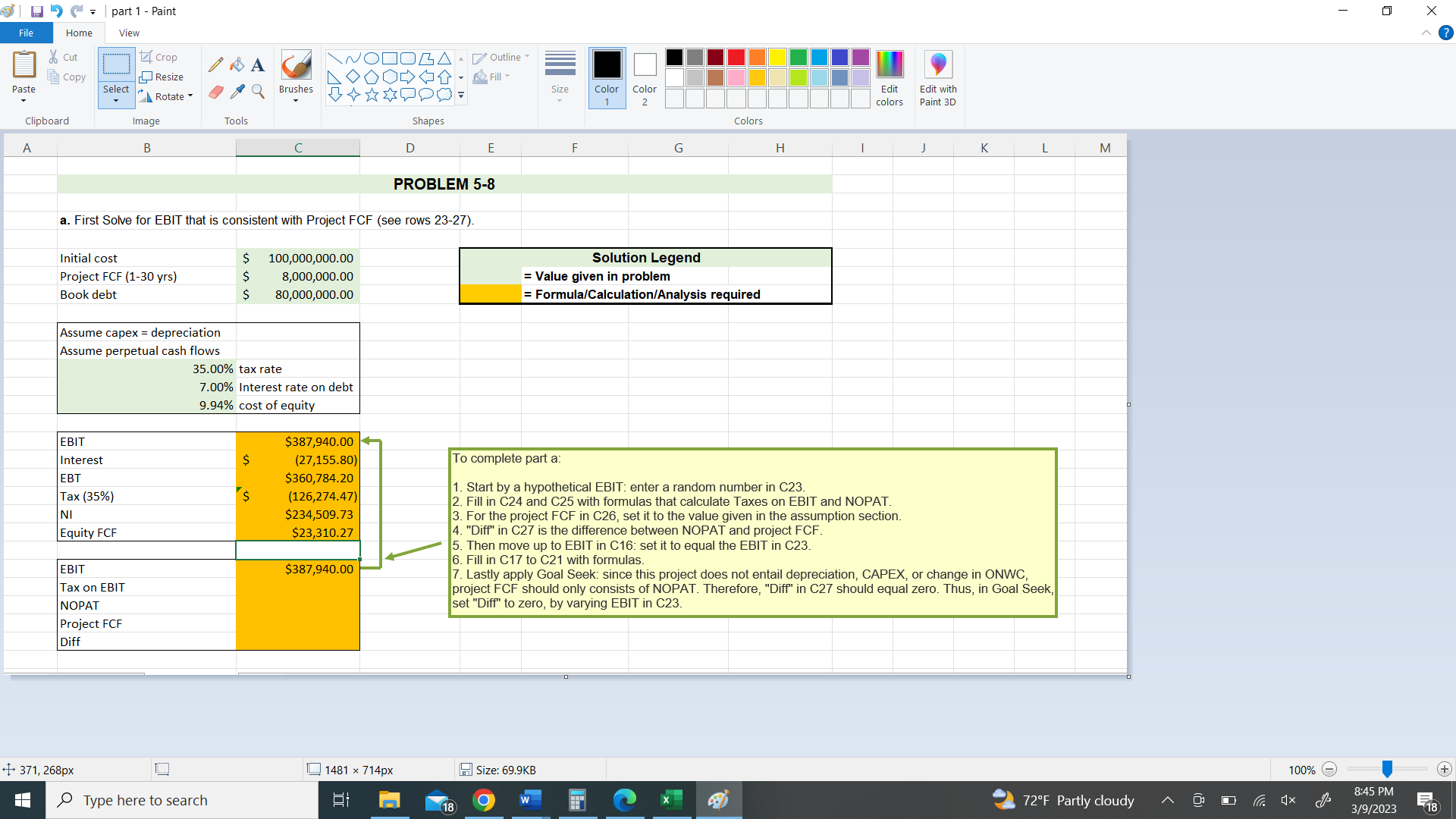
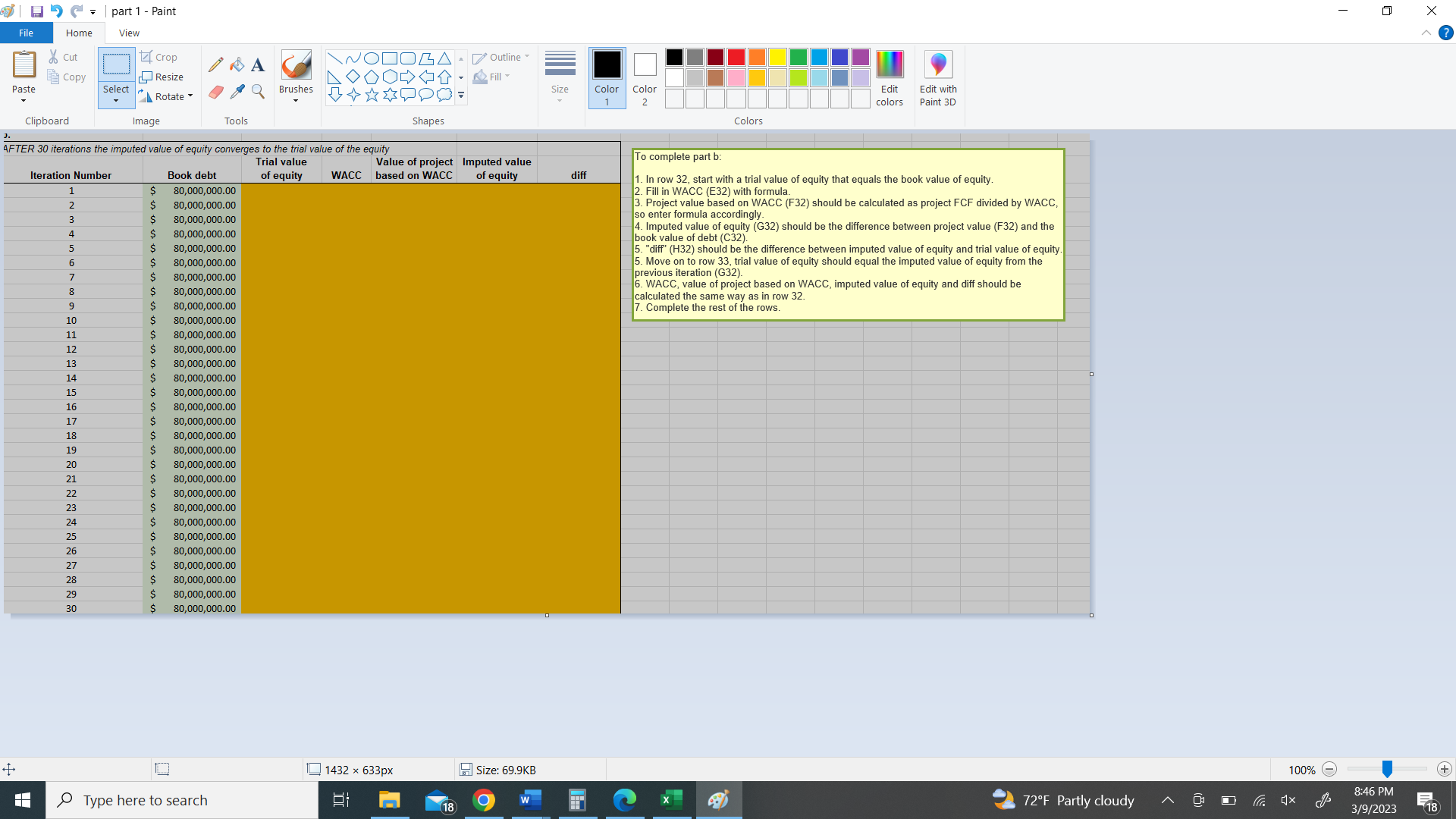
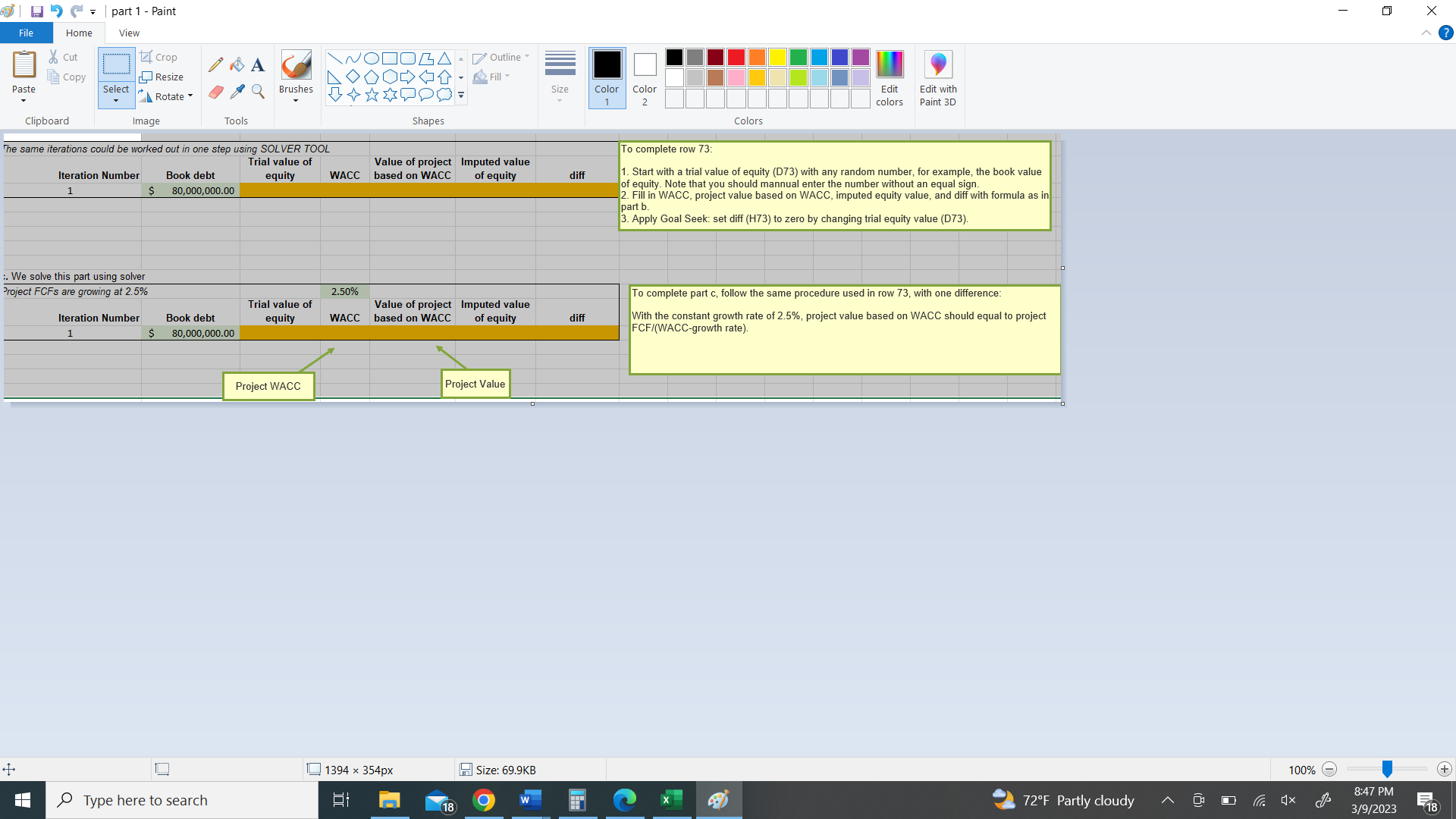
| 9 6 : | part 1 - Paint X File Home View 6 Cut t crop WOODGA . Outline Copy Resize DODOD 42 . Fill Paste Select Size Color Rotate Brushes Color =dit Edit with 1 2 colors Paint 3D Clipboard Image Tools Shapes Colors A B C D E F G H K L M PROBLEM 5-8 a. First Solve for EBIT that is consistent with Project FCF (see rows 23-27). Initial cost 100,000,000.00 Solution Legend Project FCF (1-30 yrs) 8,000,000.00 = Value given in problem Book debt 80,000,000.00 = Formula/Calculation/Analysis required Assume capex = depreciation Assume perpetual cash flows 35.00% tax rate 7.00% Interest rate on debt 9.94% cost of equity EBIT $387,940.00 Interest S (27,155.80) To complete part a: EBT $360,784.20 Tax (35%) (126,274.47) 1. Start by a hypothetical EBIT: enter a random number in C23. 2. Fill in C24 and C25 with formulas that calculate Taxes on EBIT and NOPAT. NI $234,509.73 3. For the project FCF in C26, set it to the value given in the assumption section. Equity FCF $23,310.27 4. "Diff" in C27 is the difference between NOPAT and project FCF 5. Then move up to EBIT in C16: set it to equal the EBIT in C23 EBIT $387,940.00 6. Fill in C17 to C21 with formulas. 7. Lastly apply Goal Seek: since this project does not entail depreciation, CAPEX, or change in ONWC, Tax on EBIT project FCF should only consists of NOPAT. Therefore, "Diff" in C27 should equal zero. Thus, in Goal Seek, NOPAT set "Diff" to zero, by varying EBIT in C23 Project FCF Diff . 371, 268px 1481 x 714px Size: 69.9KB 100% + Type here to search W 72F Partly cloudy 8:45 PM 18 9 @ x 3/9/2023| 7 6 : | part 1 - Paint X File Home View 6 Cut t crop WOOOGA . Outline Copy Resize DODOD 42 . Fill Paste elect Brushes Size Color Color Edit Edit with Rotate 1 2 colors Paint 3D Clipboard Image Tools Shapes Colors AFTER 30 iterations the imputed value of equity converges to the trial value of the equity Trial value Value of project Imputed value To complete part b: Iteration Number Book debt of equity WACC based on WACC of equity diff 1. In row 32, start with a trial value of equity that equals the book value of equity 80,000,000.00 2. Fill in WACC (E32) with formula. 80,000,000.00 3. Project value based on WACC (F32) should be calculated as project FCF divided by WACC, 80,000,000.00 so enter formula accordingly. 4. Imputed value of equity (G32) should be the difference between project value (F32) and the 80,000,000.00 book value of debt (C32). 80,000,000.00 5. "diff" (H32) should be the difference between imputed value of equity and trial value of equity. 80,000,000.00 5. Move on to row 33, trial value of equity should equal the imputed value of equity from the 80,000,000.00 previous iteration (G32). 6. WACC, value of project based on WACC, imputed value of equity and diff should be 80,000,000.00 calculated the same way as in row 32. 80,000,000.00 7. Complete the rest of the rows. 80,000,000.00 80,000,000.00 80,000,000.00 80,000,000.00 80,000,000.00 80,000,000.00 80,000,000.00 80,000,000.00 80,000,000.00 80,000,000.00 80,000,000.00 80,000,000.00 80,000,000.00 30,000,000.00 80,000,000.00 80,000,000.00 80,000,000.00 30,000,000.00 80,000,000.00 30,000,000.00 80,000,000.00 1432 x 633px Size: 69.9KB 100% + 8:46 PM Type here to search 18 W TO x 72F Partly cloudy 3/9/2023| 9 6 : | part 1 - Paint X File Home View 6 Cut t crop WOODGA . Outline Copy Resize DODODGY. Fill Paste Select Rotate Brushes Size Color Color Edit Edit with 1 2 colors Paint 3D Clipboard Image Tools Shapes Colors The same iterations could be worked out in one step using SOLVER TOOL To complete row 73: Trial value of Value of project Imputed value Iteration Number Book debt equity WACC based on WACC of equity diff 1. Start with a trial value of equity (D73) with any random number, for example, the book value 80,000,000.00 of equity. Note that you should mannual enter the number without an equal sign. 2. Fill in WACC, project value based on WACC, imputed equity value, and diff with formula as in part b. 3. Apply Goal Seek: set diff (H73) to zero by changing trial equity value (D73). :. We solve this part using solver Project FCFS are growing at 2.5% 2.50% To complete part c, follow the same procedure used in row 73, with one difference Trial value of Value of project Imputed value Iteration Number Book debt equity WACC based on WACC of equity diff With the constant growth rate of 2.5%, project value based on WACC should equal to project $ 80,000,000.00 FCF/(WACC-growth rate) Project WACC Project Value 1394 x 354px Size: 69.9KB 100% + 18 W FOX 72OF Partly cloudy 8:47 PM Type here to search 9 3/9/2023
Step by Step Solution
There are 3 Steps involved in it
1 Expert Approved Answer
Step: 1 Unlock
Question Has Been Solved by an Expert!
Get step-by-step solutions from verified subject matter experts
Step: 2 Unlock
Step: 3 Unlock
Students Have Also Explored These Related Finance Questions!









 Study Help