Question: pleaseee i need help with this case study ass soon as possible 24 CASE STUDY Apple's iPhones-Not Made in America Apple has become one of
pleaseee i need help with this case study ass soon as possible
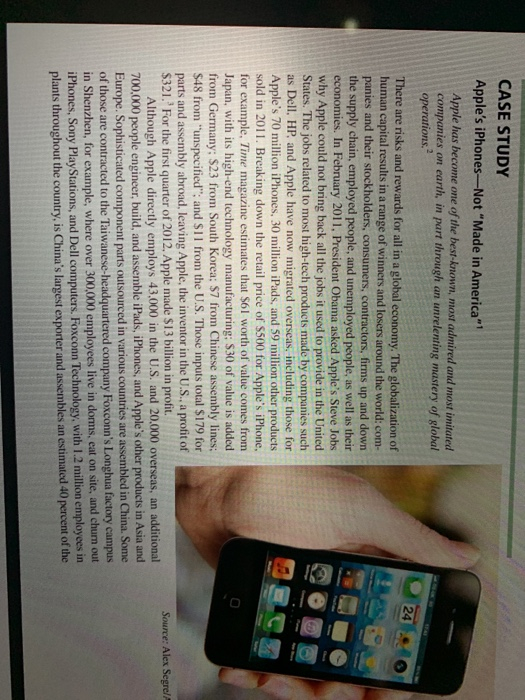
24 CASE STUDY Apple's iPhones-Not "Made in America" Apple has become one of the best-known, most admired and most imitated companies on earth, in part through an unrelenting mastery of global operations. There are risks and rewards for all in a global economy. The globalization of human capital results in a range of winners and losers around the world: com- panies and their stockholders, consumers, contractors, firms up and down the supply chain, employed people, and unemployed people, as well as their economies. In February 2011, President Obama asked Apple's Steve Jobs why Apple could not bring back all the jobs it used to provide in the United States. The jobs related to most high-tech products made by companies such as Dell, HP, and Apple have now migrated overseas, including those for Apple's 70 million iPhones, 30 million iPads, and 59 million other products sold in 2011. Breaking down the retail price of $500 for Apple's iPhone, for example, Time magazine estimates that $61 worth of value comes from Japan, with its high-end technology manufacturing: S30 of value is added from Germany: $23 from South Korea: $7 from Chinese assembly lines: $48 from "unspecified"; and $11 from the U.S. Those inputs total $179 for parts and assembly abroad, leaving Apple, the inventor in the U.S., a profit of $321. For the first quarter of 2012. Apple made $13 billion in profit. Although Apple directly employs 43,000 in the U.S. and 20.000 overseas, an additional 700,000 people engineer, build, and assemble iPads, iPhones, and Apple's other products in Asia and Europe. Sophisticated component parts outsourced in various countries are assembled in China. Some of those are contracted to the Taiwanese-headquartered company Foxconn's Longhua factory campus in Shenzhen, for example, where over 300,000 employees live in dorms, eat on site, and chum out iPhones, Sony PlayStations, and Dell computers. Foxconn Technology, with 1.2 million employees in plants throughout the country, is China's largest exporter and assembles an estimated 40 percent of the Source: Alex Segre/f CHAPTER 1. ASSESSING TH world's consumer electronics, including for customers such as Amazon, Dell, Hewlett-Packard, Nin- tendo, Nokia, and Samsung. No other factories in the world have the manufacturing scale of Foxconn. The answer to the President's question is not as simple as the ability to acquire cheaper labor overseas; Apple's executives and those at other high-tech firms claim that "Made in the U.S.A" is not a competitive strategy for them because America does not compare favorably with the industrial skills, hard work, and flexibility that can be found in companies such as Foxconn. Questions as to what corporate America owes to Americans are met with the example of thou- sands of Chinese workers being roused in the night to accommodate a redesigned iPhone screen, and within a few days being able to produce 10,000 iPhones a daya feat not possible in U.S. factories. While the cost of labor is a small percentage of an iPhone's cost, the major advantage and cost saving in China is in the management of supply chains and rapid access to component parts and manufacturing supplies from various factories in close proximity. In addition, Apple maintains that the large number of engineers and other skilled workers who could be accessed on short notice in China simply are not readily available in the United States; nor are the factories with the scale, speed, and flexibility that such a high-tech company needs. Apple executives give the example of visiting a factory to consider whether it could do the necessary work to cut the glass for the iPhone's touchscreen. Upon their arrival, a new wing of the plant was already being built in case you give us the contract. Fareed Zakaria, in Time, maintains that this competitive edge is gained largely through Chinese government subsidies and streamlined regulations in or- der to boost domestic manufacturing. In the end, however, Apple maintains that: We don't have an obligation to solve America's problems. Our only obligation is making the best product possible. 2010, report attributable to the poor work- + 2 A' Read aloud der to boost domestie manufacturing. In the end, however. Apple maintains that: We don't have an obligation to solve America's problems. Our only obligation is making the best product possible. However, after a number of suicides at Foxconn in 2010, reportedly attributable to the poor work- ing conditions and excessive hours for very low pay, Apple was under some pressure from negative publicity: subsequently Foxconn raised wages, retained counselors, and literally strung nets from its highest buildings (to catch people). Apple does have a supplier code of conduct. In January 2012, Apple joined the Fair Labor Association (FLA), the first technology company to do so, and asked the group to do an independent assessment of conditions at its major factories. This move followed the company's own report that documented numerous labor violations, including employees doing 60 hour workweeks and not getting paid proper overtime. A few days after the FLA started its inves- tigation, Foxconn said that they would increase salaries for some workers by 16% to 20% to about $400 a month before overtime and that they would reduce overtime. While this is encouraging news for workers' rights, it should be noted that Apple and other contractors are known to only allow the slimmest of profits to its suppliers, which results in the suppliers trying anything to reduce their costs, such as using cheaper and more toxic chemicals or making their employees work faster and longer. "The only way you make money working for Apple is figuring out how to do things more ef- ficiently or cheaper," said an executive at one company that helped bring the iPad to market. "And then they'll come back the next year, and force a 10 percent price cut." China is being forced to take notice of such problems and labor is gaining some ground; the issue then is that firms have already started to move jobs to other countries with lower wages. 1. Harding, Robin: Hille, Kathrin: Jung-a, Song: Kwong, Robin, Ap everything: houses, hospitals, bars. Such a not for long. Welcome to Scotia, Calif.." N ple, HP and Dell Probe Foxconn." Financial Times. London (UK). ruary 21, 2011; Charles Duhigg and David May 27 2010; Charles Duhigg and Keith Bradsher. How U.S. Costs Are Built Into an iPad, 16 AL MANAGER'S ENVIRONMENT Case Questions 1. What is meant by the globalization of human capital? Is this inevitable as firms increase their global operations? 2. How does this case illustrate the threats and opportunities facing global companies in developing their strategies? 3. Comment on the Apple executive's assertion that the company's only obligation is making the best product possible. "We don't have an obligation to solve America's problems." 4. Who are the stakeholders in this situation and what, if any, obligations do they have? 5. How much extra are you prepared to pay for an iPhone if assembled in the United States? 6. How much extra are you prepared to pay for an iPhone assembled in China but under better labor con- ditions or pay? What kind of trade-off would 7. To what extent do you think the negative media coverage has affected Apple's recent decision to ask the FLA to do an independent assessment and the subsequent decision by Foxconn to raise some salaries? What do you think will happen now? you make2









 Study Help