







Question: plesse help solve problem (1) Sales and receivables are entered at gross selling price. (2) Sales and receivables are entered at net of cash discounts.
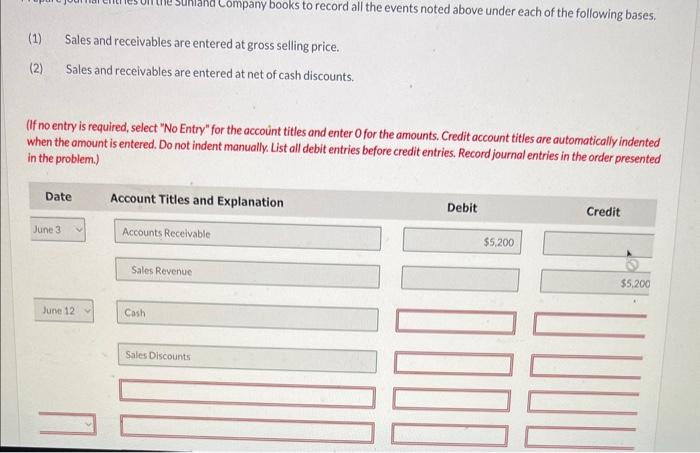
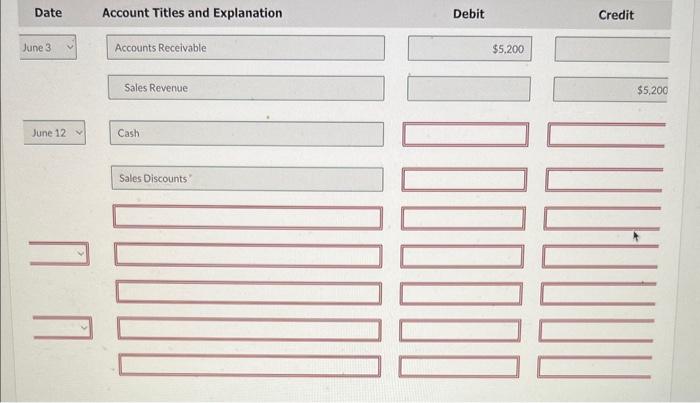
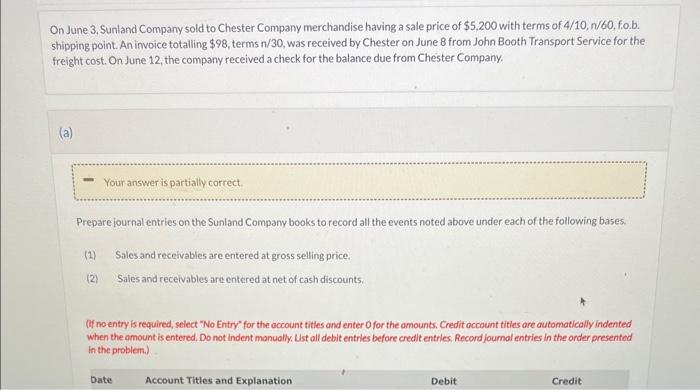
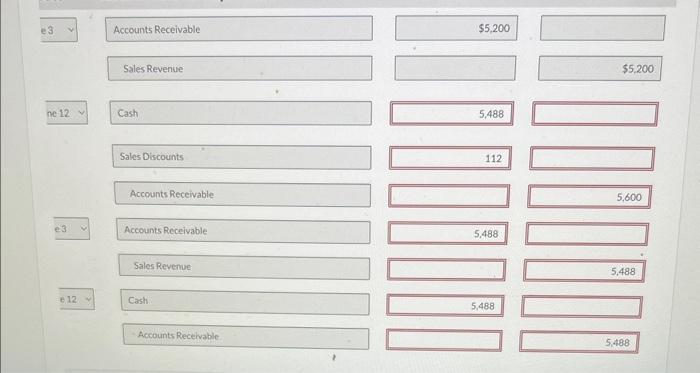
(1) Sales and receivables are entered at gross selling price. (2) Sales and receivables are entered at net of cash discounts. (If no entry is required, select "No Entry" for the account titles and enter 0 for the amounts. Credit account titles are automatically indented when the omount is entered. Do not indent manually. List all debit entries before credit entries. Record journal entries in the order presented in the problem.) \begin{tabular}{ll} Date & Account Titles and Explanation Debit \\ \hline June 3 & Accounts Receivable \\ \hline Sales Revenue \end{tabular} Credit $5,200 June 12 Cash Sales Discounts: On June 3, Sunland Company sold to Chester Company merchandise having a sale price of $5,200 with terms of 4/10,n/60, f.o.b. shipping point. An invoice totalling $98, terms n/30, was received by Chester on June 8 from John Booth Transport Service for the freight cost. On June 12 , the company received a check for the balance due from Chester Company. (a) Your answer is partially correct. Prepare journal entries on the Sunland Company books to record all the events noted above under each of the following bases. (1) Sales and receivables are entered at gross selling price. (2) Sales and receivables are entered at net of cash discounts. (If ne entry is required, select "No Entry" for the occount titles and enter O for the amounts. Credit account tities are automatically indented when the amount is entered. Do not indent manually. Lst all debit entries before credit entries. Record joumal entries in the order presented In the problem.) Accounts Receivable $5,200 Sales Revenue $5,200 ne 12 Cash Sales Discounts Accounts Receivable es Accounts Receivable Sales Revenue e12 Cash
Step by Step Solution
There are 3 Steps involved in it

Get step-by-step solutions from verified subject matter experts
 Study Help