







Question: The following relationships can be used to analyze uniform beams subject to distributed loads, dy de M(x) dM dV = 0(x) dx V(x) =
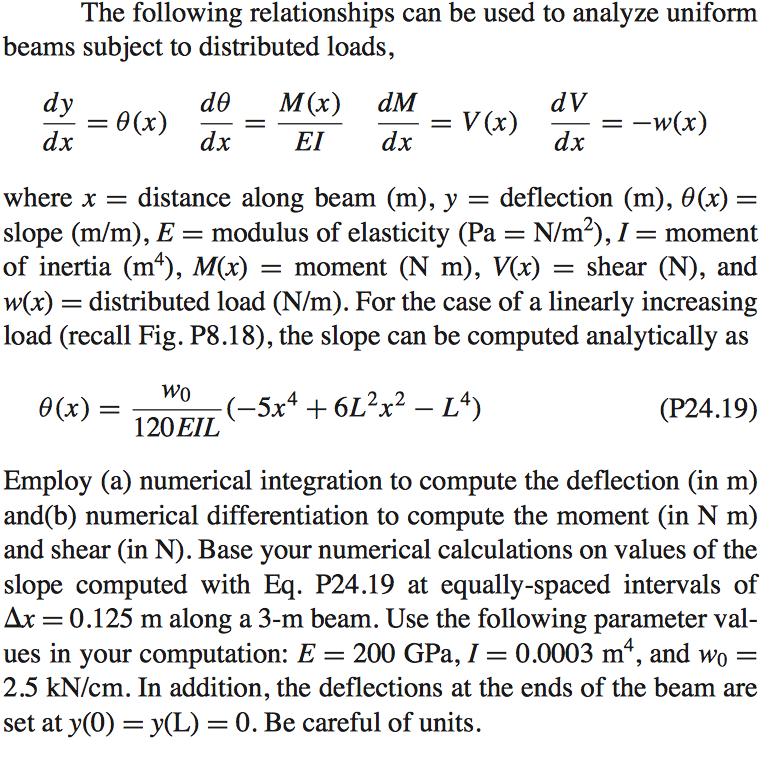
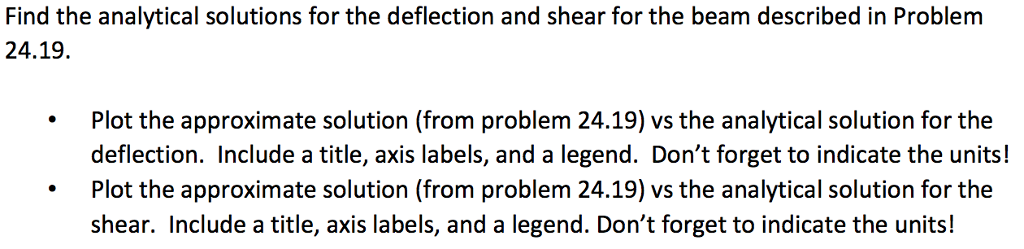
The following relationships can be used to analyze uniform beams subject to distributed loads, dy de M(x) dM dV = 0(x) dx V(x) = -w(x) dx dx EI dx where x = distance along beam (m), y = deflection (m), 0(x) = slope (m/m), E = modulus of elasticity (Pa = N/m?), I = moment of inertia (m*), M(x) = moment (N m), V(x): w(x) = distributed load (N/m). For the case of a linearly increasing load (recall Fig. P8.18), the slope can be computed analytically as = shear (N), and %3| Wo O(x) = -(-5x* + 6L?x L*) (P24.19) 120EIL Employ (a) numerical integration to compute the deflection (in m) and(b) numerical differentiation to compute the moment (in N m) and shear (in N). Base your numerical calculations on values of the slope computed with Eq. P24.19 at equally-spaced intervals of Ax = 0.125 m along a 3-m beam. Use the following parameter val- ues in your computation: E = 2.5 kN/cm. In addition, the deflections at the ends of the beam are 200 GPa, I = 0.0003 m*, and wo = set at y(0) = y(L) = 0. Be careful of units. Find the analytical solutions for the deflection and shear for the beam described in Problem 24.19. Plot the approximate solution (from problem 24.19) vs the analytical solution for the deflection. Include a title, axis labels, and a legend. Don't forget to indicate the units! Plot the approximate solution (from problem 24.19) vs the analytical solution for the shear. Include a title, axis labels, and a legend. Don't forget to indicate the units!
Step by Step Solution
3.31 Rating (148 Votes )
There are 3 Steps involved in it
To solve this problem we need to perform numerical integration to compute the deflection and numeric... View full answer

Get step-by-step solutions from verified subject matter experts
 Study Help