







Question: Plot 4(ii) Chaotic systems have exponentially diverging solutions until the differencebecomes large. Consider the Lorenz equations dtdx=(yx),dtdy=x(z)y,dtdz=xyz, with =10,=8/3 and =28. (i). Numerically solve the
Plot 4(ii)
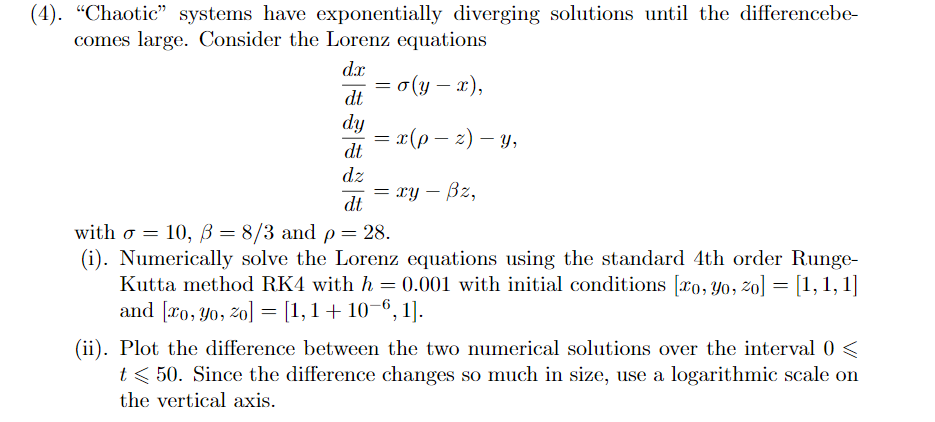
"Chaotic" systems have exponentially diverging solutions until the differencebecomes large. Consider the Lorenz equations dtdx=(yx),dtdy=x(z)y,dtdz=xyz, with =10,=8/3 and =28. (i). Numerically solve the Lorenz equations using the standard 4th order RungeKutta method RK4 with h=0.001 with initial conditions [x0,y0,z0]=[1,1,1] and [x0,y0,z0]=[1,1+106,1]. (ii). Plot the difference between the two numerical solutions over the interval 0 t50. Since the difference changes so much in size, use a logarithmic scale on the vertical axis. "Chaotic" systems have exponentially diverging solutions until the differencebecomes large. Consider the Lorenz equations dtdx=(yx),dtdy=x(z)y,dtdz=xyz, with =10,=8/3 and =28. (i). Numerically solve the Lorenz equations using the standard 4th order RungeKutta method RK4 with h=0.001 with initial conditions [x0,y0,z0]=[1,1,1] and [x0,y0,z0]=[1,1+106,1]. (ii). Plot the difference between the two numerical solutions over the interval 0 t50. Since the difference changes so much in size, use a logarithmic scale on the vertical axis
Step by Step Solution
There are 3 Steps involved in it

Get step-by-step solutions from verified subject matter experts
 Study Help