







Question: Plot the solution, on 010, to the following problem, ddy+y={Ksin();0;ifif>};y(0)=A Use the numeric values K=max(E,F,G), and A and setting a=average(A,B,C,D) The goal is to compare
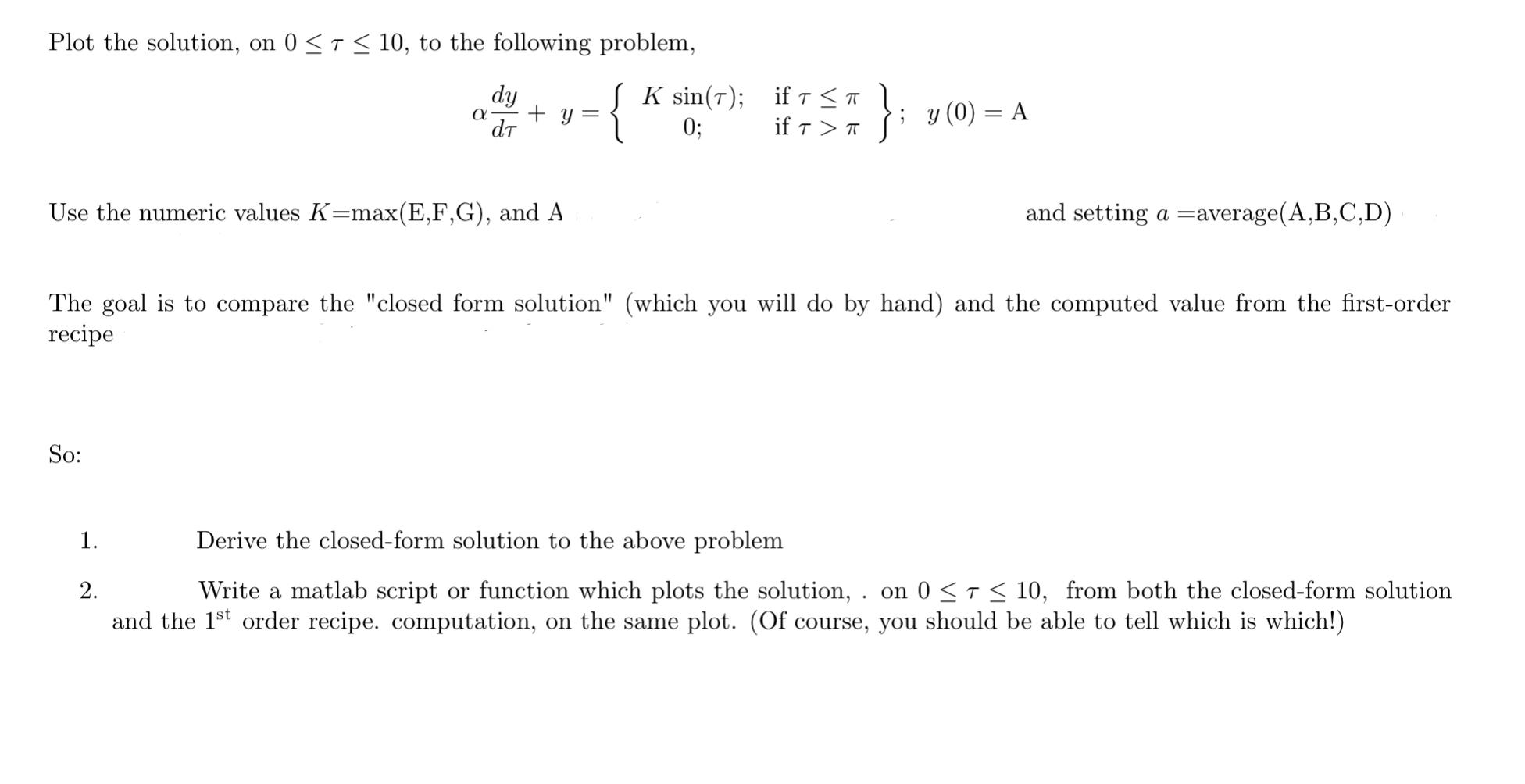
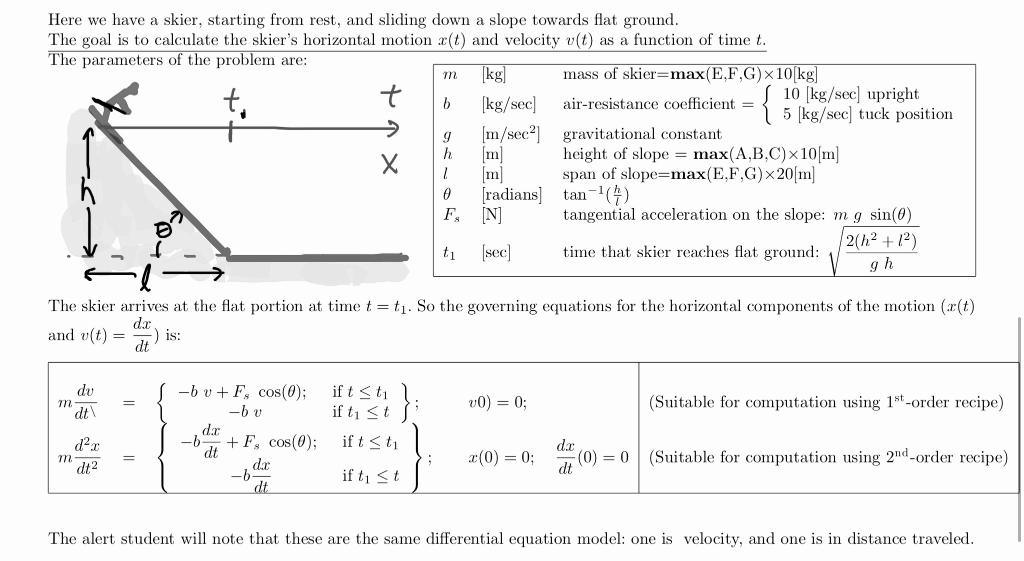
Plot the solution, on 010, to the following problem, ddy+y={Ksin();0;ifif>};y(0)=A Use the numeric values K=max(E,F,G), and A and setting a=average(A,B,C,D) The goal is to compare the "closed form solution" (which you will do by hand) and the computed value from the first-order recipe So: 1. Derive the closed-form solution to the above problem 2. Write a matlab script or function which plots the solution, . on 010, from both the closed-form solution and the 1st order recipe. computation, on the same plot. (Of course, you should be able to tell which is which!) Here we have a skier, starting from rest, and sliding down a slope towards flat ground. The goal is to calculate the skier's horizontal motion x(t) and velocity v(t) as a function of time t. The parameters of the problem are: The skier arrives at the flat portion at time t=t1. So the governing equations for the horizontal components of the motion ( x(t) and v(t)=dtdx) is: The alert student will note that these are the same differential equation model: one is velocity, and one is in distance traveled. Plot the solution, on 010, to the following problem, ddy+y={Ksin();0;ifif>};y(0)=A Use the numeric values K=max(E,F,G), and A and setting a=average(A,B,C,D) The goal is to compare the "closed form solution" (which you will do by hand) and the computed value from the first-order recipe So: 1. Derive the closed-form solution to the above problem 2. Write a matlab script or function which plots the solution, . on 010, from both the closed-form solution and the 1st order recipe. computation, on the same plot. (Of course, you should be able to tell which is which!) Here we have a skier, starting from rest, and sliding down a slope towards flat ground. The goal is to calculate the skier's horizontal motion x(t) and velocity v(t) as a function of time t. The parameters of the problem are: The skier arrives at the flat portion at time t=t1. So the governing equations for the horizontal components of the motion ( x(t) and v(t)=dtdx) is: The alert student will note that these are the same differential equation model: one is velocity, and one is in distance traveled
Step by Step Solution
There are 3 Steps involved in it

Get step-by-step solutions from verified subject matter experts
 Study Help