







Question: pls dont solve excel thanks a lot 2. (75 points) A dishwasher manufacturer is in the process of aggregate production planning for the next six
pls dont solve excel
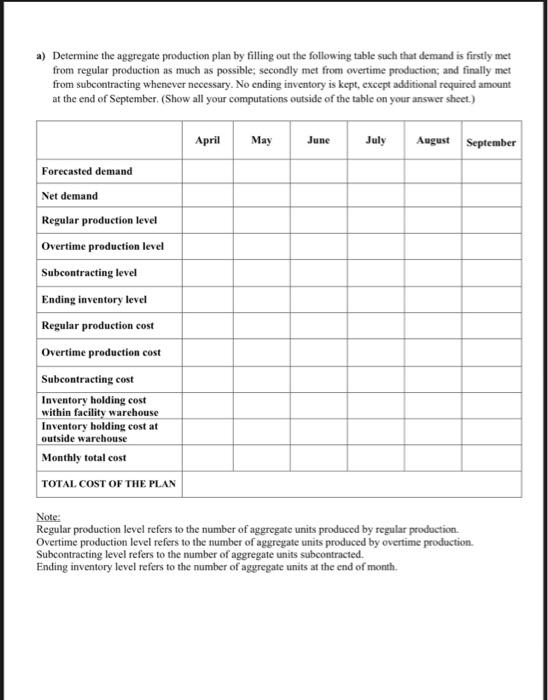
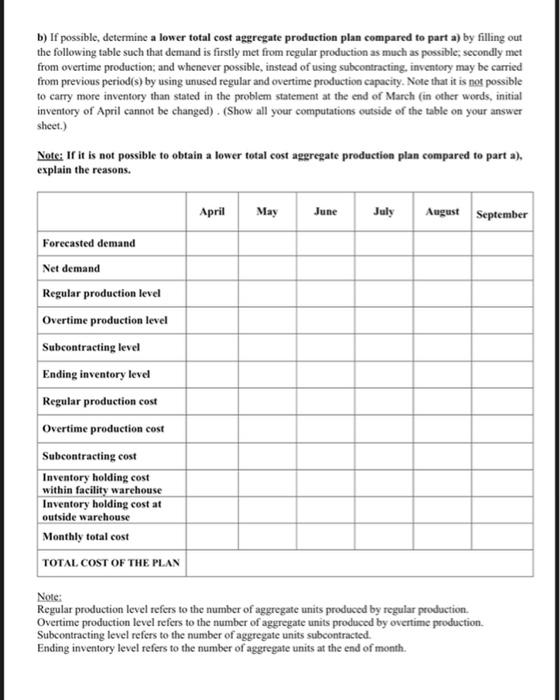
2. (75 points) A dishwasher manufacturer is in the process of aggregate production planning for the next six months. The company manufactures different models of dishwashers, and aggregates these models as an aggregated unit: "dishwasher". Currently, it is March 31. The company wants to develop an aggregate production plan from April to September. The forecasted aggregate demand for these months are DD, DDD and respectively. Suppose that there are 20 working days in cach of the 6 months ahead. Suppose that 2 hours of labor is required to produce one dishwasher. As of March 31, there are regular workers on the payroll. Suppose that it is not allowed to hire or lay-off workers as a company policy Therefore, the company will continue to have W regular workers in cach of the months over the planning horizon. Regardless of the forecasted demand, each regular worker works 10 hours per day and produces 5 dishwashers every day. It costs SRPC to produce one distrwasher using regular production, Backordering is not allowed and all demand must be met in each month. If regular production capacity is not enough to cover forecasted demand in a month, firstly, they use overtime but to do so costs them 590 per dishwasher above the regular production cost. Total overtime hours used in a month is limited by 1000 hours: equivalently, total overtime capacity is 500 units in each month. If through regular and overtime capacity, the demand is still not satisfied, they can subcontract, but to do so costs them $100 per dishwasher above the regular production cost. There is no upper bound on the number of units to be subcontracted in any month. They can use inventory, but inventory holding costs are $IC per month per dishwasher, based on the number of dishwashers in inventory at the end of the month. They have room for only 1800 dishwashers in facility Warehouse inventory, after which they must use an outside storage facility which adds another S15 per month per dishwasher to the inventory holding cost. They currently have (as of the end of March 31) L. dishwashers in facility warehouse inventory. At the end of September, the company wants to have additional 2000 units, except the forecasted demand in September (Before solving the question, select an integer value from the given interval, fill in the following table and copy only 1 & 3 columns it into your answer sheet) Parameter Interval Selected value D 15.000, 10,000 Du [5.000 10,000 D 15.000 10,000 D 15.000; 10,0001 15.000:10,0001 D 15.000 10,000 w 150; 601 D SRPC SIC 1100: 2001 15:20) 11.000 1.5001 Answer the following two parts (on the next two pages): a) Determine the aggregate production plan by filling out the following table such that demand is firstly met from regular production as much as possible, secondly met from overtime production, and finally met from subcontracting whenever necessary. No ending inventory is kept, except additional required amount at the end of September (Show all your computations outside of the table on your answer sheet.) April May June July August September Forecasted demand Net demand Regular production level Overtime production level Subcontracting level Ending inventory level Regular production cost Overtime production cost Subcontracting cost Inventory holding cost within facility warehouse Inventory holding costat outside warehouse Monthly total cost TOTAL COST OF THE PLAN Note: Regular production level refers to the number of aggregate units produced by regular production Overtime production level refers to the number of aggregate units produced by overtime production Subcontracting level refers to the number of aggregate units subcontracted. Ending inventory level refers to the number of aggregate units at the end of month. b) If possible, determine a lower total cost aggregate production plan compared to part a) by filling out the following table such that demand is firstly met from regular production as much as possible, secondly met from overtime production; and whenever possible, instead of using subcontracting, inventory may be carried from previous period(s) by using unused regular and overtime production capacity. Note that it is not possible to carry more inventory than stated in the problem statement at the end of March (in other words, initial inventory of April cannot be changed) . (Show all your computations outside of the table on your answer sheet.) Note: If it is not possible to obtain a lower total cost aggregate production plan compared to part a). explain the reasons. April May June July August September Forecasted demand Net demand Regular production level Overtime production level Subcontracting level Ending inventory levd Regular production cost Overtime production cost Subcontracting cost Inventory holding cost within facility warehouse Inventory holding cost at outside warehouse Monthly total cost TOTAL COST OF THE PLAN Note: Regular production level refers to the number of aggregate units produced by regular production Overtime production level refers to the number of aggregate units produced by overtime production Subcontracting level refers to the number of aggregate units subcontracted Ending inventory level refers to the number of aggregate units at the end of month. 2. (75 points) A dishwasher manufacturer is in the process of aggregate production planning for the next six months. The company manufactures different models of dishwashers, and aggregates these models as an aggregated unit: "dishwasher". Currently, it is March 31. The company wants to develop an aggregate production plan from April to September. The forecasted aggregate demand for these months are DD, DDD and respectively. Suppose that there are 20 working days in cach of the 6 months ahead. Suppose that 2 hours of labor is required to produce one dishwasher. As of March 31, there are regular workers on the payroll. Suppose that it is not allowed to hire or lay-off workers as a company policy Therefore, the company will continue to have W regular workers in cach of the months over the planning horizon. Regardless of the forecasted demand, each regular worker works 10 hours per day and produces 5 dishwashers every day. It costs SRPC to produce one distrwasher using regular production, Backordering is not allowed and all demand must be met in each month. If regular production capacity is not enough to cover forecasted demand in a month, firstly, they use overtime but to do so costs them 590 per dishwasher above the regular production cost. Total overtime hours used in a month is limited by 1000 hours: equivalently, total overtime capacity is 500 units in each month. If through regular and overtime capacity, the demand is still not satisfied, they can subcontract, but to do so costs them $100 per dishwasher above the regular production cost. There is no upper bound on the number of units to be subcontracted in any month. They can use inventory, but inventory holding costs are $IC per month per dishwasher, based on the number of dishwashers in inventory at the end of the month. They have room for only 1800 dishwashers in facility Warehouse inventory, after which they must use an outside storage facility which adds another S15 per month per dishwasher to the inventory holding cost. They currently have (as of the end of March 31) L. dishwashers in facility warehouse inventory. At the end of September, the company wants to have additional 2000 units, except the forecasted demand in September (Before solving the question, select an integer value from the given interval, fill in the following table and copy only 1 & 3 columns it into your answer sheet) Parameter Interval Selected value D 15.000, 10,000 Du [5.000 10,000 D 15.000 10,000 D 15.000; 10,0001 15.000:10,0001 D 15.000 10,000 w 150; 601 D SRPC SIC 1100: 2001 15:20) 11.000 1.5001 Answer the following two parts (on the next two pages): a) Determine the aggregate production plan by filling out the following table such that demand is firstly met from regular production as much as possible, secondly met from overtime production, and finally met from subcontracting whenever necessary. No ending inventory is kept, except additional required amount at the end of September (Show all your computations outside of the table on your answer sheet.) April May June July August September Forecasted demand Net demand Regular production level Overtime production level Subcontracting level Ending inventory level Regular production cost Overtime production cost Subcontracting cost Inventory holding cost within facility warehouse Inventory holding costat outside warehouse Monthly total cost TOTAL COST OF THE PLAN Note: Regular production level refers to the number of aggregate units produced by regular production Overtime production level refers to the number of aggregate units produced by overtime production Subcontracting level refers to the number of aggregate units subcontracted. Ending inventory level refers to the number of aggregate units at the end of month. b) If possible, determine a lower total cost aggregate production plan compared to part a) by filling out the following table such that demand is firstly met from regular production as much as possible, secondly met from overtime production; and whenever possible, instead of using subcontracting, inventory may be carried from previous period(s) by using unused regular and overtime production capacity. Note that it is not possible to carry more inventory than stated in the problem statement at the end of March (in other words, initial inventory of April cannot be changed) . (Show all your computations outside of the table on your answer sheet.) Note: If it is not possible to obtain a lower total cost aggregate production plan compared to part a). explain the reasons. April May June July August September Forecasted demand Net demand Regular production level Overtime production level Subcontracting level Ending inventory levd Regular production cost Overtime production cost Subcontracting cost Inventory holding cost within facility warehouse Inventory holding cost at outside warehouse Monthly total cost TOTAL COST OF THE PLAN Note: Regular production level refers to the number of aggregate units produced by regular production Overtime production level refers to the number of aggregate units produced by overtime production Subcontracting level refers to the number of aggregate units subcontracted Ending inventory level refers to the number of aggregate units at the end of month
thanks a lot 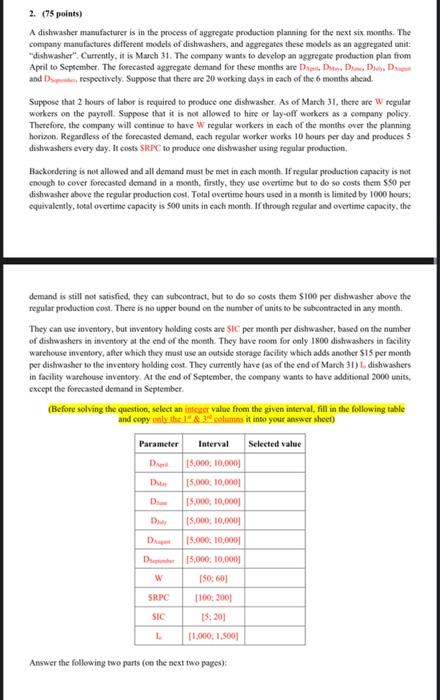
Step by Step Solution
There are 3 Steps involved in it
1 Expert Approved Answer
Step: 1 Unlock

Question Has Been Solved by an Expert!
Get step-by-step solutions from verified subject matter experts
Step: 2 Unlock
Step: 3 Unlock
 Study Help