







Question: pls help 1st drop down options 2nd 3rd Whitaker Company produces two models of blenders for restaurants: the Super Model (priced at $396) and the
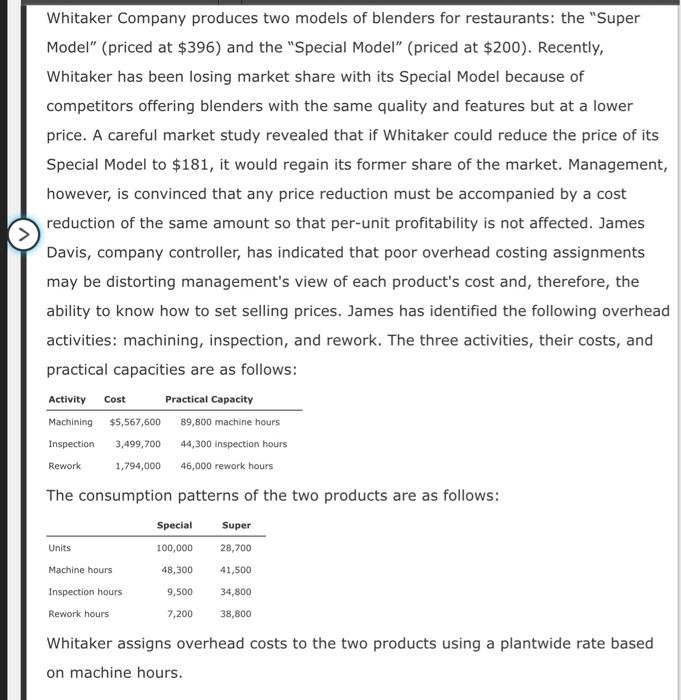
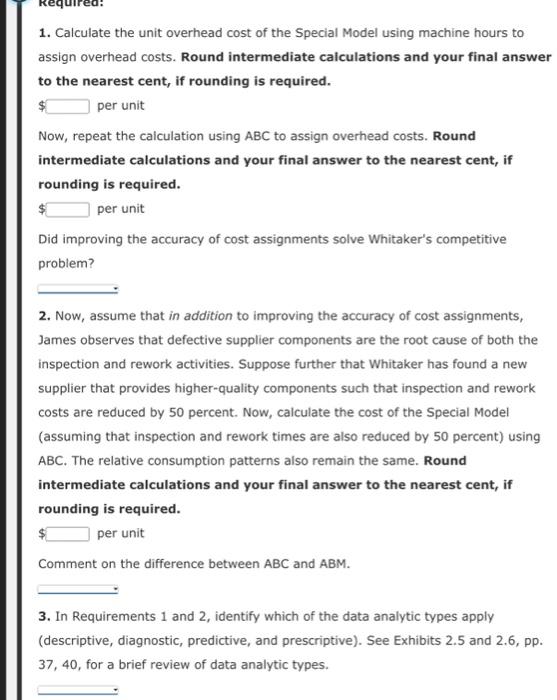
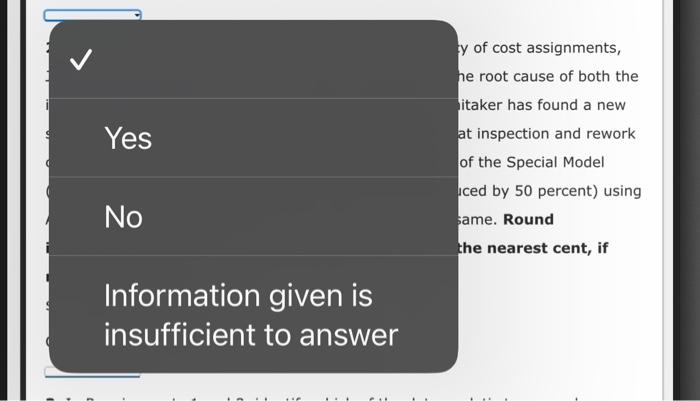
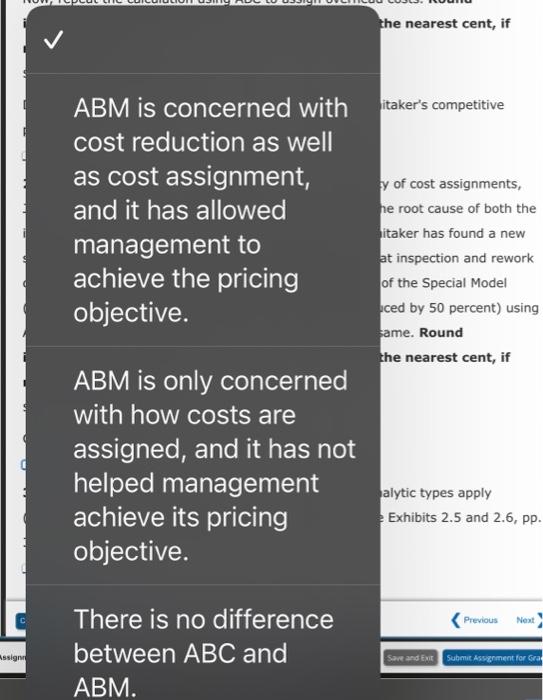
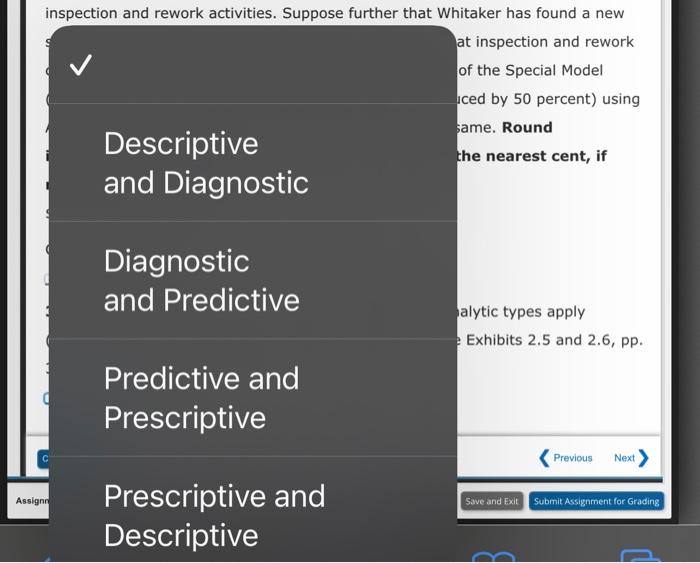
Whitaker Company produces two models of blenders for restaurants: the "Super Model" (priced at \$396) and the "Special Model" (priced at \$200). Recently, Whitaker has been losing market share with its Special Model because of competitors offering blenders with the same quality and features but at a lower price. A careful market study revealed that if Whitaker could reduce the price of its Special Model to $181, it would regain its former share of the market. Management, however, is convinced that any price reduction must be accompanied by a cost reduction of the same amount so that per-unit profitability is not affected. James Davis, company controller, has indicated that poor overhead costing assignments may be distorting management's view of each product's cost and, therefore, the ability to know how to set selling prices. James has identified the following overhead activities: machining, inspection, and rework. The three activities, their costs, and practical capacities are as follows: The consumption patterns of the two products are as follows: Whitaker assigns overhead costs to the two products using a plantwide rate based on machine hours. 1. Calculate the unit overhead cost of the Special Model using machine hours to assign overhead costs. Round intermediate calculations and your final answer to the nearest cent, if rounding is required. $ per unit Now, repeat the calculation using ABC to assign overhead costs. Round intermediate calculations and your final answer to the nearest cent, if rounding is required. 4 per unit Did improving the accuracy of cost assignments solve Whitaker's competitive problem? 2. Now, assume that in addition to improving the accuracy of cost assignments, James observes that defective supplier components are the root cause of both the inspection and rework activities. Suppose further that Whitaker has found a new supplier that provides higher-quality components such that inspection and rework costs are reduced by 50 percent. Now, calculate the cost of the Special Model (assuming that inspection and rework times are also reduced by 50 percent) using ABC. The relative consumption patterns also remain the same. Round intermediate calculations and your final answer to the nearest cent, if rounding is required. $ per unit Comment on the difference between ABC and ABM. 3. In Requirements 1 and 2, identify which of the data analytic types apply (descriptive, diagnostic, predictive, and prescriptive). See Exhibits 2.5 and 2.6, pp. 37,40 , for a brief review of data analytic types. of cost assignments, he root cause of both the itaker has found a new at inspection and rework of the Special Model iced by 50 percent) using same. Round the nearest cent, if ABM is concerned with cost reduction as well as cost assignment, and it has allowed management to achieve the pricing objective. ABM is only concerned with how costs are assigned, and it has not helped management achieve its pricing objective. There is no difference between ABC and ABM. inspection and rework activities. Suppose further that Whitaker has found a new at inspection and rework of the Special Model iced by 50 percent) using Descriptive same. Round and Diagnostic Diagnostic and Predictive alytic types apply Exhibits 2.5 and 2.6, pp. Predictive and Prescriptive Prescriptive and Descriptive
Step by Step Solution
There are 3 Steps involved in it

Get step-by-step solutions from verified subject matter experts
 Study Help