







Question: Pls help. I need help with the Forecasts for the Company CVS for 2020. Please help with Number 1 | ONGOING ANALYSIS PROJECT This ongoing
Pls help. I need help with the Forecasts for the Company CVS for 2020. Please help with Number 1
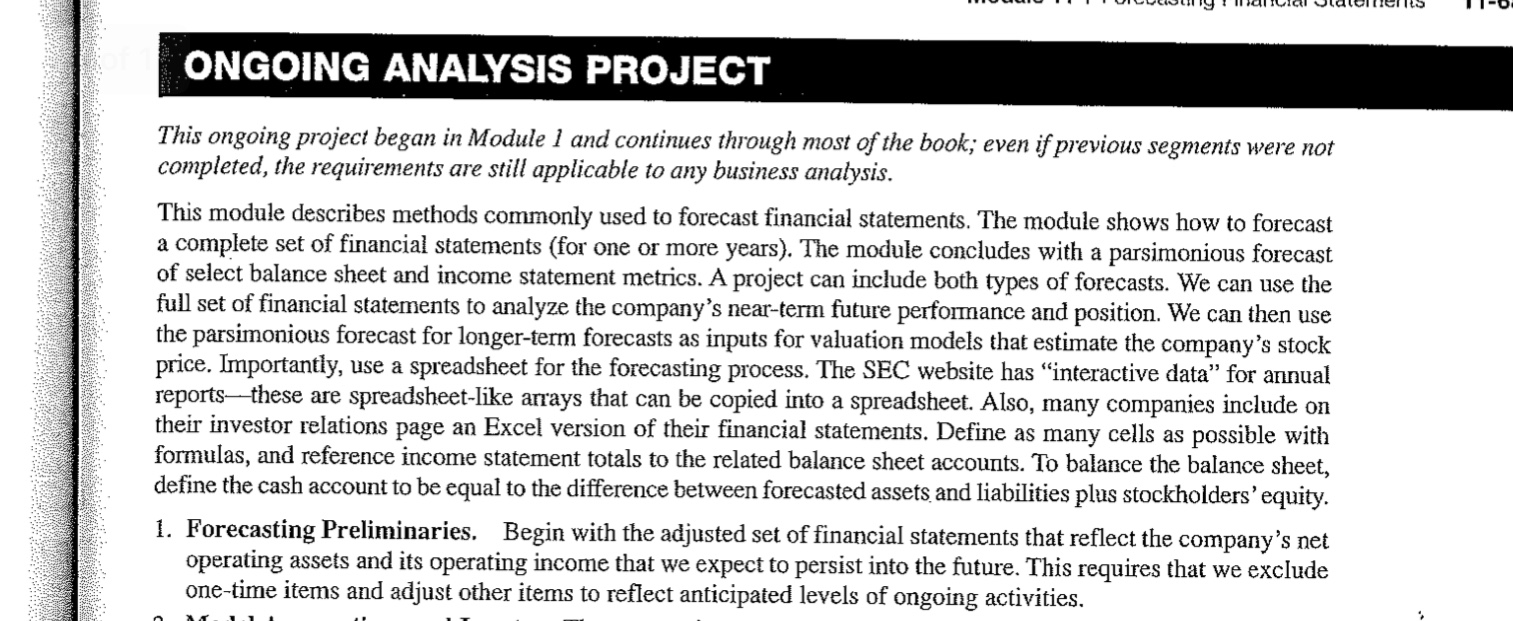
| ONGOING ANALYSIS PROJECT This ongoing project began in Module 1 and continues through most of the book; even if previous segments were not completed, the requirements are still applicable to any business analysis. This module describes methods commonly used to forecast financial statements. The module shows how to forecast a complete set of financial statements (for one or more years). The module concludes with a parsimonious forecast of select balance sheet and income statement metrics. A project can include both types of forecasts. We can use the full set of financial statements to analyze the company's near-term future performance and position. We can then use the parsimonious forecast for longer-term forecasts as inputs for valuation models that estimate the company's stock price. Importantly, use a spreadsheet for the forecasting process. The SEC website has "interactive data" for annual reports, these are spreadsheet-like arrays that can be copied into a spreadsheet. Also, many companies include on their investor relations page an Excel version of their financial statements. Define as many cells as possible with formulas, and reference income statement totals to the related balance sheet accounts. To balance the balance sheet, define the cash account to be equal to the difference between forecasted assets and liabilities plus stockholders' equity. 1. Forecasting Preliminaries. Begin with the adjusted set of financial statements that reflect the company's net operating assets and its operating income that we expect to persist into the future. This requires that we exclude one-time items and adjust other items to reflect anticipated levels of ongoing activities. | ONGOING ANALYSIS PROJECT This ongoing project began in Module 1 and continues through most of the book; even if previous segments were not completed, the requirements are still applicable to any business analysis. This module describes methods commonly used to forecast financial statements. The module shows how to forecast a complete set of financial statements (for one or more years). The module concludes with a parsimonious forecast of select balance sheet and income statement metrics. A project can include both types of forecasts. We can use the full set of financial statements to analyze the company's near-term future performance and position. We can then use the parsimonious forecast for longer-term forecasts as inputs for valuation models that estimate the company's stock price. Importantly, use a spreadsheet for the forecasting process. The SEC website has "interactive data" for annual reports, these are spreadsheet-like arrays that can be copied into a spreadsheet. Also, many companies include on their investor relations page an Excel version of their financial statements. Define as many cells as possible with formulas, and reference income statement totals to the related balance sheet accounts. To balance the balance sheet, define the cash account to be equal to the difference between forecasted assets and liabilities plus stockholders' equity. 1. Forecasting Preliminaries. Begin with the adjusted set of financial statements that reflect the company's net operating assets and its operating income that we expect to persist into the future. This requires that we exclude one-time items and adjust other items to reflect anticipated levels of ongoing activities
Step by Step Solution
There are 3 Steps involved in it

Get step-by-step solutions from verified subject matter experts
 Study Help