







Question: pls help me answer the following questions 1. INSTRUCTION: Select the correct answer for each of the following questions. Write your answer on a separate
pls help me answer the following questions
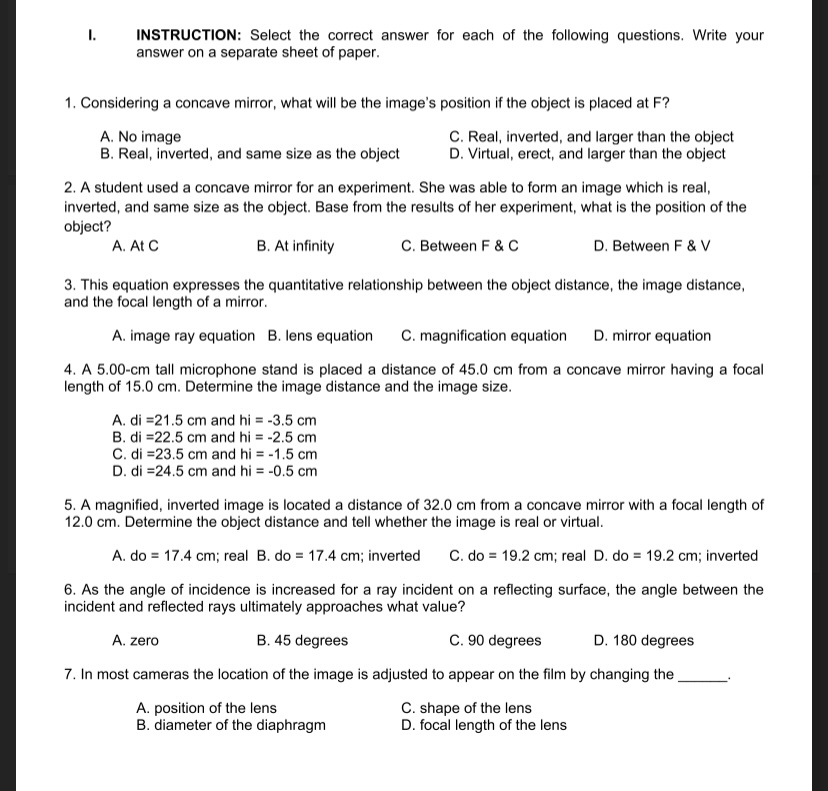
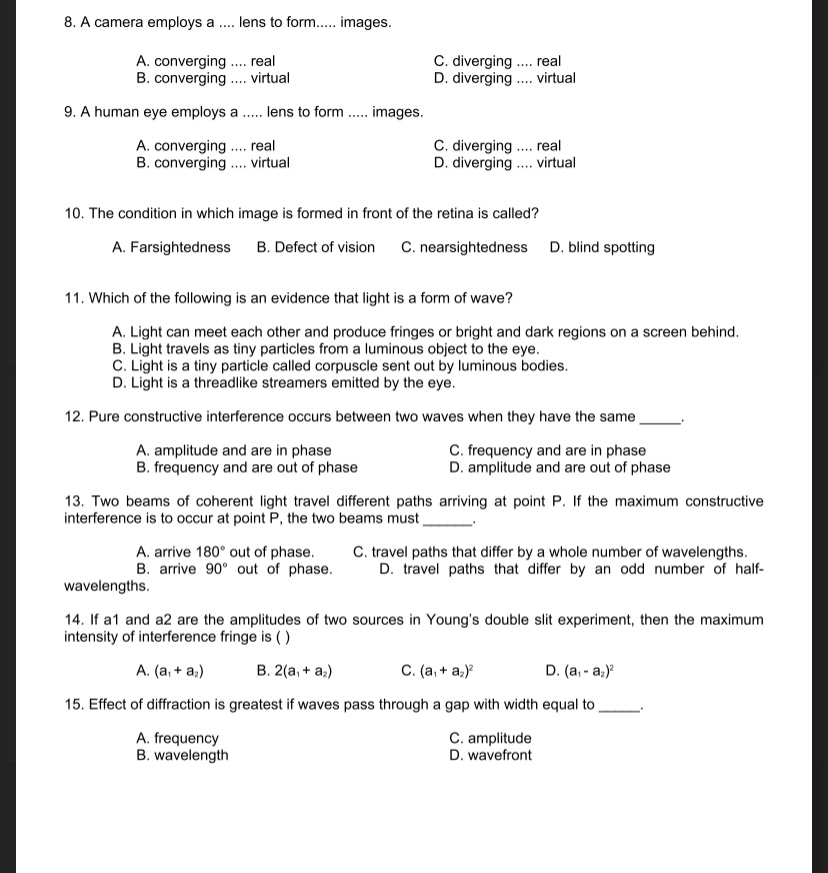
1. INSTRUCTION: Select the correct answer for each of the following questions. Write your answer on a separate sheet of paper. 1. Considering a concave mirror, what will be the image's position if the object is placed at F? A. No image C. Real, inverted, and larger than the object B. Real, inverted, and same size as the object D. Virtual, erect, and larger than the object 2. A student used a concave mirror for an experiment. She was able to form an image which is real, inverted, and same size as the object. Base from the results of her experiment, what is the position of the object? A. At C B. At infinity C. Between F & C D. Between F & V 3. This equation expresses the quantitative relationship between the object distance, the image distance, and the focal length of a mirror. A. image ray equation B. lens equation C. magnification equation D. mirror equation 4. A 5.00-cm tall microphone stand is placed a distance of 45.0 cm from a concave mirror having a focal length of 15.0 cm. Determine the image distance and the image size. A. di =21.5 cm and hi = -3.5 cm B. di =22.5 cm and hi = -2.5 cm C. di =23.5 cm and hi = -1.5 cm D. di =24.5 cm and hi = -0.5 cm 5. A magnified, inverted image is located a distance of 32.0 cm from a concave mirror with a focal length of 12.0 cm. Determine the object distance and tell whether the image is real or virtual. A. do = 17.4 cm; real B. do = 17.4 cm; inverted C. do = 19.2 cm; real D. do = 19.2 cm; inverted 6. As the angle of incidence is increased for a ray incident on a reflecting surface, the angle between the incident and reflected rays ultimately approaches what value? A. zero B. 45 degrees C. 90 degrees D. 180 degrees 7. In most cameras the location of the image is adjusted to appear on the film by changing the A. position of the lens C. shape of the lens B. diameter of the diaphragm D. focal length of the lens8. A camera employs a lens to form ..... images. A. converging reel C. diverging reel B. converging virtual D. diverging virtual 9. A human eye employs a lens to form ..... images. A. converging real C. diverging real 3. converging virtual D. diverging virtual 1D. The condition in which image is formed in front of the retina ls called? A. Farsightedness B. Defect of vision C.nearsightedness D. blind spotting 11. Which of the following is an evidence that light is a form of wave? A. Light can meet each other and produce fringes or bright and clerk regions on a screen behind. E. Light travels as tiny particles from a luminous object to the eye. C. Light is a tiny particle called ccrpuscle sent out by luminous bodies. D. Light is a threadllite streamers emitted by the eye. 12. Pure constructive Interference occurs between two waves when they have the same A. amplitude and are in phase 0. frequency and are in phase El. frequency and are out of phase L'l. amplitude and are out of phase 13. Two beams of coherent light travel different paths arriving at point P. It the maximum constructive interference Is to occur at point P. the two beams must A. arrive mm out or phase. c. travel paths that differ by a whole number of wavelengths. B. an'ive 90" out of phase. D. travel paths that differ by an odd number of half- wavelengths. 14. If a1 and e2 are the amplitudes of two sources in Young's double slit experiment. then the maximum intensity of interference fringe is l l A. (51+ 5:} B. 21:81 'I' as} C. {a1+ as}? D. (at ' a1}: 15. Effect of diffraction is greatest i1 waves pass through a gap with width equal to . A. frequency (3. amplitude B. wavelength D. wavefront
Step by Step Solution
There are 3 Steps involved in it

Get step-by-step solutions from verified subject matter experts
 Study Help