Question: pls help this for English class help me ole FEDUARY 27. 2O17 ISSUE DOOKS WHY FACTS DON'T CHANGE OUR MINDS New discoveries about the buman
pls help this for English class help me ole

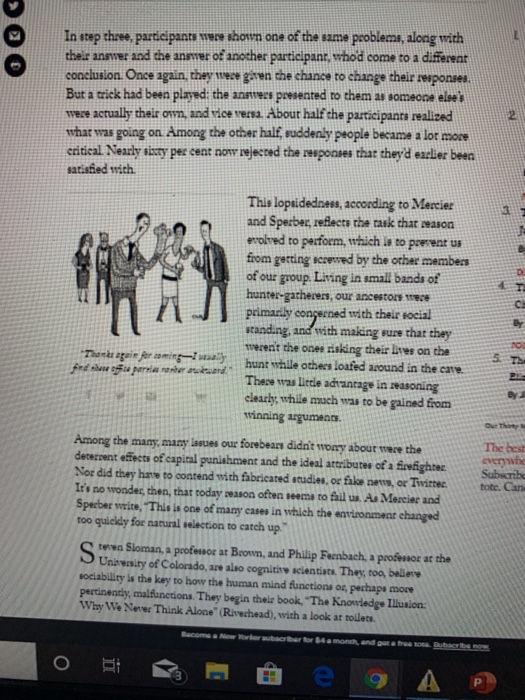
FEDUARY 27. 2O17 ISSUE DOOKS WHY FACTS DON'T CHANGE OUR MINDS New discoveries about the buman mind sbow the limitations of reason. The teunnd buman capaciny for reason may baow mara re de wirh suinning. nbinking smraigba. d tu ahnion 1975, researchers at Stanford imvited a group of undergraduates to take part in a study about suicide. They were presented with pairs of suicide notes. In each pair, one note had been composed by a random individual, the other by a person who had subsequently taken his own Life. The students were then asked to distinguish berween the genuine notes and the fake ones. I; Some students discovered that they had a genius for the task Out of twenry- five pairs of notes, they correctly identified the real one rwenty-four times. Others discovered that they were hopeless. They identified the real note in only ten instances. As is often the case with psychological studies, the whole serup was a put-on. Though half the notes were indeed genuine-they'd been obtained from the Los Angeles County coroner's office-the scores were fictitious. The students whod been told they were almost akways right were, on average, no more discerning than those who had been told they were mostly wrong. In the second phase of the study, the deception ws revealed. The students were told that the real point of the experiment was to gauge their responses to thinking they were right or wrong. (This, it rumed out, was also a deception.) Finally, the students were asked to estimate how many suicide notes they had actually categorized correctly, and how many they thought an aerage student ger right. Ar this point, something curious happened. The srudents in the high-score group said that they thought they had, in fact, done quite well- significantly better than the average student-even though, as they'd just been told, they had zero grounds for believing this. Comersely, those whod been assigned to the low-score group said that they thought they had done significantly worse than the average student-a conclusion thar was ecqually unfounded. would "Once formed," the researchers observed dryly, "impressions are remarkably perseverant" Get and Mal A few years larer, a new set of Stanford students was recruited for a related study. The srudents were handed packets of information about a pair of firefighters, Frank K. and George H Franks bio noted that, among other things, he had a baby daughter and he liked to scuba dive. George had a small son and played golf The packets also included the mens responses on what the researchers called the Risky-Conservative Choice Test. According to one version of the packet, Frank was a successful firefighter who, on the test, almost always went with the safest option. In the other version, Frank also chose the safest option, but he was a lousy firefighter who'd been pur "on report by his supervisore several times. Once again, midway through the study, the students were informed that they'd been misled, and that the information they'd receired was entirely fictitious. The students were then asked to describe their owm beliefs. What sort of attitude toward risk did they think a successful firefighrer would have? The students who'd received the first packet thought that he would avoid it. The students in the second group thought he'd embrace it. Even after the evidence "for their beliefs has been totally refuted, people fail to make appropriate revisions in those beliefs," the sfsearchers noted. In this case, the failure was "particularly impressive," since rwo data points would nerer have been enough information to generalize from. The Stanford studies became famous. Coming from a group of academics in the nineteen-seventies, the contention that people can't think straight wvas shocking. It isn't any longer. Thousands of subsequent esperiments have confirmed (and elaborated on) this finding. As everyone who's followed the research-or even occasionally picked up a copy of Payvbalogy Today-knows, any graduate student with a clipboard can demonstrate that reasonable-seeming people are often totally irrational Rarely has this insight seemed more relevant than it does right now. Still, an essential puzzle remains: How did we come to be this way? na new book, The Enigma of Reason Harad, the cognirecientien Hugo Mercier and Dan Sperber take a stab at aneecing this question Meccier who torks ar a French research institute in Lvon, and Sperber, now based at the Cenral European Univenity, in Budapesc, point our that reason a an evolved trait, like bipedalism or three-color vision. It emerged on the 1rannas of Africa, and has to be understood in that contet I Stripped of a lot of whar might be called cognicive-science-ese, Mercier and Sperber's argumenr runs, more or less, as follows: Humans' biggest adrantage orer other species is our ability to cooperaze. Cooperation is difcult to establish and almost as difficult to sustain. For any individual, freeloading is always the best course of action. Reason dereloped not to enable us to soite abetract, logical problems or even to help us draw conclusions from unfamiliar dara rather, it developed to resole the problems posed by iving in colaborative sdnoa Reason is an adapration to the hypersocial niche humans have erolved for themselves, "Mercier and Sperber wzite. Habits of mind that seem weird or goofy or just plain dumb fiom an "inrelacnualist point of view prove shrend when seen from a social "inteactionist perspectie Consider whar's become known as "oconfirmation bias," the tendeney people have to embrace information that supports their beliefs and reject information that contradicts them. Of the many forma of faulty thinking that have been identified, confirmation bias is among the best catalogued; its the subject of entire testbooka orth of erpeciments. One of the most famous of these waa conducted, again, at Stanford. For this especiment, researchers zounded up a group of students who had opposing opinions abour capital punishment. Half the students wece in fanoe of it and thought that it detened crime; the other half wece againat it and thought that it had no effect on crime The students wece asked to respond to wo srudies. One provided data in Bupport of the detesence argument, and the other provided dara that called ir into question Both studiesvou guessed inwere made up, and had been designed to pesent what wee, objectively peaking equally compelling atatistics The students who had orig nally pupported capital punishmeet cared the peo-decersecce dara highly credible and the anti-dereence data half were against it and thought that it had no effect on crime. The students were asked to respond to wo studies. One provided data in support of the deterrence argument, and the other proided data that called it into question. Both studies-you guessed itvere made up, and had been designed to present whar were, objectively speaking, equally compelling statistics. The srudents who had originally supported capital punishment rated the pro-deterrence data highly credible and the anti-deterrence data uncomvincing, the students who'd originally opposed capital punishment did the reverse. Ar the end of the experiment, the students were asked once again about their views. Those who'd started out pro-capital punishment were now even more in favor of it, those who'd opposed it were even more hostile. 2. If reason is designed to generate sound judgments, then it's hard to conceive of a more serious design flaw than confirmation bias. Imagine, Mercier and Sperber suggest, a mouse that thinks the way we do. Such a mouse, "bent on confirming its belief that there are no cars around," would soon be dinner To the extent that confirmation bias leads people to dismiss evidence of new or 3. underappreciated threats-the human equivalent of the cat around the corner t's a trait that should have been selected againat. The fact that both we and it survive, Mercier and Sperber argue, proves thar imust have some adaptive function, and thar function, they maintain, is relared to our "hypersociabiliry" Mercier and Sperber prefer the term "myside bias."Humans, they point out, aren't randomly credulous. Presented with someone else's argument, wee quite adepr at spotting the weaknesses. Almost invariably, the positions we're blind about are our own. Our Thit The b cveryw Subscri tote. C A recent esperiment performed by Mercier and some European colleagues neatly demonstrates this asymmetry. Participants were asked to anawer a secies of simple reasoning problems. They wece then asked to eplain their seeponaes, and were given a chance to modify them if they identified mistakes. The majority were satisfied with their original choices; fewer than fifteen per cent changed their minds in step rwo. MOE EBOM THT itn In step three, participants ere shown one of the same problems, along with their answer and the answer of another participanr, whod come to a different conclusion. Once again, they wece garen the chance to change their responses. But a trick had been played: the answers presented ro them as someone else's were actually their own, and vice versa. About half the participanrs realized whar was going on Among the other half suddenly people became a lor more critical. Nearly sixty per cent now rejected the responses thatr they'd earlier been satisfied with. This lopsidedness, according to Mercier and Sperber, reflects the cask thar reason erolved to perform, which is to prerent Us from getting screwed by the other members of our group. Living in small bands of hunter-gatherers, our ancestors wece primarily congerned with their social standing, and with making sure that they werenit the ones risking their lives on the hunt while others loafed around in the cave. Thanks again fer caming-aaiy fed shene fu perria ranber aukuard." Thece was lirtle advanrage in wasoning clearly, while much was to be gained from 1winning arguments. By OuThy The best everyahe Subsribe tote. Can Among the many, many issues our forebears didn't wony about were the deterrent effects of capital punishment and the ideal artributes of a firefighter Nor did they hae to contend with fabricated studies, or fake nes, or Twitec It's no wonder, then, that today reason often seema to fail us. As Mercier and Sperber write, "This is one of many cases in which the environmenat changed too quickdy for natural selection to catch up." teren Sloman, a professor at Brown, and Philip Fernbach, a professor at the Univeniry of Colorado, are also cognitive scientiats. They, too, beliere sociabiliry is the key to how the human mind functions or, pechape more pertinently, malfunetions. They begin their book, "The Knowledge Illusion: Why We Never Thnk Alone" (Riverhead), with a look at toilets. RecomeaNw Yorkersubacrber for $4a monch, and ta free soea Bubacrbe now OF Creaerd Video agane mer Cartoona Fietion a Poetry Beola Cuture ciearry, wnue muen was to De gainea rom winning arguments. Among the many, many issues our forebears didn't worry about were the deterrent effects of capital punishment and the ideal attributes of a firefighter Nor did they have to contend with fabricated studies, or fake ne1s, or Twitter. It's no wonder, then, that today reason often seems to fail us. As Mercier and Sperber write, "This is one of many cases in which the environment changed too quickly for natural selection to catch up." teren Sloman, a professor at Brown, and Philip Fernbach, a professor at the S University of Colorado, are also cognitive scientists They, too, believe sociability is the key to how the human mind functions or, perhaps more pertinently, malfunctions. They begin their book, "The Knowledge Illusion: Why We Never Think Alone" (Riverhead), with a look at toilecs. Virtually everyone in the United States, and indeed throughout the dereloped wold, is familiar with toilets. A sypical flush toiler has a ceramic bowi filled with water When the handle is depressed, or the burron pushed, the water- and everything that's been deposited in ir-gets sucked into a pipe and from there into the sewage system. But how does this aenually happen? In a study conducted at Yale, graduate snudents were asked to rate their understanding of ereryday devices, including toilets, zippers, and cylinder locks. They were then asked to write detailed, step-by-step esplanations of how the derices work, and to rate their understanding again. Apparently, the effort revealed to the srudents their own ignorance, because their self-assessments dropped. (Toileta, it tums out, are more complicated than they appear) Sloman and Fernbach see this effect, which they call the "illusion of esplanatory depth," just about ererywhere. People beliere that they know way moe than they actually do. What allows us to peniat in this belief is other people. In the case of my toilet, someone elae designed it so that I can operate it easily. This is something humana are very good ar. We've been selying on one another's eccpertise ever since we figured out how to hunt together, which was probably a kay development in our evolutionary history. So well do we collaborare, Sloman and Fernbach argue, that we can hardly tell where our own understanding ends and othern' begina. "One imali.. Magasine Mumer &Catena Fiston & Poaty Booia Cuture Newa SmremeTann n mo ararta mas rmt a m fanre DPAnS e and others begins. "One implication of the naturalness with which we divide cognitive labor," they write, is that there's "no sharp boundary between one personis ideas and knowledge" and "those of other members" of the group. This borderlessness, or, if you prefer, confusion, is also crucial to whar we consider progress. As people invented new tools for new ways of living, they simultaneously created new realms of ignorance; if everyone had insisted on, say, mastering the principles of metalworking before picking up a knife, the Bronze Age wouldn't have amounted to much. When it comes to new technologies, incomplete understanding is empowering CO IT Where it gets us into trouble, according to Sloman and Fernbach, is in the political domain. It's one thing for me to flush a toiler without knowing howit operates, and another for me to favor (or oppose) an immigration ban without knowing what I'm talking about. Sloman and Fermbach cite a survey conducted in 2014, not long after Russia anneced the Ukrainian territory of Crimea. Respondents were asked how they thought the U.S. should react, and also whether they could identify Ukraine on a map The farther off base they were abour the geography, the more likely they were to favor military intervention (Respondents were so unsure of Ukraine's location that the median guess was wrong by eighreen hundred miles, roughly the distance from Kiev to Madrid.) Surveys on many other issues have yielded similarly dismaying results. "As a rule, strong feelings abour issues do not emerge from deep understanding Sloman and Fernbach write. And here our dependence on other minds reinforces the problem. If your position on, say, the Affordable Care Act is baseless and I rely on it, then my opinion is also baseless. When I ralk to Tom and he decides he agrees with me, his opinion is also baseless, bur now that the three of us concur we feel that much more smug about our views. If we all now diamiss as uncomincing any infomation that contradicts our opinion, you get, well, the Trump Administration. Cre "This is how a community of knowledge can become dangerous," Sloman and Fernbach observe. The rwo have performed their own version of the toilet experiment, subetituting public policy for household gadgers. In a srudy conducted in 2012, they asiked people for their stance on questions like: Should there be a single-payer health-care system Or merit-based pay for teachees Participants were asked to rate their positions depending on how strongly they agreed or disagreed with the proposals. Nest, they were instructed to eplain, in 2s much detail as they could, the impacts of implementing each one. Mosr people ar this point ran into trouble. Asked once again to rate their viens, they rateheted down the intenairy, so that they either agreed or disagreed less vehemently Sloman and Fernbach see in this result a lirle candle for a dark world. If we or our friends or the pundits on CNN-spent less time pontificating and more trying to work through the implicationa of policy proposals, ed realize how clueless we are and moderate our vies This, they write, "may be the only form of thinking that will sharter the illusion of eplanarory depth and change people's artirudes." O ne way to look at science is as a sywtem that corrects for peoples narural inclinations In a well-run laboratory, theres no room for myside bias, the rOvulta have to be zeproducible in other laborarories, by sesearchere who have no motive to confirm them. And this, it could be agued, is why the system has prored so succesfial At any given moment, a field may be dominated by squabbles, bur, in the end, the methodology prevaila. Science moves forward, eren as we remain stuck in place. In Denying to the Grave: Why W% Ignore the Facta That Will Save U (Orfoed). Jack Gorman, a peychiatrist, and his daughtes, Sara Gorman, a public-health specialiat, probe the gap bewen what science tella us and what we tell ourselves. Their concerm la with those pesiatent beliefn which are not juat demonstrably false but also potentially deadly, like the comiction that vaccines are hazardous. Of course, what's hazardous la mat being vaccinated; that's why vaccines were coeated in the first place. "Immunization is one of the triumphs of modem medicine," the Gormana note. Bur no marter how many scientific studies conclude that vaccines are safe, and that there's no link berween immunizationa and autiam, anti-vazcers remain unmoved. (They can now count on their side-ort of-DonaldTrump, who has said that, although ne way to look at science is as a system that corrects for people's natural inclinations. In a well-run laboratory, there's no room for myside bias; the results have to be reproducible in other laboratories, by researchers who have no motive to confirm them. And this, it could be argued, is why the system has proved so successful Ar any given moment, a field may be dominated by squabbles, but, in the end, the methodology prevails. Science moves forward, even as we remain stuck in place. In Denying to the Grave: Why We Ignore the Facrs Thar Will Save Us (Osford), Jack Gorman, a psychiatrist, and his daughrer Sara Gorman, a public-health specialist, probe the gap berween whar science tells us and whar me rell ourselves. Their concern is with those persistent beliefs which are not just demonatrably false but also porentially deadly, like the comiction that vaccines are hazardous. Of course, what's hazardous is mer being vaccinated; that's why vaccines 1ere creared in the first place. "Immunization is one of the triumphs of modem medicine," the Gomans note. Bur no matter how many scientific studies conclude that vaccines are safe, and that there's no link nor berween immunizations and autism, anti-aes remain unmoved. (They can now count on their side-sort of-Donald Trump, who has said that, although he and his wife had their son, Barron, vaccinared they refused to do so on the timetable recommended by pediatricians.) The Gormana, too, argue thar ways of thinking thar now seem self-destructive muat at some point have been adaptive. And they, too, dedicate many pages to confirmation bias, which, they claim, has a physiological component. They cite research suggesting that people esperience genuine pleanurea rush of dopaminevhen processing information that supports their beliefs. "It feela good to 'stick to our guna' even if we are wrong," they observe The Gormana don't just want to catalogue the ways we go waong, they want to correct for them. There must be some way, they maintain, to comince people that vaccines are good for kids, and handguna are dangerous. (Another widespread but staristically inaupportable bellef they'd Like to discoedit is that onvning a gun makes you safer) But here they encounter the very problema they have enumerated. Providing people with aceurate information doesn't seem to help; they simply discount it. Appealing to their emotiona may work better, bur doing so is obrioualy antithetical to the goal of promoting sound science. The challenge that cemaina," they write toward the end of their book. ia to figure cot bor to addren the rendancies that lead to falee scientifc belief ecomea Nw Yorer ubcrber tor $4a mon and gera treeo tacrtenow Cre nd Padcast Magane Vides Fietion Peety Mumer Carteena DeolaCue In Denying to the Grave: Why We Ignore the Facts That Will Save Us (O:ford). Jack Gorman, a prychiatrist, and his daughter Sara Gorman, a public-health specialist, probe the gap benveen what science tells us and whar te tell ourselves. Their concern is with those persistent beliefs which are not just demonstrably false bur also potenrially deadly, like the comviction that vaccines are hazardous. Of course, what's hazardous is mer being vaccinared; that's why vaccines were created in the first place "Immunization is one of the triumpha of modem medicine," the Gormans note. But no matter how many scientific studies conclude that vaccines are safe, and that thece's no link berween immunizations and autism, anti-vcers remain unmoved (They can CO now count on their side-sort of-Donald Trump, who has said that, although he and his wife had their son, Barron, vaccinated, they refused to do so on the timetable recommended by pediatriciana.) The Gormans, too, argue that ways of thinking thar now seem self-destructive must at some point have been adaptive. And they, too, dedicate many pages to confirmation bias, 1which, they claim, has a physiological component. They cire research suggesting that people esperience genuine pleasure naah of dopaminewhen processing information that supports their beliefa. Ir feels good to 'stick to our guns' even if we are wrong," hey observe. The Gormans don't just want to catalogue the ways we go wzong; they want to correct for them. There must be some way, they maintain, to comince people that vaccines are good for kids, and handguns are dangerous. (Anothec widespread but statistically insupportable belief they'd like to discredit ia thar ovning a gun makes you safee) Bur here they encounter the very problema they hare enumerated. Providing people with accurate information doean't seem to help, they simply discount it. Appealing to their emotions may work better, bur doing so la obviously antithetical to the goal of promoting sound science "The challenge that pemaina," they write toward the end of their book "la to figure out how to address the tendencies that lead to false scientific belief" The Enigma of Reason.""The Knowiedge Illusion."and "Denying to the Grave"were all written before the November election And yet they anticipate Kellyanne Comvay and the rise of alternative facte. "These days, it can feel as if the entice country has been given over to a vast paychological epeciment being run either by no one or by Stere Bannon. Rational agents would be able to think their way to a solution But, on this marrer, the literature is not reassuring, Discussion Forum Read the New Yorker article "Why Facts Don't Change Our Minds" written by Elizabeth Kolbert and respond to the prompts listed below: What is the main idea or point of the article? Who is the audience that Kolbert is addressing? How do you know? (Describe things you noticed about the publication, the New Yorker, where the article appeared, that gave you this idea.) What might be an alternative way to analyze her conclusions? In other words, what might be another claim that could be debated based on her research? Why do you think Kolbert wrote this article? Does she want readers to behave in a different way? Think about something differently? Or, something else? What do the visual elements in the article reveal? In other words, what point does the painting above the title make? How do the visuals support Kolbert's main claim? Do you agree with Kolbert's claims in this article? Why or why not? Thi FEDUARY 27. 2O17 ISSUE DOOKS WHY FACTS DON'T CHANGE OUR MINDS New discoveries about the buman mind sbow the limitations of reason. The teunnd buman capaciny for reason may baow mara re de wirh suinning. nbinking smraigba. d tu ahnion 1975, researchers at Stanford imvited a group of undergraduates to take part in a study about suicide. They were presented with pairs of suicide notes. In each pair, one note had been composed by a random individual, the other by a person who had subsequently taken his own Life. The students were then asked to distinguish berween the genuine notes and the fake ones. I; Some students discovered that they had a genius for the task Out of twenry- five pairs of notes, they correctly identified the real one rwenty-four times. Others discovered that they were hopeless. They identified the real note in only ten instances. As is often the case with psychological studies, the whole serup was a put-on. Though half the notes were indeed genuine-they'd been obtained from the Los Angeles County coroner's office-the scores were fictitious. The students whod been told they were almost akways right were, on average, no more discerning than those who had been told they were mostly wrong. In the second phase of the study, the deception ws revealed. The students were told that the real point of the experiment was to gauge their responses to thinking they were right or wrong. (This, it rumed out, was also a deception.) Finally, the students were asked to estimate how many suicide notes they had actually categorized correctly, and how many they thought an aerage student ger right. Ar this point, something curious happened. The srudents in the high-score group said that they thought they had, in fact, done quite well- significantly better than the average student-even though, as they'd just been told, they had zero grounds for believing this. Comersely, those whod been assigned to the low-score group said that they thought they had done significantly worse than the average student-a conclusion thar was ecqually unfounded. would "Once formed," the researchers observed dryly, "impressions are remarkably perseverant" Get and Mal A few years larer, a new set of Stanford students was recruited for a related study. The srudents were handed packets of information about a pair of firefighters, Frank K. and George H Franks bio noted that, among other things, he had a baby daughter and he liked to scuba dive. George had a small son and played golf The packets also included the mens responses on what the researchers called the Risky-Conservative Choice Test. According to one version of the packet, Frank was a successful firefighter who, on the test, almost always went with the safest option. In the other version, Frank also chose the safest option, but he was a lousy firefighter who'd been pur "on report by his supervisore several times. Once again, midway through the study, the students were informed that they'd been misled, and that the information they'd receired was entirely fictitious. The students were then asked to describe their owm beliefs. What sort of attitude toward risk did they think a successful firefighrer would have? The students who'd received the first packet thought that he would avoid it. The students in the second group thought he'd embrace it. Even after the evidence "for their beliefs has been totally refuted, people fail to make appropriate revisions in those beliefs," the sfsearchers noted. In this case, the failure was "particularly impressive," since rwo data points would nerer have been enough information to generalize from. The Stanford studies became famous. Coming from a group of academics in the nineteen-seventies, the contention that people can't think straight wvas shocking. It isn't any longer. Thousands of subsequent esperiments have confirmed (and elaborated on) this finding. As everyone who's followed the research-or even occasionally picked up a copy of Payvbalogy Today-knows, any graduate student with a clipboard can demonstrate that reasonable-seeming people are often totally irrational Rarely has this insight seemed more relevant than it does right now. Still, an essential puzzle remains: How did we come to be this way? na new book, The Enigma of Reason Harad, the cognirecientien Hugo Mercier and Dan Sperber take a stab at aneecing this question Meccier who torks ar a French research institute in Lvon, and Sperber, now based at the Cenral European Univenity, in Budapesc, point our that reason a an evolved trait, like bipedalism or three-color vision. It emerged on the 1rannas of Africa, and has to be understood in that contet I Stripped of a lot of whar might be called cognicive-science-ese, Mercier and Sperber's argumenr runs, more or less, as follows: Humans' biggest adrantage orer other species is our ability to cooperaze. Cooperation is difcult to establish and almost as difficult to sustain. For any individual, freeloading is always the best course of action. Reason dereloped not to enable us to soite abetract, logical problems or even to help us draw conclusions from unfamiliar dara rather, it developed to resole the problems posed by iving in colaborative sdnoa Reason is an adapration to the hypersocial niche humans have erolved for themselves, "Mercier and Sperber wzite. Habits of mind that seem weird or goofy or just plain dumb fiom an "inrelacnualist point of view prove shrend when seen from a social "inteactionist perspectie Consider whar's become known as "oconfirmation bias," the tendeney people have to embrace information that supports their beliefs and reject information that contradicts them. Of the many forma of faulty thinking that have been identified, confirmation bias is among the best catalogued; its the subject of entire testbooka orth of erpeciments. One of the most famous of these waa conducted, again, at Stanford. For this especiment, researchers zounded up a group of students who had opposing opinions abour capital punishment. Half the students wece in fanoe of it and thought that it detened crime; the other half wece againat it and thought that it had no effect on crime The students wece asked to respond to wo srudies. One provided data in Bupport of the detesence argument, and the other provided dara that called ir into question Both studiesvou guessed inwere made up, and had been designed to pesent what wee, objectively peaking equally compelling atatistics The students who had orig nally pupported capital punishmeet cared the peo-decersecce dara highly credible and the anti-dereence data half were against it and thought that it had no effect on crime. The students were asked to respond to wo studies. One provided data in support of the deterrence argument, and the other proided data that called it into question. Both studies-you guessed itvere made up, and had been designed to present whar were, objectively speaking, equally compelling statistics. The srudents who had originally supported capital punishment rated the pro-deterrence data highly credible and the anti-deterrence data uncomvincing, the students who'd originally opposed capital punishment did the reverse. Ar the end of the experiment, the students were asked once again about their views. Those who'd started out pro-capital punishment were now even more in favor of it, those who'd opposed it were even more hostile. 2. If reason is designed to generate sound judgments, then it's hard to conceive of a more serious design flaw than confirmation bias. Imagine, Mercier and Sperber suggest, a mouse that thinks the way we do. Such a mouse, "bent on confirming its belief that there are no cars around," would soon be dinner To the extent that confirmation bias leads people to dismiss evidence of new or 3. underappreciated threats-the human equivalent of the cat around the corner t's a trait that should have been selected againat. The fact that both we and it survive, Mercier and Sperber argue, proves thar imust have some adaptive function, and thar function, they maintain, is relared to our "hypersociabiliry" Mercier and Sperber prefer the term "myside bias."Humans, they point out, aren't randomly credulous. Presented with someone else's argument, wee quite adepr at spotting the weaknesses. Almost invariably, the positions we're blind about are our own. Our Thit The b cveryw Subscri tote. C A recent esperiment performed by Mercier and some European colleagues neatly demonstrates this asymmetry. Participants were asked to anawer a secies of simple reasoning problems. They wece then asked to eplain their seeponaes, and were given a chance to modify them if they identified mistakes. The majority were satisfied with their original choices; fewer than fifteen per cent changed their minds in step rwo. MOE EBOM THT itn In step three, participants ere shown one of the same problems, along with their answer and the answer of another participanr, whod come to a different conclusion. Once again, they wece garen the chance to change their responses. But a trick had been played: the answers presented ro them as someone else's were actually their own, and vice versa. About half the participanrs realized whar was going on Among the other half suddenly people became a lor more critical. Nearly sixty per cent now rejected the responses thatr they'd earlier been satisfied with. This lopsidedness, according to Mercier and Sperber, reflects the cask thar reason erolved to perform, which is to prerent Us from getting screwed by the other members of our group. Living in small bands of hunter-gatherers, our ancestors wece primarily congerned with their social standing, and with making sure that they werenit the ones risking their lives on the hunt while others loafed around in the cave. Thanks again fer caming-aaiy fed shene fu perria ranber aukuard." Thece was lirtle advanrage in wasoning clearly, while much was to be gained from 1winning arguments. By OuThy The best everyahe Subsribe tote. Can Among the many, many issues our forebears didn't wony about were the deterrent effects of capital punishment and the ideal artributes of a firefighter Nor did they hae to contend with fabricated studies, or fake nes, or Twitec It's no wonder, then, that today reason often seema to fail us. As Mercier and Sperber write, "This is one of many cases in which the environmenat changed too quickdy for natural selection to catch up." teren Sloman, a professor at Brown, and Philip Fernbach, a professor at the Univeniry of Colorado, are also cognitive scientiats. They, too, beliere sociabiliry is the key to how the human mind functions or, pechape more pertinently, malfunetions. They begin their book, "The Knowledge Illusion: Why We Never Thnk Alone" (Riverhead), with a look at toilets. RecomeaNw Yorkersubacrber for $4a monch, and ta free soea Bubacrbe now OF Creaerd Video agane mer Cartoona Fietion a Poetry Beola Cuture ciearry, wnue muen was to De gainea rom winning arguments. Among the many, many issues our forebears didn't worry about were the deterrent effects of capital punishment and the ideal attributes of a firefighter Nor did they have to contend with fabricated studies, or fake ne1s, or Twitter. It's no wonder, then, that today reason often seems to fail us. As Mercier and Sperber write, "This is one of many cases in which the environment changed too quickly for natural selection to catch up." teren Sloman, a professor at Brown, and Philip Fernbach, a professor at the S University of Colorado, are also cognitive scientists They, too, believe sociability is the key to how the human mind functions or, perhaps more pertinently, malfunctions. They begin their book, "The Knowledge Illusion: Why We Never Think Alone" (Riverhead), with a look at toilecs. Virtually everyone in the United States, and indeed throughout the dereloped wold, is familiar with toilets. A sypical flush toiler has a ceramic bowi filled with water When the handle is depressed, or the burron pushed, the water- and everything that's been deposited in ir-gets sucked into a pipe and from there into the sewage system. But how does this aenually happen? In a study conducted at Yale, graduate snudents were asked to rate their understanding of ereryday devices, including toilets, zippers, and cylinder locks. They were then asked to write detailed, step-by-step esplanations of how the derices work, and to rate their understanding again. Apparently, the effort revealed to the srudents their own ignorance, because their self-assessments dropped. (Toileta, it tums out, are more complicated than they appear) Sloman and Fernbach see this effect, which they call the "illusion of esplanatory depth," just about ererywhere. People beliere that they know way moe than they actually do. What allows us to peniat in this belief is other people. In the case of my toilet, someone elae designed it so that I can operate it easily. This is something humana are very good ar. We've been selying on one another's eccpertise ever since we figured out how to hunt together, which was probably a kay development in our evolutionary history. So well do we collaborare, Sloman and Fernbach argue, that we can hardly tell where our own understanding ends and othern' begina. "One imali.. Magasine Mumer &Catena Fiston & Poaty Booia Cuture Newa SmremeTann n mo ararta mas rmt a m fanre DPAnS e and others begins. "One implication of the naturalness with which we divide cognitive labor," they write, is that there's "no sharp boundary between one personis ideas and knowledge" and "those of other members" of the group. This borderlessness, or, if you prefer, confusion, is also crucial to whar we consider progress. As people invented new tools for new ways of living, they simultaneously created new realms of ignorance; if everyone had insisted on, say, mastering the principles of metalworking before picking up a knife, the Bronze Age wouldn't have amounted to much. When it comes to new technologies, incomplete understanding is empowering CO IT Where it gets us into trouble, according to Sloman and Fernbach, is in the political domain. It's one thing for me to flush a toiler without knowing howit operates, and another for me to favor (or oppose) an immigration ban without knowing what I'm talking about. Sloman and Fermbach cite a survey conducted in 2014, not long after Russia anneced the Ukrainian territory of Crimea. Respondents were asked how they thought the U.S. should react, and also whether they could identify Ukraine on a map The farther off base they were abour the geography, the more likely they were to favor military intervention (Respondents were so unsure of Ukraine's location that the median guess was wrong by eighreen hundred miles, roughly the distance from Kiev to Madrid.) Surveys on many other issues have yielded similarly dismaying results. "As a rule, strong feelings abour issues do not emerge from deep understanding Sloman and Fernbach write. And here our dependence on other minds reinforces the problem. If your position on, say, the Affordable Care Act is baseless and I rely on it, then my opinion is also baseless. When I ralk to Tom and he decides he agrees with me, his opinion is also baseless, bur now that the three of us concur we feel that much more smug about our views. If we all now diamiss as uncomincing any infomation that contradicts our opinion, you get, well, the Trump Administration. Cre "This is how a community of knowledge can become dangerous," Sloman and Fernbach observe. The rwo have performed their own version of the toilet experiment, subetituting public policy for household gadgers. In a srudy conducted in 2012, they asiked people for their stance on questions like: Should there be a single-payer health-care system Or merit-based pay for teachees Participants were asked to rate their positions depending on how strongly they agreed or disagreed with the proposals. Nest, they were instructed to eplain, in 2s much detail as they could, the impacts of implementing each one. Mosr people ar this point ran into trouble. Asked once again to rate their viens, they rateheted down the intenairy, so that they either agreed or disagreed less vehemently Sloman and Fernbach see in this result a lirle candle for a dark world. If we or our friends or the pundits on CNN-spent less time pontificating and more trying to work through the implicationa of policy proposals, ed realize how clueless we are and moderate our vies This, they write, "may be the only form of thinking that will sharter the illusion of eplanarory depth and change people's artirudes." O ne way to look at science is as a sywtem that corrects for peoples narural inclinations In a well-run laboratory, theres no room for myside bias, the rOvulta have to be zeproducible in other laborarories, by sesearchere who have no motive to confirm them. And this, it could be agued, is why the system has prored so succesfial At any given moment, a field may be dominated by squabbles, bur, in the end, the methodology prevaila. Science moves forward, eren as we remain stuck in place. In Denying to the Grave: Why W% Ignore the Facta That Will Save U (Orfoed). Jack Gorman, a peychiatrist, and his daughtes, Sara Gorman, a public-health specialiat, probe the gap bewen what science tella us and what we tell ourselves. Their concerm la with those pesiatent beliefn which are not juat demonstrably false but also potentially deadly, like the comiction that vaccines are hazardous. Of course, what's hazardous la mat being vaccinated; that's why vaccines were coeated in the first place. "Immunization is one of the triumphs of modem medicine," the Gormana note. Bur no marter how many scientific studies conclude that vaccines are safe, and that there's no link berween immunizationa and autiam, anti-vazcers remain unmoved. (They can now count on their side-ort of-DonaldTrump, who has said that, although ne way to look at science is as a system that corrects for people's natural inclinations. In a well-run laboratory, there's no room for myside bias; the results have to be reproducible in other laboratories, by researchers who have no motive to confirm them. And this, it could be argued, is why the system has proved so successful Ar any given moment, a field may be dominated by squabbles, but, in the end, the methodology prevails. Science moves forward, even as we remain stuck in place. In Denying to the Grave: Why We Ignore the Facrs Thar Will Save Us (Osford), Jack Gorman, a psychiatrist, and his daughrer Sara Gorman, a public-health specialist, probe the gap berween whar science tells us and whar me rell ourselves. Their concern is with those persistent beliefs which are not just demonatrably false but also porentially deadly, like the comiction that vaccines are hazardous. Of course, what's hazardous is mer being vaccinated; that's why vaccines 1ere creared in the first place. "Immunization is one of the triumphs of modem medicine," the Gomans note. Bur no matter how many scientific studies conclude that vaccines are safe, and that there's no link nor berween immunizations and autism, anti-aes remain unmoved. (They can now count on their side-sort of-Donald Trump, who has said that, although he and his wife had their son, Barron, vaccinared they refused to do so on the timetable recommended by pediatricians.) The Gormana, too, argue thar ways of thinking thar now seem self-destructive muat at some point have been adaptive. And they, too, dedicate many pages to confirmation bias, which, they claim, has a physiological component. They cite research suggesting that people esperience genuine pleanurea rush of dopaminevhen processing information that supports their beliefs. "It feela good to 'stick to our guna' even if we are wrong," they observe The Gormana don't just want to catalogue the ways we go waong, they want to correct for them. There must be some way, they maintain, to comince people that vaccines are good for kids, and handguna are dangerous. (Another widespread but staristically inaupportable bellef they'd Like to discoedit is that onvning a gun makes you safer) But here they encounter the very problema they have enumerated. Providing people with aceurate information doesn't seem to help; they simply discount it. Appealing to their emotiona may work better, bur doing so is obrioualy antithetical to the goal of promoting sound science. The challenge that cemaina," they write toward the end of their book. ia to figure cot bor to addren the rendancies that lead to falee scientifc belief ecomea Nw Yorer ubcrber tor $4a mon and gera treeo tacrtenow Cre nd Padcast Magane Vides Fietion Peety Mumer Carteena DeolaCue In Denying to the Grave: Why We Ignore the Facts That Will Save Us (O:ford). Jack Gorman, a prychiatrist, and his daughter Sara Gorman, a public-health specialist, probe the gap benveen what science tells us and whar te tell ourselves. Their concern is with those persistent beliefs which are not just demonstrably false bur also potenrially deadly, like the comviction that vaccines are hazardous. Of course, what's hazardous is mer being vaccinared; that's why vaccines were created in the first place "Immunization is one of the triumpha of modem medicine," the Gormans note. But no matter how many scientific studies conclude that vaccines are safe, and that thece's no link berween immunizations and autism, anti-vcers remain unmoved (They can CO now count on their side-sort of-Donald Trump, who has said that, although he and his wife had their son, Barron, vaccinated, they refused to do so on the timetable recommended by pediatriciana.) The Gormans, too, argue that ways of thinking thar now seem self-destructive must at some point have been adaptive. And they, too, dedicate many pages to confirmation bias, 1which, they claim, has a physiological component. They cire research suggesting that people esperience genuine pleasure naah of dopaminewhen processing information that supports their beliefa. Ir feels good to 'stick to our guns' even if we are wrong," hey observe. The Gormans don't just want to catalogue the ways we go wzong; they want to correct for them. There must be some way, they maintain, to comince people that vaccines are good for kids, and handguns are dangerous. (Anothec widespread but statistically insupportable belief they'd like to discredit ia thar ovning a gun makes you safee) Bur here they encounter the very problema they hare enumerated. Providing people with accurate information doean't seem to help, they simply discount it. Appealing to their emotions may work better, bur doing so la obviously antithetical to the goal of promoting sound science "The challenge that pemaina," they write toward the end of their book "la to figure out how to address the tendencies that lead to false scientific belief" The Enigma of Reason.""The Knowiedge Illusion."and "Denying to the Grave"were all written before the November election And yet they anticipate Kellyanne Comvay and the rise of alternative facte. "These days, it can feel as if the entice country has been given over to a vast paychological epeciment being run either by no one or by Stere Bannon. Rational agents would be able to think their way to a solution But, on this marrer, the literature is not reassuring, Discussion Forum Read the New Yorker article "Why Facts Don't Change Our Minds" written by Elizabeth Kolbert and respond to the prompts listed below: What is the main idea or point of the article? Who is the audience that Kolbert is addressing? How do you know? (Describe things you noticed about the publication, the New Yorker, where the article appeared, that gave you this idea.) What might be an alternative way to analyze her conclusions? In other words, what might be another claim that could be debated based on her research? Why do you think Kolbert wrote this article? Does she want readers to behave in a different way? Think about something differently? Or, something else? What do the visual elements in the article reveal? In other words, what point does the painting above the title make? How do the visuals support Kolbert's main claim? Do you agree with Kolbert's claims in this article? Why or why not? Thi









 Study Help