



Question: pls help urgently with full answers Appendix 1 LO 4,7 10-80 Budgeting: motivational issues Nate Young is the dean of a business school. The university
pls help urgently with full answers
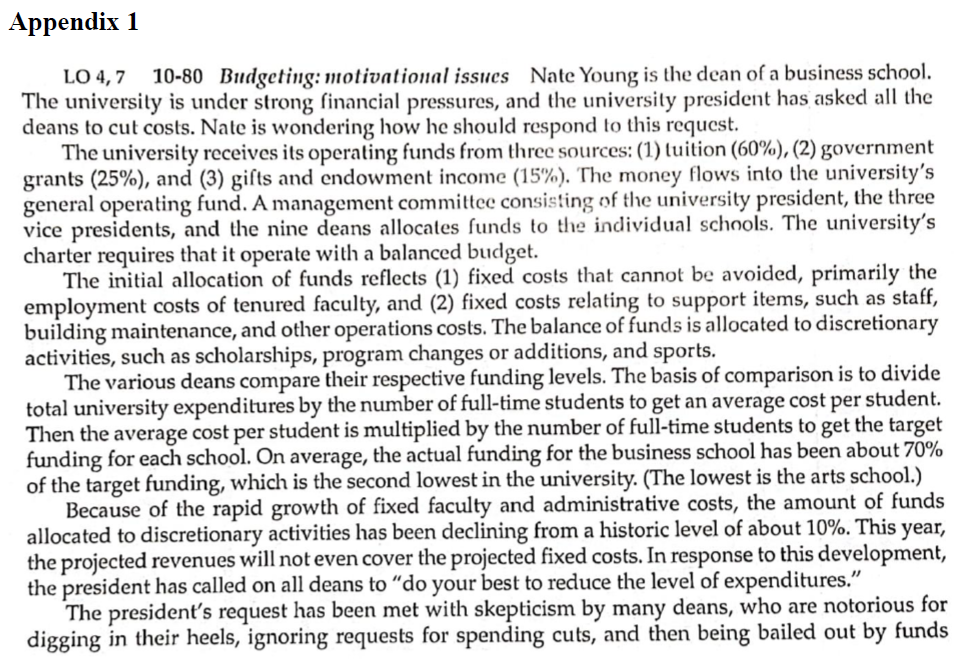
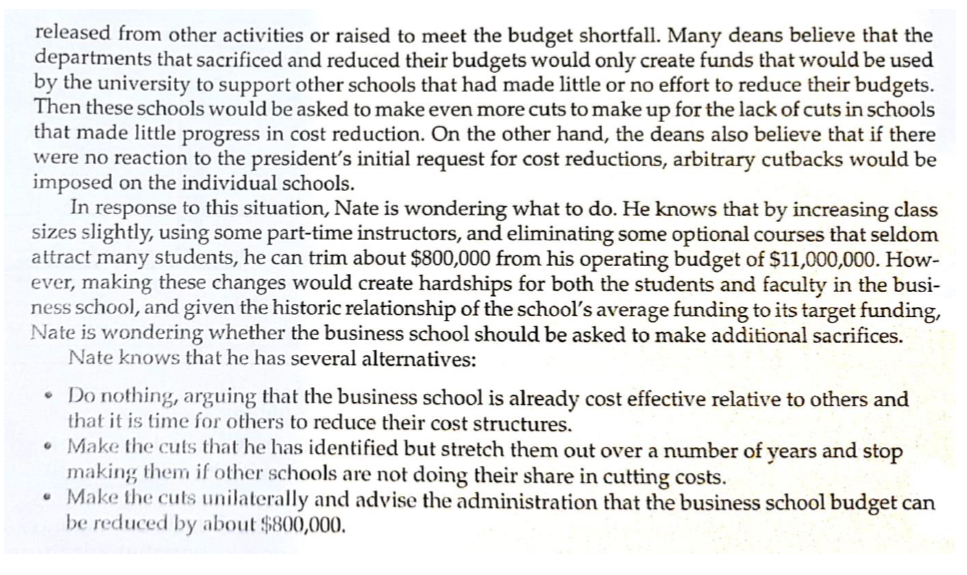
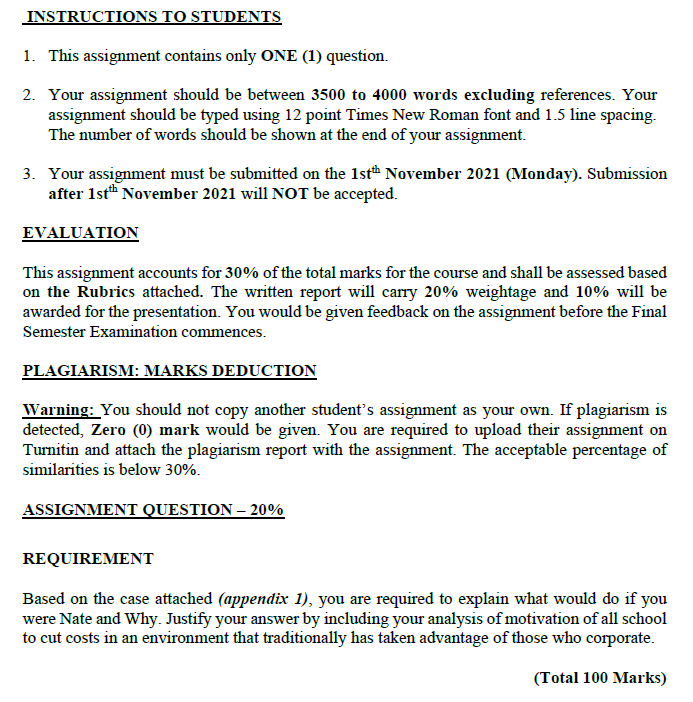
Appendix 1 LO 4,7 10-80 Budgeting: motivational issues Nate Young is the dean of a business school. The university is under strong financial pressures, and the university president has asked all the deans to cut costs. Nate is wondering how he should respond to this request. The university receives its operating funds from three sources: (1) tuition (60%), (2) government grants (25%), and (3) gits and endowment income (15%). The money flows into the university's general operating fund. A management committee consisting of the university president, the three vice presidents, and the nine deans allocates funds to the individual schools. The university's charter requires that it operate with a balanced budget. The initial allocation of funds reflects (1) fixed costs that cannot be avoided, primarily the employment costs of tenured faculty, and (2) fixed costs relating to support items, such as staff, building maintenance, and other operations costs. The balance of funds is allocated to discretionary activities, such as scholarships, program changes or additions, and sports. The various deans compare their respective funding levels. The basis of comparison is to divide total university expenditures by the number of full-time students to get an average cost per student. Then the average cost per student is multiplied by the number of full-time students to get the target funding for each school. On average, the actual funding for the business school has been about 70% of the target funding, which is the second lowest in the university. (The lowest is the arts school.) Because of the rapid growth of fixed faculty and administrative costs, the amount of funds allocated to discretionary activities has been declining from a historic level of about 10%. This year, the projected revenues will not even cover the projected fixed costs. In response to this development, the president has called on all deans to "do your best to reduce the level of expenditures." The president's request has been met with skepticism by many deans, who are notorious for digging in their heels, ignoring requests for spending cuts, and then being bailed out by funds released from other activities or raised to meet the budget shortfall. Many deans believe that the departments that sacrificed and reduced their budgets would only create funds that would be used by the university to support other schools that had made little or no effort to reduce their budgets. Then these schools would be asked to make even more cuts to make up for the lack of cuts in schools that made little progress in cost reduction. On the other hand, the deans also believe that if there were no reaction to the president's initial request for cost reductions, arbitrary cutbacks would be imposed on the individual schools. In response to this situation, Nate is wondering what to do. He knows that by increasing class sizes slightly, using some part-time instructors, and eliminating some optional courses that seldom attract many students, he can trim about $800,000 from his operating budget of $11,000,000. How- ever, making these changes would create hardships for both the students and faculty in the busi- ness school, and given the historic relationship of the school's average funding to its target funding, Nate is wondering whether the business school should be asked to make additional sacrifices. Nate knows that he has several alternatives: Do nothing, arguing that the business school is already cost effective relative to others and that it is time for others to reduce their cost structures. Make the cuts that he has identified but stretch them out over a number of years and stop making them if other schools are not doing their share in cutting costs. Make the cuts unilaterally and advise the administration that the business school budget can be reduced by about $800,000. INSTRUCTIONS TO STUDENTS 1. This assignment contains only ONE (1) question. 2. Your assignment should be between 3500 to 4000 words excluding references. Your assignment should be typed using 12 point Times New Roman font and 1.5 line spacing. The number of words should be shown at the end of your assignment. 3. Your assignment must be submitted on the 1sth November 2021 (Monday). Submission after 1sth November 2021 will NOT be accepted. EVALUATION This assignment accounts for 30% of the total marks for the course and shall be assessed based on the Rubrics attached. The written report will cany 20% weightage and 10% will be awarded for the presentation. You would be given feedback on the assignment before the Final Semester Examination commences. PLAGIARISM: MARKS DEDUCTION Warning: You should not copy another student's assignment as your own. If plagiarism is detected, Zero (0) mark would be given. You are required to upload their assignment on Turnitin and attach the plagiarism report with the assignment. The acceptable percentage of similarities is below 30%. ASSIGNMENT QUESTION 20% REQUIREMENT Based on the case attached (appendix 1), you are required to explain what would do if you were Nate and Why. Justify your answer by including your analysis of motivation of all school to cut costs in an environment that traditionally has taken advantage of those who corporate. (Total 100 Marks) Appendix 1 LO 4,7 10-80 Budgeting: motivational issues Nate Young is the dean of a business school. The university is under strong financial pressures, and the university president has asked all the deans to cut costs. Nate is wondering how he should respond to this request. The university receives its operating funds from three sources: (1) tuition (60%), (2) government grants (25%), and (3) gits and endowment income (15%). The money flows into the university's general operating fund. A management committee consisting of the university president, the three vice presidents, and the nine deans allocates funds to the individual schools. The university's charter requires that it operate with a balanced budget. The initial allocation of funds reflects (1) fixed costs that cannot be avoided, primarily the employment costs of tenured faculty, and (2) fixed costs relating to support items, such as staff, building maintenance, and other operations costs. The balance of funds is allocated to discretionary activities, such as scholarships, program changes or additions, and sports. The various deans compare their respective funding levels. The basis of comparison is to divide total university expenditures by the number of full-time students to get an average cost per student. Then the average cost per student is multiplied by the number of full-time students to get the target funding for each school. On average, the actual funding for the business school has been about 70% of the target funding, which is the second lowest in the university. (The lowest is the arts school.) Because of the rapid growth of fixed faculty and administrative costs, the amount of funds allocated to discretionary activities has been declining from a historic level of about 10%. This year, the projected revenues will not even cover the projected fixed costs. In response to this development, the president has called on all deans to "do your best to reduce the level of expenditures." The president's request has been met with skepticism by many deans, who are notorious for digging in their heels, ignoring requests for spending cuts, and then being bailed out by funds released from other activities or raised to meet the budget shortfall. Many deans believe that the departments that sacrificed and reduced their budgets would only create funds that would be used by the university to support other schools that had made little or no effort to reduce their budgets. Then these schools would be asked to make even more cuts to make up for the lack of cuts in schools that made little progress in cost reduction. On the other hand, the deans also believe that if there were no reaction to the president's initial request for cost reductions, arbitrary cutbacks would be imposed on the individual schools. In response to this situation, Nate is wondering what to do. He knows that by increasing class sizes slightly, using some part-time instructors, and eliminating some optional courses that seldom attract many students, he can trim about $800,000 from his operating budget of $11,000,000. How- ever, making these changes would create hardships for both the students and faculty in the busi- ness school, and given the historic relationship of the school's average funding to its target funding, Nate is wondering whether the business school should be asked to make additional sacrifices. Nate knows that he has several alternatives: Do nothing, arguing that the business school is already cost effective relative to others and that it is time for others to reduce their cost structures. Make the cuts that he has identified but stretch them out over a number of years and stop making them if other schools are not doing their share in cutting costs. Make the cuts unilaterally and advise the administration that the business school budget can be reduced by about $800,000. INSTRUCTIONS TO STUDENTS 1. This assignment contains only ONE (1) question. 2. Your assignment should be between 3500 to 4000 words excluding references. Your assignment should be typed using 12 point Times New Roman font and 1.5 line spacing. The number of words should be shown at the end of your assignment. 3. Your assignment must be submitted on the 1sth November 2021 (Monday). Submission after 1sth November 2021 will NOT be accepted. EVALUATION This assignment accounts for 30% of the total marks for the course and shall be assessed based on the Rubrics attached. The written report will cany 20% weightage and 10% will be awarded for the presentation. You would be given feedback on the assignment before the Final Semester Examination commences. PLAGIARISM: MARKS DEDUCTION Warning: You should not copy another student's assignment as your own. If plagiarism is detected, Zero (0) mark would be given. You are required to upload their assignment on Turnitin and attach the plagiarism report with the assignment. The acceptable percentage of similarities is below 30%. ASSIGNMENT QUESTION 20% REQUIREMENT Based on the case attached (appendix 1), you are required to explain what would do if you were Nate and Why. Justify your answer by including your analysis of motivation of all school to cut costs in an environment that traditionally has taken advantage of those who corporate. (Total 100 Marks)
Step by Step Solution
There are 3 Steps involved in it

Get step-by-step solutions from verified subject matter experts