







Question: pls solve asap! 1. write the functional requirements 2. draw a context diagram 3. draw DFD level-0 Home Sweet Home Prepared by Chris Procter Introduction
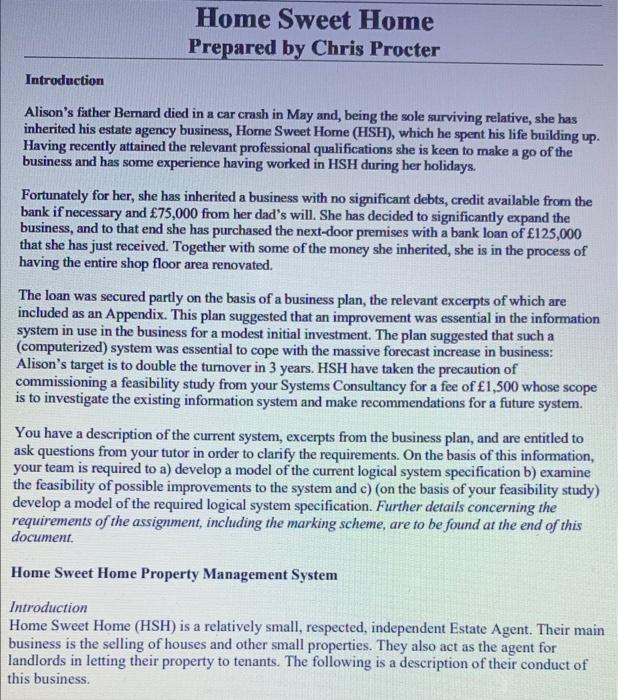
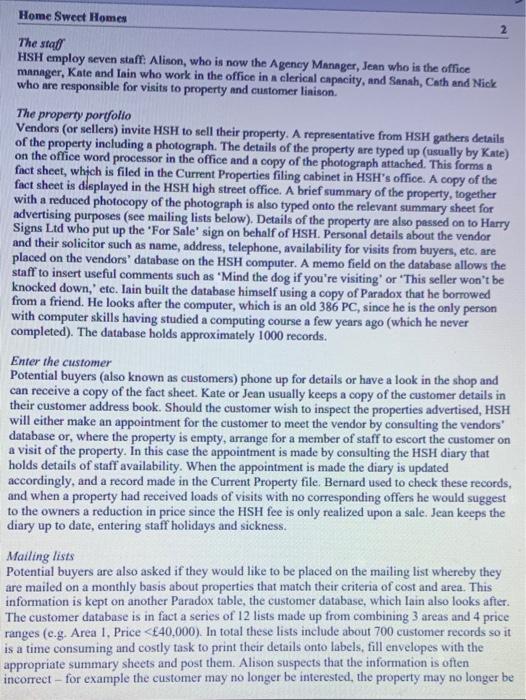
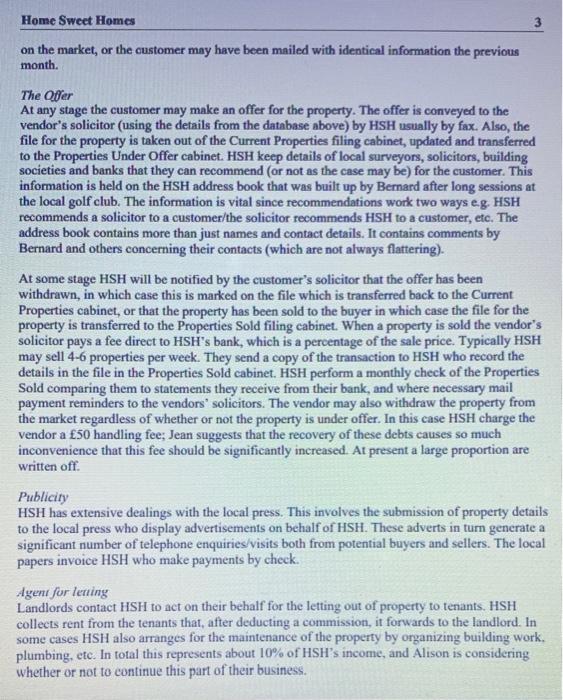
Home Sweet Home Prepared by Chris Procter Introduction Alison's father Bernard died in a car crash in May and, being the sole surviving relative, she has inherited his estate agency business, Home Sweet Home (HSH), which he spent his life building up. Having recently attained the relevant professional qualifications she is keen to make a go of the business and has some experience having worked in HSH during her holidays. Fortunately for her, she has inherited a business with no significant debts, credit available from the bank if necessary and 75,000 from her dad's will. She has decided to significantly expand the business, and to that end she has purchased the next-door premises with a bank loan of 125,000 that she has just received. Together with some of the money she inherited, she is in the process of having the entire shop floor area renovated. The loan was secured partly on the basis of a business plan, the relevant excerpts of which are included as an Appendix. This plan suggested that an improvement was essential in the information system in use in the business for a modest initial investment. The plan suggested that such a (computerized) system was essential to cope with the massive forecast increase in business: Alison's target is to double the turnover in 3 years. HSH have taken the precaution of commissioning a feasibility study from your Systems Consultancy for a fee of 1,500 whose scope is to investigate the existing information system and make recommendations for a future system. You have a description of the current system, excerpts from the business plan, and are entitled to ask questions from your tutor in order to clarify the requirements. On the basis of this information, your team is required to a) develop a model of the current logical system specification b) examine the feasibility of possible improvements to the system and c) (on the basis of your feasibility study) develop a model of the required logical system specification. Further details concerning the requirements of the assignment, including the marking scheme, are to be found at the end of this document. Home Sweet Home Property Management System Introduction Home Sweet Home (HSH) is a relatively small, respected, independent Estate Agent. Their main business is the selling of houses and other small properties. They also act as the agent for landlords in letting their property to tenants. The following is a description of their conduct of this business. 2 Home Sweet Homes The stad HSH employ seven staff: Alison, who is now the Agency Manager, Jean who is the office manager, Kate and lain who work in the office in a clerical capacity, and Sanah, Cath and Nick who are responsible for visits to property and customer linison. The property portfolio Vendors (or sellers) invite HSH to sell their property. A representative from HSH gathers details of the property including a photograph. The details of the property are typed up (usually by Kate) on the office word processor in the office and a copy of the photograph attached. This forms a fact sheet, which is filed in the Current Properties filing cabinet in HSH's office. A copy of the fact sheet is displayed in the HSH high street office. A brief summary of the property, together with a reduced photocopy of the photograph is also typed onto the relevant summary sheet for advertising purposes (see mailing lists below), Details of the property are also pessed on to Harry Signs Ltd who put up the 'For Sale' sign on behalf of HSH. Personal details about the vendor and their solicitor such as name, address, telephone, availability for visits from buyers, etc. are placed on the vendors' database on the HSH computer. A memo field on the database allows the staff'to insert useful comments such as "Mind the dog if you're visiting' or 'This seller won't be knocked down,' etc. Iain built the database himself using a copy of Paradox that he borrowed from a friend. He looks after the computer, which is an old 386 PC, since he is the only person with computer skills having studied a computing course a few years ago (which he never completed). The database holds approximately 1000 records. Enter the customer Potential buyers (also known as customers) phone up for details or have a look in the shop and can receive a copy of the fact sheet. Kate or Jean usually keeps a copy of the customer details in their customer address book. Should the customer wish to inspect the properties advertised, HSH will either make an appointment for the customer to meet the vendor by consulting the vendors' database or, where the property is empty, arrange for a member of staff to escort the customer on a visit of the property. In this case the appointment is made by consulting the HSH diary that holds details of staff availability. When the appointment is made the diary is updated accordingly, and a record made in the Current Property file. Bernard used to check these records, and when a property had received loads of visits with no corresponding offers he would suggest to the owners a reduction in price since the HSH fee is only realized upon a sale. Jean keeps the diary up to date, entering staff holidays and sickness. Mailing lists Potential buyers are also asked if they would like to be placed on the mailing list whereby they are mailed on a monthly basis about properties that match their criteria of cost and area. This information is kept on another Paradox table, the customer database, which lain also looks after. The customer database is in fact a series of 12 lists made up from combining 3 areas and 4 price ranges (e.g. Area 1. Price
Step by Step Solution
There are 3 Steps involved in it

Get step-by-step solutions from verified subject matter experts
 Study Help