







Question: Pls solve early This problem forces you to learn about the vector cross product and curl (or rot - UK usage) operator. This is a
Pls solve early
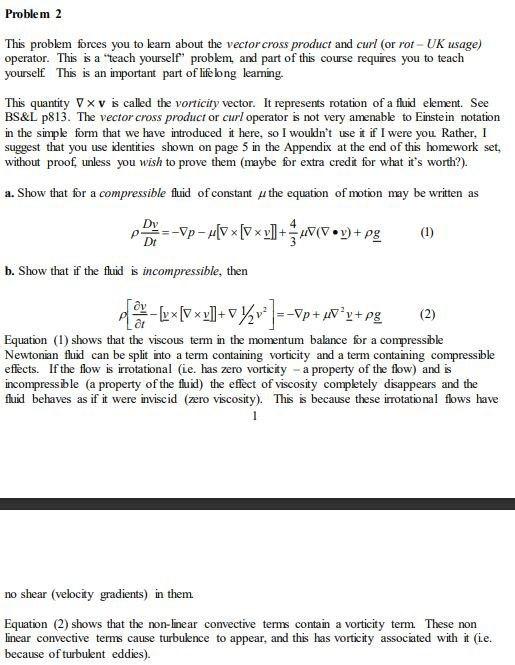
This problem forces you to learn about the vector cross product and curl (or rot - UK usage) operator. This is a "teach yourself' problem, and part of this course requires you to teach yourself This is an important part of lifelong learning. This quantity v is called the vorticity vector. It represents rotation of a fluid element. See BS\&L p813. The vector cross product or curl operator is not very amenable to Einstein notation in the simple form that we have introduced it here, so I wouldn't use it if I were you Rather, I suggest that you use identities shown on page 5 in the Appendix at the end of this homework set, without proof, unless you wish to prove them (maybe for extra credit for what it's worth?). a. Show that for a compressible fluid of constant the equation of motion may be written as DtDv=p[[v]]+34(v)+g b. Show that if the fluid is incompressible, then [tv[v[v]]+1/22]=p+2v+g Equation (1) shows that the viscous term in the momentum balance for a compressible Newtonian fluid can be split into a term containing vorticity and a term containing compressible effects. If the flow is irrotational (ie. has zero vorticity - a property of the flow) and is incompressible (a property of the fluid) the effect of viscosity completely disappears and the fluid behaves as if it were inviscid (zero viscosity). This is because these irrotational flows have 1 no shear (velocity gradients) in them. Equation (2) shows that the non-linear convective terms contain a vorticity term. These non linear convective terms cause turbulence to appear, and this has vorticity associated with it (i.e. because of turbulent eddies)
Step by Step Solution
There are 3 Steps involved in it

Get step-by-step solutions from verified subject matter experts
 Study Help