


Question: plz answer #2 a and b via the link https://www.aicpa.org/research/standards/auditattest/downloadabledocuments/au-c-00240.pdf. thank you. Requirements: 1. Consideration of Fraud in a Financial Statement Audit (au-c-00240.pdf (aicpa.org) and

plz answer #2 a and b via the link https://www.aicpa.org/research/standards/auditattest/downloadabledocuments/au-c-00240.pdf. thank you.
plz answer #2 a and b via the link
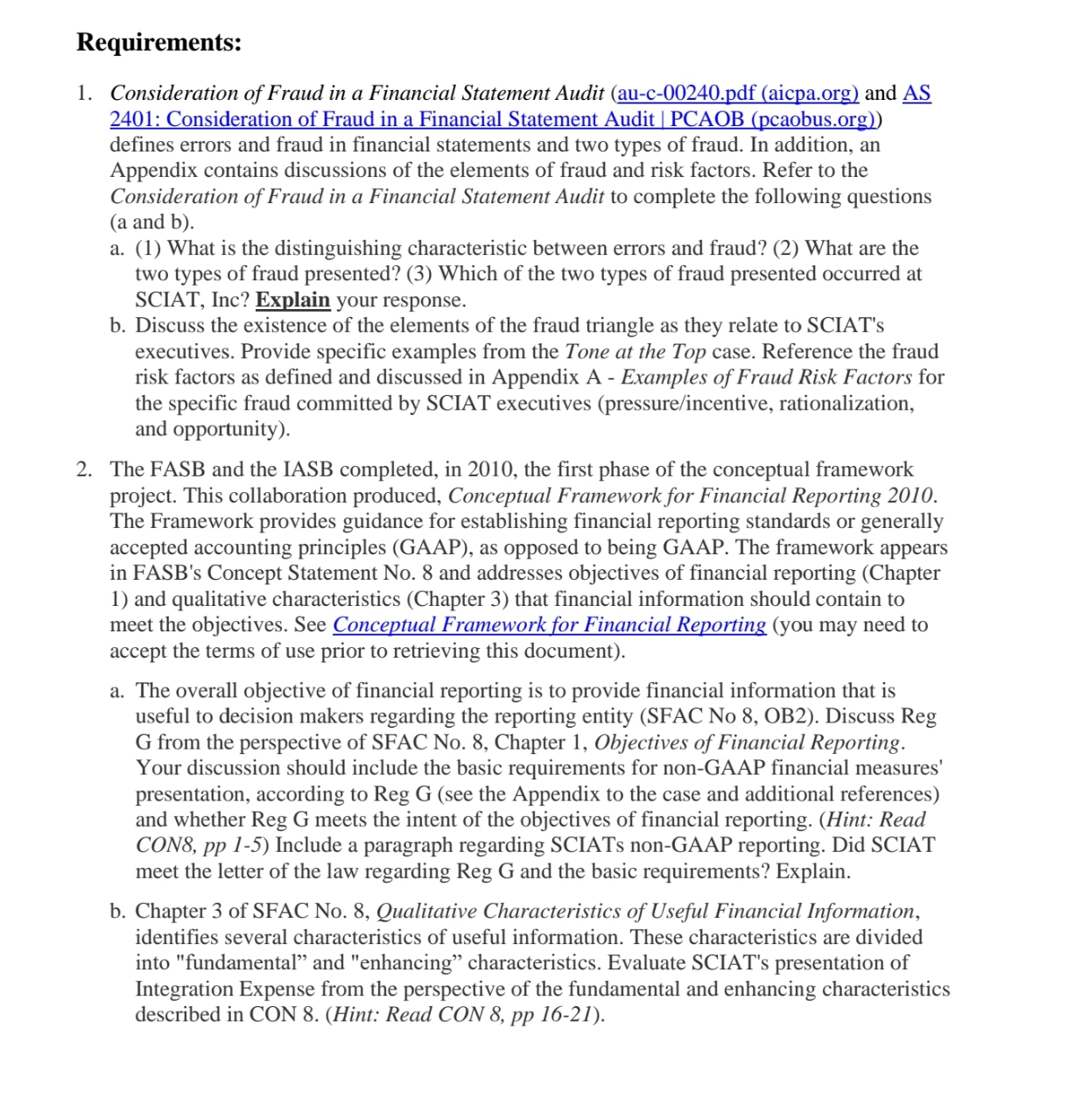
Requirements: 1. Consideration of Fraud in a Financial Statement Audit (au-c-00240.pdf (aicpa.org) and AS 2401: Consideration of Fraud in a Financial Statement Audit | PCAOB (pcaobus.org)) defines errors and fraud in financial statements and two types of fraud. In addition, an Appendix contains discussions of the elements of fraud and risk factors. Refer to the Consideration of Fraud in a Financial Statement Audit to complete the following questions (a and b). a. (1) What is the distinguishing characteristic between errors and fraud? (2) What are the two types of fraud presented? (3) Which of the two types of fraud presented occurred at SCIAT, Inc? Explain your response. b. Discuss the existence of the elements of the fraud triangle as they relate to SCIAT's executives. Provide specific examples from the Tone at the Top case. Reference the fraud risk factors as defined and discussed in Appendix A - Examples of Fraud Risk Factors for the specific fraud committed by SCIAT executives (pressure/incentive, rationalization, and opportunity). 2. The FASB and the IASB completed, in 2010, the first phase of the conceptual framework project. This collaboration produced, Conceptual Framework for Financial Reporting 2010. The Framework provides guidance for establishing financial reporting standards or generally accepted accounting principles (GAAP), as opposed to being GAAP. The framework appears in FASB's Concept Statement No. 8 and addresses objectives of financial reporting (Chapter 1) and qualitative characteristics (Chapter 3) that financial information should contain to meet the objectives. See Conceptual Framework for Financial Reporting (you may need to accept the terms of use prior to retrieving this document). a. The overall objective of financial reporting is to provide financial information that is useful to decision makers regarding the reporting entity (SFAC No 8, OB2). Discuss Reg G from the perspective of SFAC No. 8, Chapter 1, Objectives of Financial Reporting. Your discussion should include the basic requirements for non-GAAP financial measures' presentation, according to Reg G (see the Appendix to the case and additional references) and whether Reg G meets the intent of the objectives of financial reporting. (Hint: Read CON8, pp 1-5) Include a paragraph regarding SCIATs non-GAAP reporting. Did SCIAT meet the letter of the law regarding Reg G and the basic requirements? Explain. b. Chapter 3 of SFAC No. 8, Qualitative Characteristics of Useful Financial Information, identifies several characteristics of useful information. These characteristics are divided into "fundamental" and "enhancing" characteristics. Evaluate SCIAT's presentation of Integration Expense from the perspective of the fundamental and enhancing characteristics described in CON 8. (Hint: Read CON 8, pp 16-21)

Step by Step Solution

There are 3 Steps involved in it

1 Expert Approved Answer
Step: 1 Unlock blur-text-image

Question Has Been Solved by an Expert!

Get step-by-step solutions from verified subject matter experts

Step: 2 Unlock
Step: 3 Unlock

Students Have Also Explored These Related Accounting Questions!