







Question: plz answer #9 I posted wrong pic. 8. Delaware enacted an apprentice regulatory scheme to develop and conduct employee training and registered apprenticeship programs and
plz answer #9 I posted wrong pic.
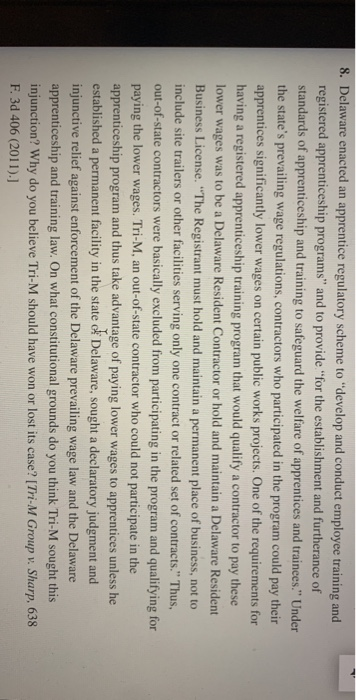
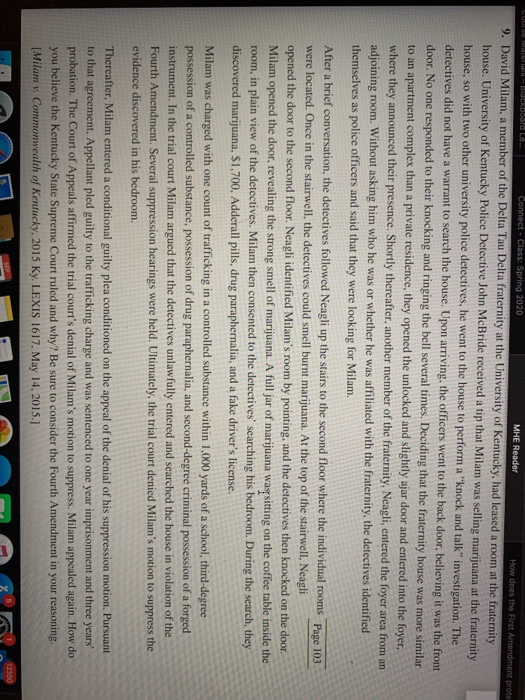
8. Delaware enacted an apprentice regulatory scheme to develop and conduct employee training and registered apprenticeship programs" and to provide for the establishment and furtherance of standards of apprenticeship and training to safeguard the welfare of apprentices and trainees." Under the state's prevailing wage regulations, contractors who participated in the program could pay their apprentices significantly lower wages on certain public works projects. One of the requirements for having a registered apprenticeship training program that would qualify a contractor to pay these lower wages was to be a Delaware Resident Contractor or hold and maintain a Delaware Resident Business License. "The Registrant must hold and maintain a permanent place of business, not to include site trailers or other facilities serving only one contract or related set of contracts." Thus, out-of-state contractors were basically excluded from participating in the program and qualifying for paying the lower wages. Tri-M, an out-of-state contractor who could not participate in the apprenticeship program and thus take advantage of paying lower wages to apprentices unless he established a permanent facility in the state de Delaware, sought a declaratory judgment and injunctive relief against enforcement of the Delaware prevailing wage law and the Delaware apprenticeship and training law. On what constitutional grounds do you think Tri-M sought this injunction? Why do you believe Tri-M should have won or lost its case? [Tri-M Group v. Sharp, 638 F. 3d 406 (2011).] COULSO MU - Blackboard Le.. Connect - Class: Spring 2020 MHE Reader How does the First Amendment prote 9. David Milam, a member of the Delta Tau Delta fraternity at the University of Kentucky, had leased a room at the fraternity house. University of Kentucky Police Detective John McBride received a tip that Milam was selling marijuana at the fraternity house, so with two other university police detectives, he went to the house to perform a "knock and talk" investigation. The detectives did not have a warrant to search the house. Upon arriving, the officers went to the back door, believing it was the front door. No one responded to their knocking and ringing the bell several times. Deciding that the fraternity house was more similar to an apartment complex than a private residence, they opened the unlocked and slightly ajar door and entered into the foyer, where they announced their presence. Shortly thereafter, another member of the fraternity, Neagli, entered the foyer area from an adjoining room. Without asking him who he was or whether he was affiliated with the fraternity, the detectives identified themselves as police officers and said that they were looking for Milam. After a brief conversation, the detectives followed Neagli up the stairs to the second floor where the individual rooms Page 103 were located. Once in the stairwell, the detectives could smell burnt marijuana. At the top of the stairwell, Neagli opened the door to the second floor. Neagli identified Milam's room by pointing, and the detectives then knocked on the door. Milam opened the door, revealing the strong smell of marijuana. A full jar of marijuana wapsitting on the coffee table inside the room, in plain view of the detectives. Milam then consented to the detectives' searching his bedroom. During the search, they discovered marijuana, $1,700. Adderall pills, drug paraphernalia, and a fake driver's license. Milam was charged with one count of trafficking in a controlled substance within 1,000 yards of a school, third-degree possession of a controlled substance, possession of drug paraphernalia, and second-degree criminal possession of a forged instrument. In the trial court Milam argued that the detectives unlawfully entered and searched the house in violation of the Fourth Amendment. Several suppression hearings were held. Ultimately, the trial court denied Milam's motion to suppress the evidence discovered in his bedroom. Thereafter, Milam entered a conditional guilty plea conditioned on the appeal of the denial of his suppression motion. Pursuant to that agreement, Appellant pled guilty to the trafficking charge and was sentenced to one year imprisonment and three years probation. The Court of Appeals affirmed the trial court's denial of Milam's motion to suppress. Milam appealed again. How do you believe the Kentucky State Supreme Court ruled and why? Be sure to consider the Fourth Amendment in your reasoning. [Milam v. Commonwealth of Kentucky, 2015 Ky. LEXIS 1617. May 14, 2015.] 12350 Step by Step Solution
There are 3 Steps involved in it
1 Expert Approved Answer
Step: 1 Unlock

Question Has Been Solved by an Expert!
Get step-by-step solutions from verified subject matter experts
Step: 2 Unlock
Step: 3 Unlock
 Study Help