







Question: PlZ explain as much as you can Please read the following case. In response to this role play, please the information you've gained over the
PlZ explain as much as you can
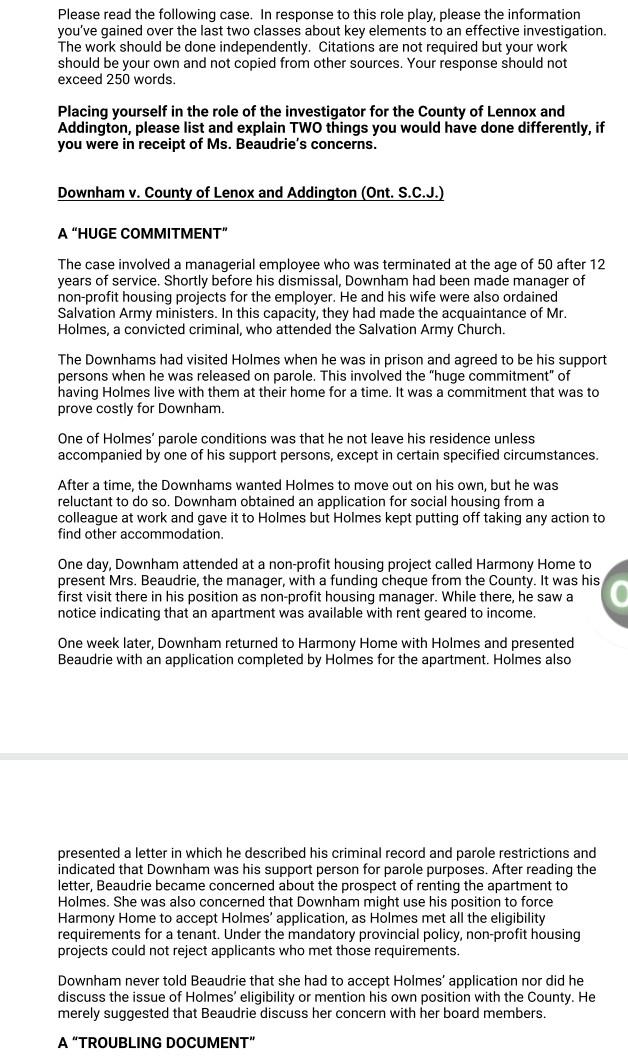
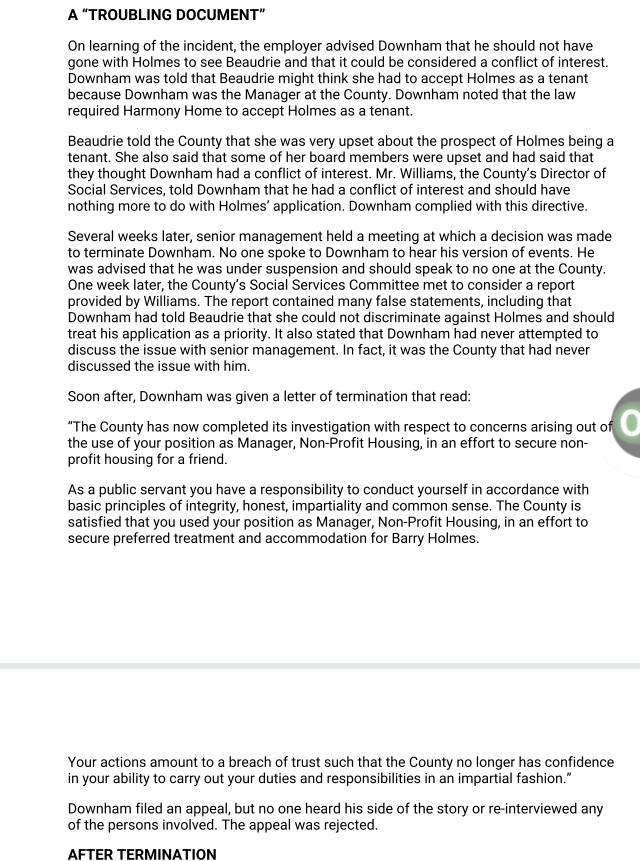
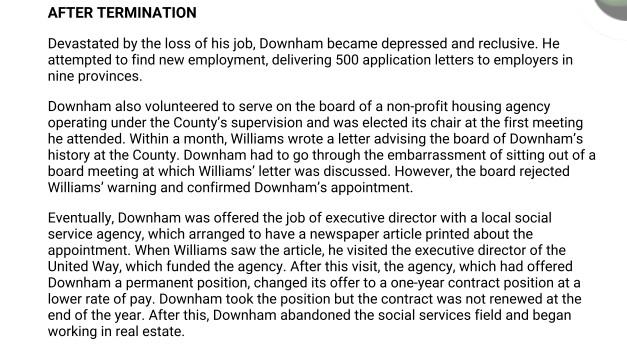
Please read the following case. In response to this role play, please the information you've gained over the last two classes about key elements to an effective investigation. The work should be done independently. Citations are not required but your work should be your own and not copied from other sources. Your response should not exceed 250 words. Placing yourself in the role of the investigator for the County of Lennox and Addington, please list and explain TWO things you would have done differently, if you were in receipt of Ms. Beaudrie's concerns. Downham v. County of Lenox and Addington (Ont. S.C.J.) A "HUGE COMMITMENT" The case involved a managerial employee who was terminated at the age of 50 after 12 years of service. Shortly before his dismissal, Downham had been made manager of non-profit housing projects for the employer. He and his wife were also ordained Salvation Army ministers. In this capacity, they had made the acquaintance of Mr. Holmes, a convicted criminal, who attended the Salvation Army Church. The Downhams had visited Holmes when he was in prison and agreed to be his support persons when he was released on parole. This involved the "huge commitment" of having Holmes live with them at their home for a time. It was a commitment that was to prove costly for Downham. One of Holmes' parole conditions was that he not leave his residence unless accompanied by one of his support persons, except in certain specified circumstances. After a time, the Downhams wanted Holmes to move out on his own, but he was reluctant to do so. Downham obtained an application for social housing from a colleague at work and gave it to Holmes but Holmes kept putting off taking any action to find other accommodation. One day, Downham attended at a non-profit housing project called Harmony Home to present Mrs. Beaudrie, the manager, with a funding cheque from the County. It was his first visit there in his position as non-profit housing manager. While there, he saw a notice indicating that an apartment was available with rent geared to income. One week later, Downham returned to Harmony Home with Holmes and presented Beaudrie with an application completed by Holmes for the apartment. Holmes also presented a letter in which he described his criminal record and parole restrictions and indicated that Downham was his support person for parole purposes. After reading the letter, Beaudrie became concerned about the prospect of renting the apartment to Holmes. She was also concerned that Downham might use his position to force Harmony Home to accept Holmes' application, as Holmes met all the eligibility requirements for a tenant. Under the mandatory provincial policy, non-profit housing projects could not reject applicants who met those requirements. Downham never told Beaudrie that she had to accept Holmes' application nor did he discuss the issue of Holmes' eligibility or mention his own position with the County. He merely suggested that Beaudrie discuss her concern with her board members. A "TROUBLING DOCUMENT" A "TROUBLING DOCUMENT" On learning of the incident, the employer advised Downham that he should not have gone with Holmes to see Beaudrie and that it could be considered a conflict of interest. Downham was told that Beaudrie might think she had to accept Holmes as a tenant because Downham was the Manager at the County. Downham noted that the law required Harmony Home to accept Holmes as a tenant. Beaudrie told the County that she was very upset about the prospect of Holmes being a tenant. She also said that some of her board members were upset and had said that they thought Downham had a conflict of interest. Mr. Williams, the County's Director of Social Services, told Downham that he had a conflict of interest and should have nothing more to do with Holmes' application. Downham complied with this directive. Several weeks later, senior management held a meeting at which a decision was made to terminate Downham. No one spoke to Downham to hear his version of events. He was advised that he was under suspension and should speak to no one at the County, One week later, the County's Social Services Committee met to consider a report provided by Williams. The report contained many false statements, including that Downham had told Beaudrie that she could not discriminate against Holmes and should treat his application as a priority. It also stated that Downham had never attempted to discuss the issue with senior management. In fact, it was the County that had never discussed the issue with him. Soon after, Downham was given a letter of termination that read: "The County has now completed its investigation with respect to concerns arising out of the use of your position as Manager, Non-Profit Housing, in an effort to secure non- profit housing for a friend. As a public servant you have a responsibility to conduct yourself in accordance with basic principles of integrity, honest, impartiality and common sense. The County is satisfied that you used your position as Manager, Non-Profit Housing, in an effort to secure preferred treatment and accommodation for Barry Holmes. Your actions amount to a breach of trust such that the County no longer has confidence in your ability to carry out your duties and responsibilities in an impartial fashion." Downham filed an appeal, but no one heard his side of the story or re-interviewed any of the persons involved. The appeal was rejected. AFTER TERMINATION AFTER TERMINATION Devastated by the loss of his job, Downham became depressed and reclusive. He attempted to find new employment, delivering 500 application letters to employers in nine provinces. Downham also volunteered to serve on the board of a non-profit housing agency operating under the County's supervision and was elected its chair at the first meeting he attended. Within a month, Williams wrote a letter advising the board of Downham's history at the County. Downham had to go through the embarrassment of sitting out of a board meeting at which Williams' letter was discussed. However, the board rejected Williams' warning and confirmed Downham's appointment. Eventually, Downham was offered the job of executive director with a local social service agency, which arranged to have a newspaper article printed about the appointment. When Williams saw the article, he visited the executive director of the United Way, which funded the agency. After this visit, the agency, which had offered Downham a permanent position, changed its offer to a one-year contract position at a lower rate of pay. Downham took the position but the contract was not renewed at the end of the year. After this, Downham abandoned the social services field and began working in real estateStep by Step Solution
There are 3 Steps involved in it
1 Expert Approved Answer
Step: 1 Unlock

Question Has Been Solved by an Expert!
Get step-by-step solutions from verified subject matter experts
Step: 2 Unlock
Step: 3 Unlock
 Study Help