







Question: plz giveconclusion Two other elements emphasise the need for preparation and implementation of crisis communication in modern military organisations and these are the complex roles
plz giveconclusion
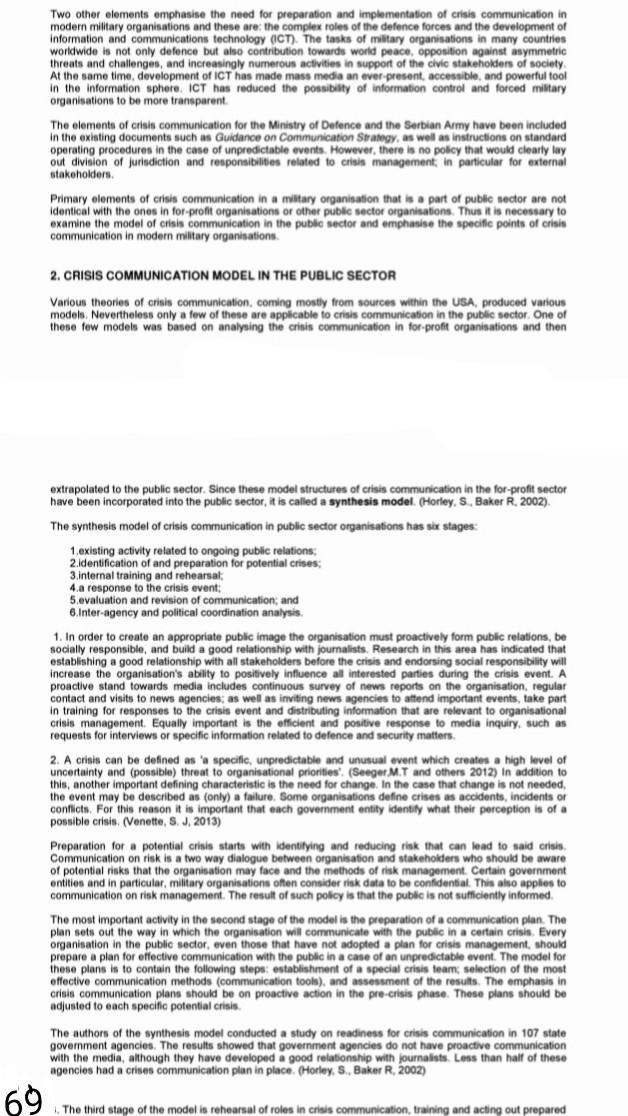
Two other elements emphasise the need for preparation and implementation of crisis communication in modern military organisations and these are the complex roles of the defence forces and the development of information and communications technology (ICT). The tasks of military organisations in many countries worldwide is not only defence but also contribution towards world peace, opposition against asymmetric threats and challenges, and increasingly numerous activities in support of the civic stakeholders of society At the same time, development of ICT has made mass media an ever-present, accessible, and powerful tool in the information sphere, ICT has reduced the possibility of information control and forced military organisations to be more transparent The elements of crisis communication for the Ministry of Defence and the Serbian Army have been included in the existing documents such as Guidance on Communication Strategy, as well as instructions on standard operating procedures in the case of unpredictable events. However, there is no policy that would clearly tay out division of jurisdiction and responsibilities related to crisis management, in particular for external stakeholders Primary elements of crisis communication in a military organisation that is a part of public sector are not identical with the ones in for-profit organisations or other public sector organisations. Thus it is necessary to examine the model of crisis communication in the public sector and emphasise the specific points of crisis communication modern military organisations 2. CRISIS COMMUNICATION MODEL IN THE PUBLIC SECTOR Various theories of crisis communication, coming mostly from sources within the USA, produced various models. Nevertheless only a few of these are applicable to crisis communication in the public sector. One of these few models was based on analysing the crisis communication in for-profit organisations and then extrapolated to the public sector. Since these model structures of crisis communication in the for-profit sector have been incorporated into the public sector, it is called a synthesis model. (Horley, S.Baker R. 2002) The synthesis model of crisis communication in public sector organisations has six stages: existing activity related to ongoing public relations, 2.identification of and preparation for potential crises 3.internal training and rehearsal: 4. a response to the crisis event: 5.evaluation and revision of communication, and 6.Inter-agency and political coordination analysis. 1. In order to create an appropriate public image the organisation must proactively form public relations, be socially responsible, and build a good relationship with journalists. Research in this area has indicated that establishing a good relationship with all stakeholders before the crisis and endorsing social responsibility will increase the organisation's ability to positively influence al interested parties during the crisis event. A proactive stand towards media includes continuous survey of news reports on the organisation, regular contact and visits to news agencies, as well as inviting news agencies to attend important events, take part in training for responses to the crisis event and distributing information that are relevant to organisational crisis management. Equally important is the efficient and positive response to media inquiry, such as requests for interviews or specific information related to defence and security matters. 2. A crisis can be defined as a specific, unpredictable and unusual event which creates a high level of uncertainty and possible) threat to organisational priorities' (Seeger M.T and others 2012) In addition to this, another important defining characteristic is the need for change. In the case that change is not needed, the event may be described as (only) a failure. Some organisations define crises as accidents, incidents or conflicts. For this reason it is important that each government entity identify what their perception is of a possible crisis. (Venette, S. J. 2013) Preparation for a potential crisis starts with identifying and reducing risk that can lead to said crisis Communication on risk is a two way dialogue between organisation and stakeholders who should be aware of potential risks that the organisation may face and the methods of risk management. Certain government entities and in particular, military organisations often consider risk data to be confidential. This also applies to communication on risk management. The result of such policy is that the public is not sufficiently informed. The most important activity in the second stage of the model is the preparation of a communication plan. The plan sets out the way in which the organisation will communicate with the public in a certain crisis. Every organisation in the public sector, even those that have not adopted a plan for crisis management should prepare a plan for effective communication with the public in a case of an unpredictable event. The model for these plans is to contain the following steps: establishment of a special crisis team, selection of the most effective communication methods (communication tools), and assessment of the results. The emphasis in crisis communication plans should be on proactive action in the pre-crisis phase. These plans should be adjusted to each specific potential crisis The authors of the synthesis model conducted a study on readiness for crisis communication in 107 state government agencies. The results showed that government agencies do not have proactive communication with the media, although they have developed a good relationship with journalists. Less than half of these agencies had a crises communication plan in place (Horley, S., Baker R. 2002) 69 The third stage of the model is rehearsal of roles in crisis communication, training and acting out preparedStep by Step Solution
There are 3 Steps involved in it
1 Expert Approved Answer
Step: 1 Unlock

Question Has Been Solved by an Expert!
Get step-by-step solutions from verified subject matter experts
Step: 2 Unlock
Step: 3 Unlock
 Study Help