



Question: plz help me this question (viii) Now recall the mapping from the price simplex to itself that we used in order to generate a xed
plz help me this question
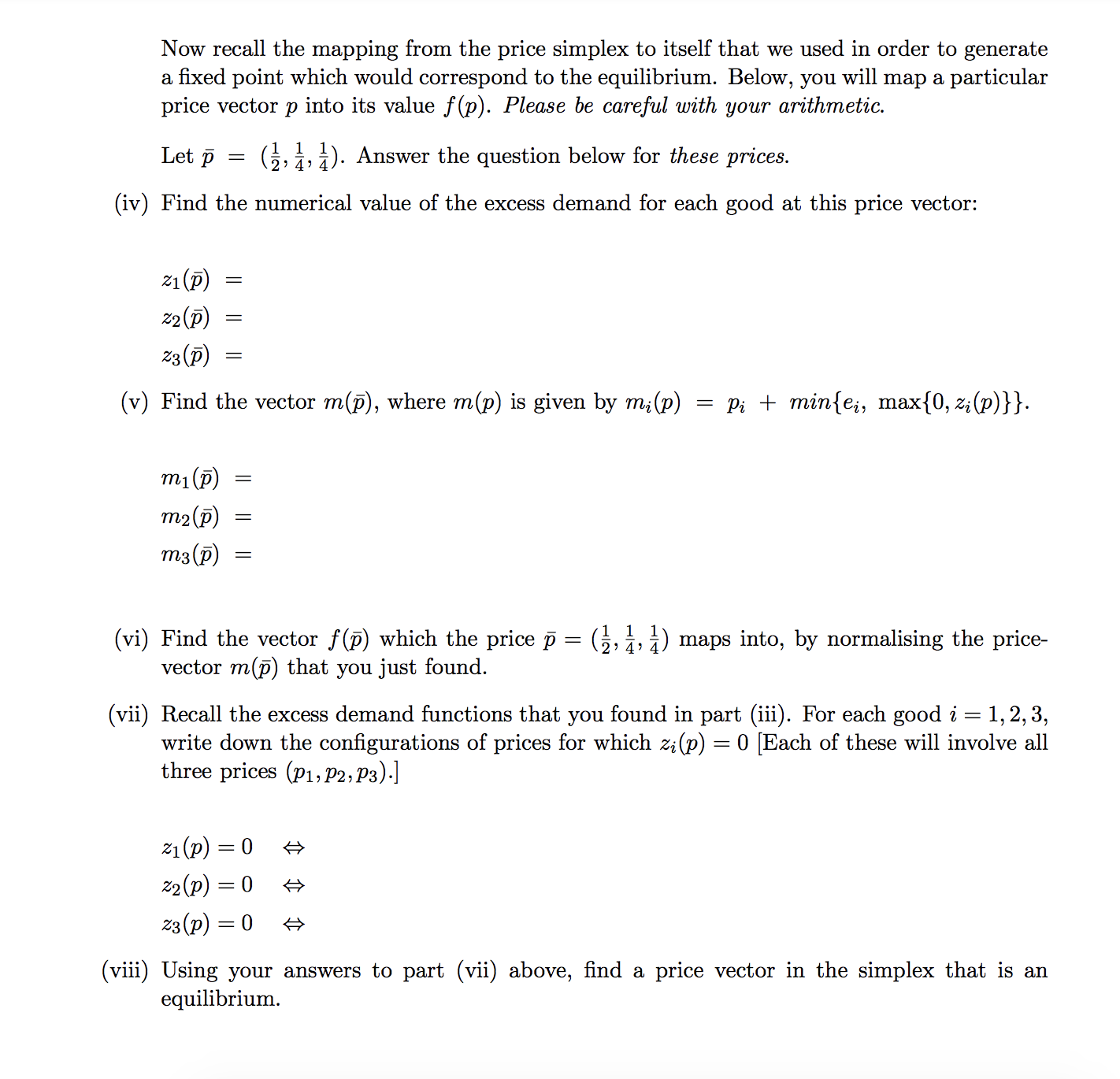
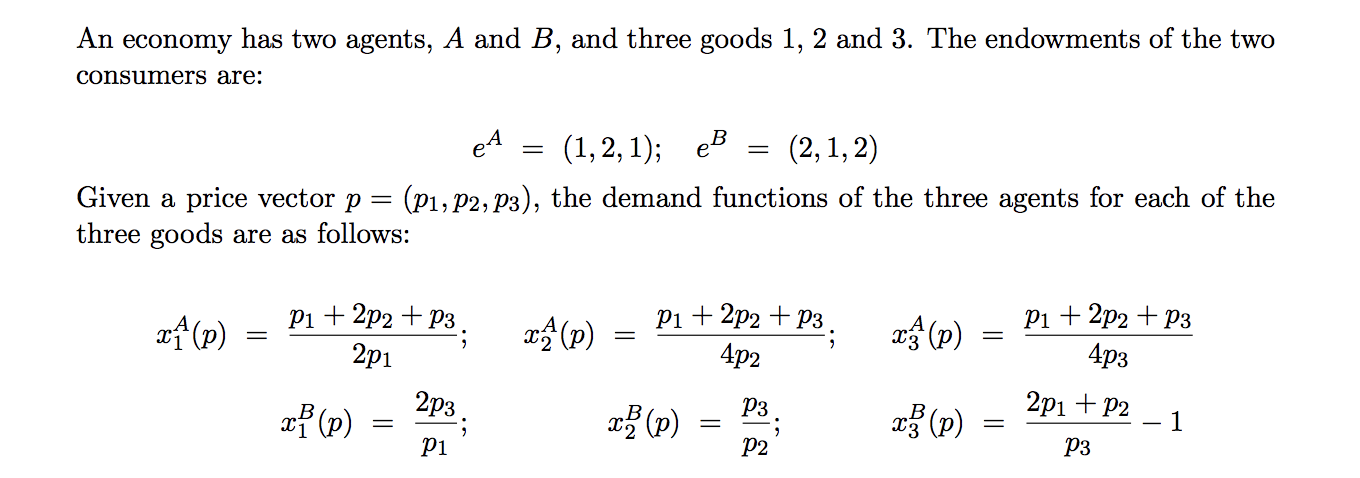
(viii) Now recall the mapping from the price simplex to itself that we used in order to generate a xed point which would correspond to the equilibrium. Below, you will map a particular price vector 19 into its value f (1)) Please be careful with your arithmetic. Let 33 = (, , i). Answer the question below for these prices. inn- Find the numerical value of the excess demand for each good at this price vector: Z1 (I5) 22 (15) 23 (P) Find the vector 171(16), where m(p) is given by 1114,01!) = p, + min{e,;, max{0,z,(p)}}. 333 121: 331?; || || || Find the vector f (1')) which the price 13 = (%, %, vector m(_) that you just found. ) maps into, by normalising the price- sh- Recall the excess demand functions that you found in part (iii). For each good i = 1, 2, 3, write down the congurations of prices for which 2,99) = 0 [Each of these will involve all three prices (pl, 132 , p3) -] Using your answers to part (vii) above, nd a price vector in the simplex that is an equilibrium. An economy has two agents, A and B, and three goods 1, 2 and 3. The endowments of the two consumers are: eA = (1,2,1); e3 = (2,1,2) Given a price vector p = (131,312, 393), the demand functions of the three agents for each of the three goods are as follows: P1 + 2Pz +P3 P1 + 2P2 +P3 P1 + 2P2 + P3 314(1)) = 2p1 ; P2A(P) = 4p2 ; 9334(1)) = 4p3 2P3 P3 2P1 +P2 might?) = ; $113019) = ; Pal-3(1)) = -1 P1 p2 P3
Step by Step Solution
There are 3 Steps involved in it

Get step-by-step solutions from verified subject matter experts