







Question: plz help me to explain this Instructions: You will continue to practice applying what you are learning about job evaluation in MGMT 259 Compensation and
plz help me to explain this
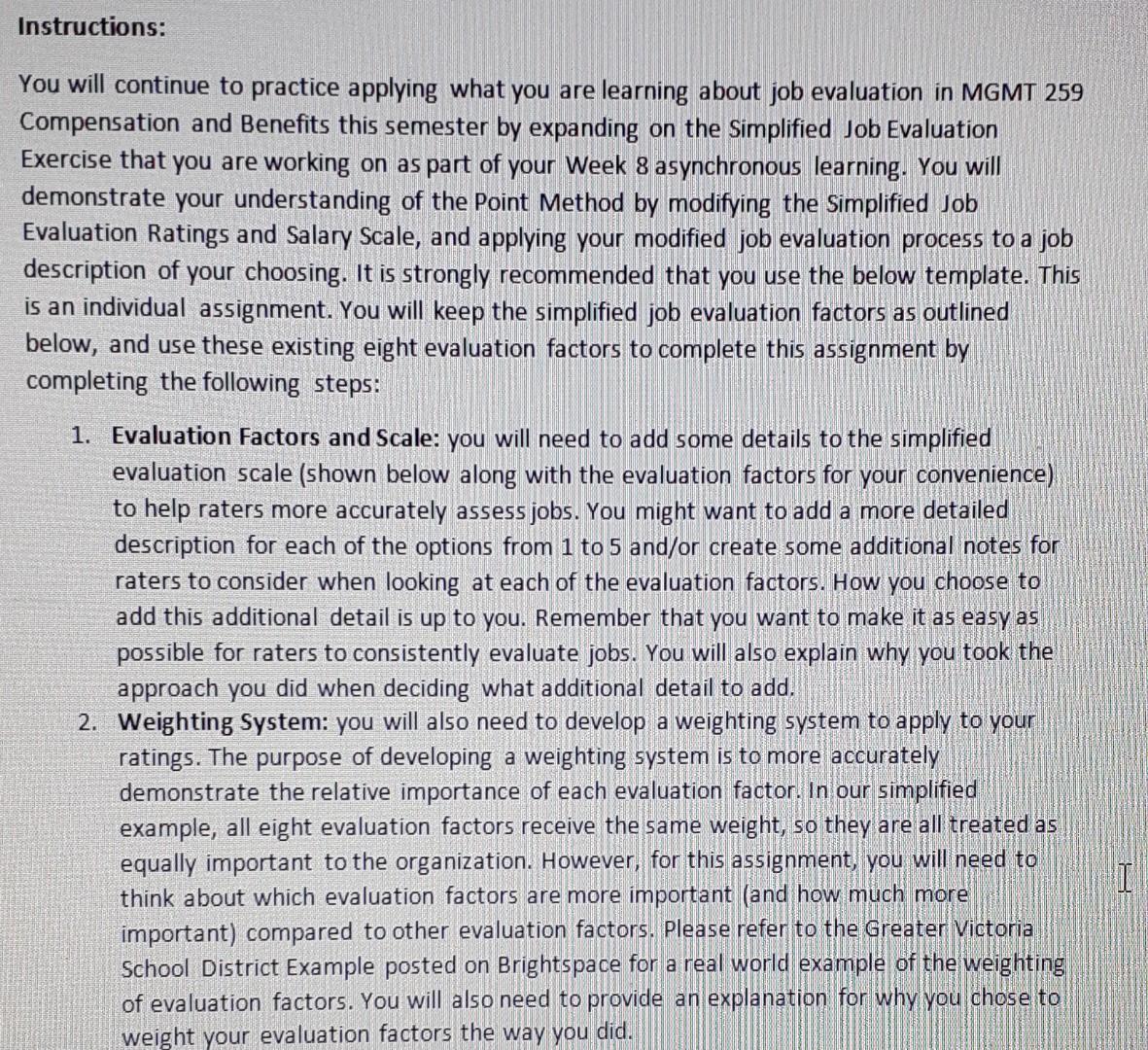
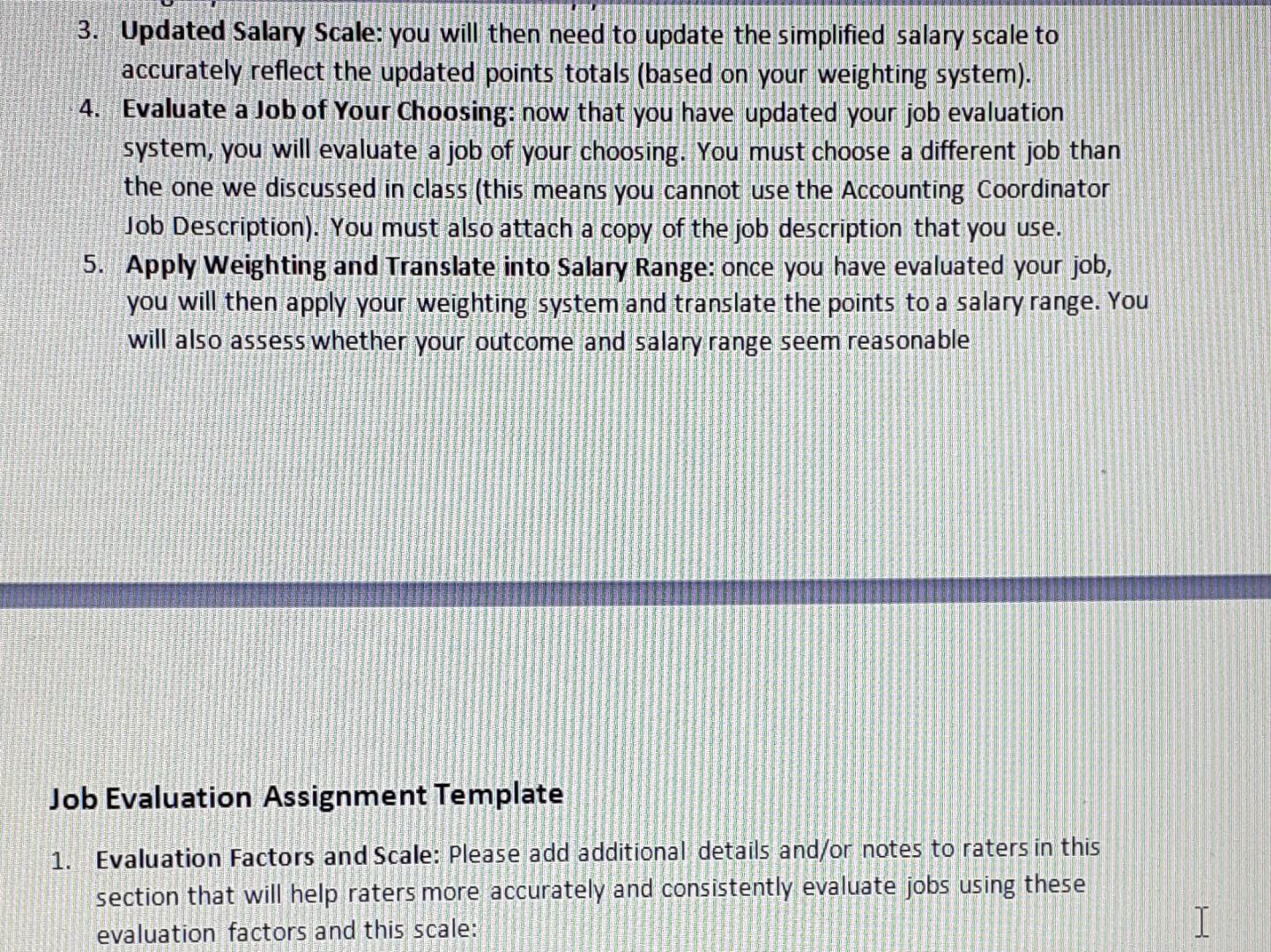
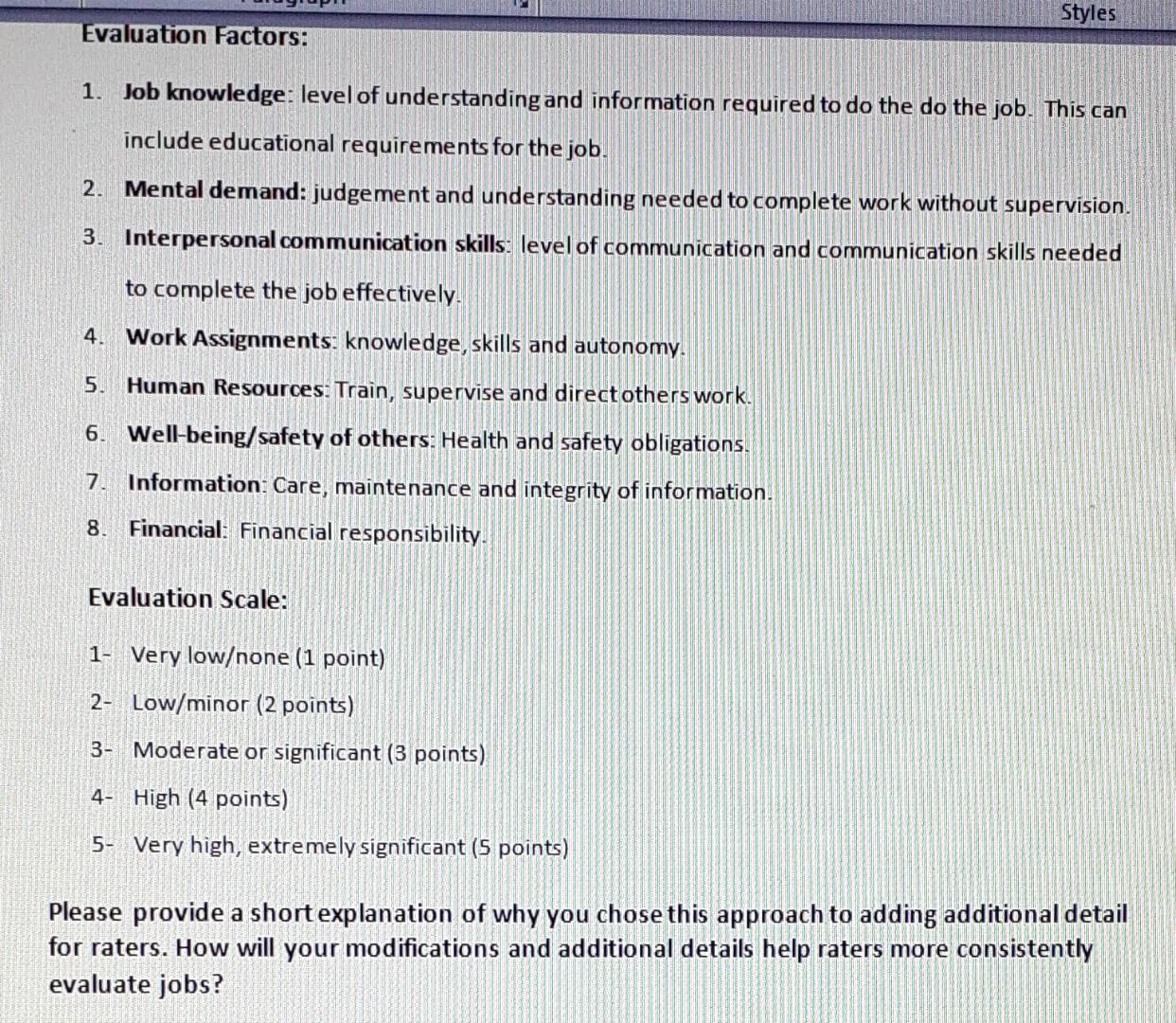
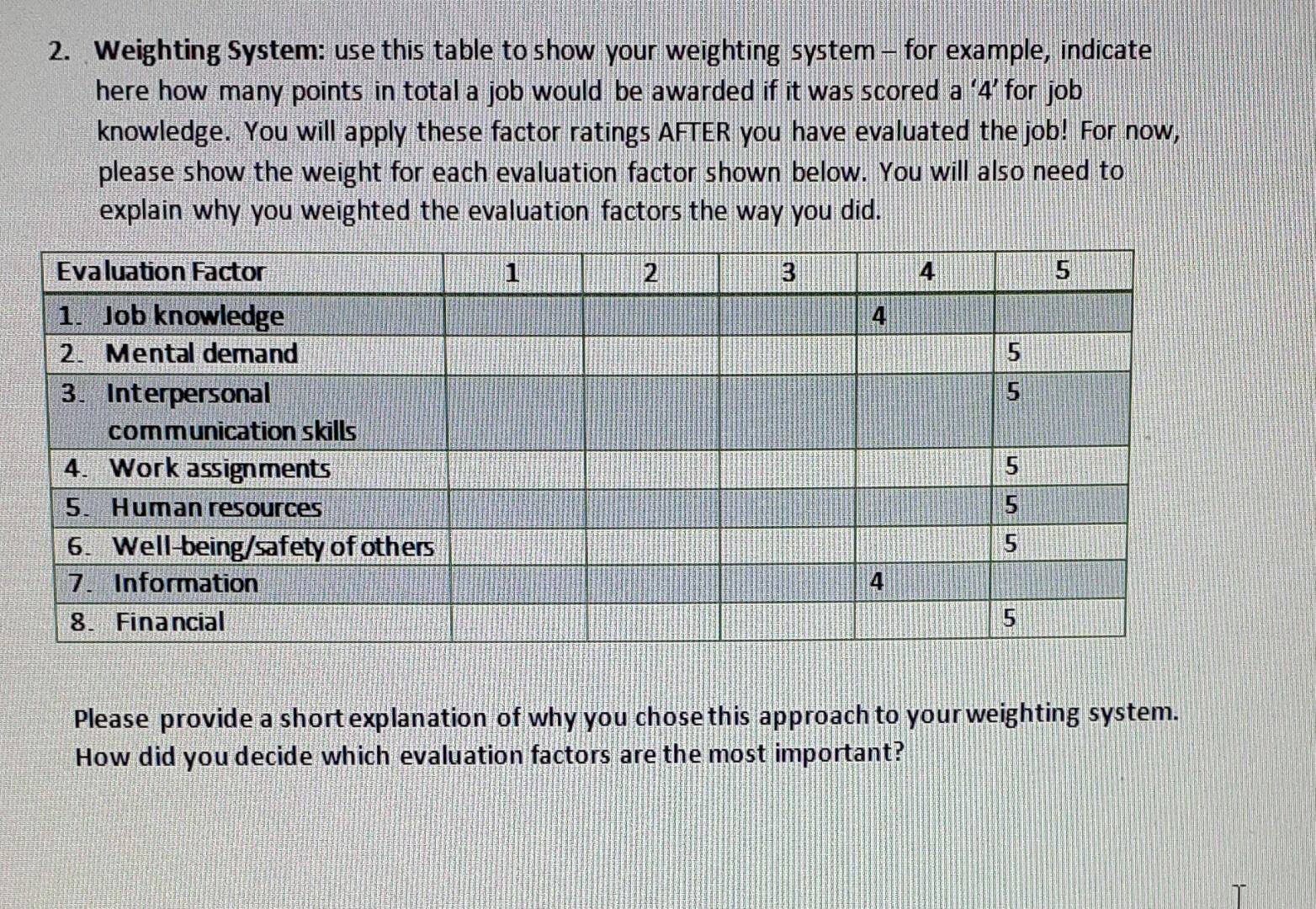
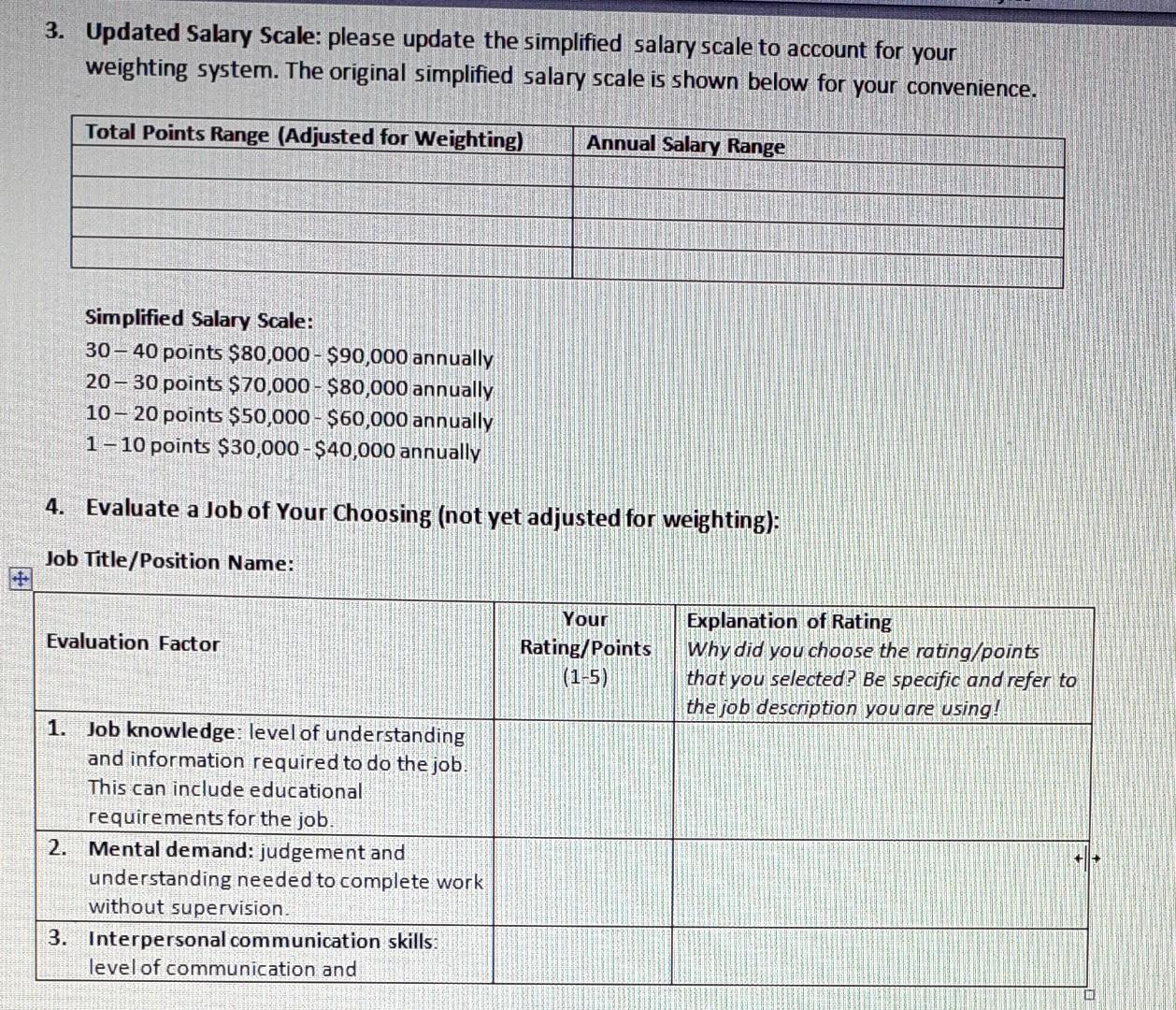
Instructions: You will continue to practice applying what you are learning about job evaluation in MGMT 259 Compensation and Benefits this semester by expanding on the Simplified Job Evaluation Exercise that you are working on as part of your Week 8 asynchronous learning. You will demonstrate your understanding of the Point Method by modifying the Simplified Job Evaluation Ratings and Salary Scale, and applying your modified job evaluation process to a job description of your choosing. It is strongly recommended that you use the below template. This is an individual assignment. You will keep the simplified job evaluation factors as outlined below, and use these existing eight evaluation factors to complete this assignment by completing the following steps: 1. Evaluation Factors and Scale: you will need to add some details to the simplified evaluation scale (shown below along with the evaluation factors for your convenience) to help raters more accurately assess jobs. You might want to add a more detailed description for each of the options from 1 to 5 and/or create some additional notes for raters to consider when looking at each of the evaluation factors. How you choose to add this additional detail is up to you. Remember that you want to make it as easy as possible for raters to consistently evaluate jobs. You will also explain why you took the approach you did when deciding what additional detail to add. 2. Weighting System: you will also need to develop a weighting system to apply to your ratings. The purpose of developing a weighting system is to more accurately demonstrate the relative importance of each evaluation factor. In our Simplified example, all eight evaluation factors receive the same weight, so they are all treated as equally important to the organization. However, for this assignment, you will need to think about which evaluation factors are more important (and how much more important) compared to other evaluation factors. Please refer to the Greater Victoria School District Example posted on Brightspace for a real world example of the weighting of evaluation factors. You will also need to provide an explanation for why you chose to weight your evaluation factors the way you did. 3. Updated Salary Scale: you will then need to update the simplified salary scale to accurately reflect the updated points totals (based on your weighting system). 4. Evaluate a Job of Your Choosing: now that you have updated your job evaluation system, you will evaluate a job of your choosing. You must choose a different job than the one we discussed in class (this means you cannot use the Accounting Coordinator Job Description). You must also attach a copy of the job description that you use. 5. Apply Weighting and Translate into Salary Range: once you have evaluated your job, you will then apply your weighting system and translate the points to a salary range. You will also assess whether your outcome and salary range seem reasonable Job Evaluation Assignment Template 1. Evaluation Factors and Scale: Please add additional details and/or notes to raters in this section that will help raters more accurately and consistently evaluate jobs using these evaluation factors and this scale: 1 Styles Evaluation Factors: 1. Job knowledge: level of understanding and information required to do the do the job. This can include educational requirements for the job. 2. Mental demand: judgement and understanding needed to complete work without supervision. 3. Interpersonal communication skills. level of communication and communication skills needed to complete the job effectively. 4. Work Assignments: knowledge, skills and autonomy. 5. Human Resources: Train, supervise and directothers work. 6. Well-being/safety of others: Health and safety obligations. 7. Information: Care, maintenance and integrity of information. 8 Financial: Financial responsibility. Evaluation Scale: 1- Very lowone (1 point) 2- Low/minor (2 points) 3- Moderate or significant (3 points) 4- High (4 points) 5- Very high, extremely significant (5 points) Please provide a short explanation of why you chose this approach to adding additional detail for raters. How will your modifications and additional details help raters more consistently evaluate jobs? 2. Weighting System: use this table to show your weighting system - for example, indicate here how many points in total a job would be awarded if it was scored a 'A' for job knowledge. You will apply these factor ratings AFTER you have evaluated the job! For now, please show the weight for each evaluation factor shown below. You will also need to explain why you weighted the evaluation factors the way you did. 2 3 4 5 4 5 5 Evaluation Factor 1. Job knowledge 2. Mental demand 3. Interpersonal communication skills 4. Work assignments 5. Human resources 6. Well-being/safety of others 7. Information 8 Financial 5 5 4 5 Please provide a short explanation of why you chose this approach to your weighting system. How did you decide which evaluation factors are the most important? 3. Updated Salary Scale: please update the simplified salary scale to account for your weighting system. The original simplified salary scale is shown below for your convenience. Total Points Range (Adjusted for Weighting) Annual Salary Range Simplified Salary Scale: 30- 40 points $80,000 - $90,000 annually 20-30 points $70,000 - $80,000 annually 10- 20 points $50,000 - $60,000 annually 1-10 points $30,000 - $40,000 annually 4. Evaluate a Job of Your Choosing (not yet adjusted for weighting): Job Title/Position Name: Evaluation Factor Your Rating/Points (1-5) Explanation of Rating Why did you choose the rating points that you selected? Be specific and refer to the job description you are using! 1. Job knowledge: level of understanding and information required to do the job. This can include educational requirements for the job. 2. Mental demand: judgement and understanding needed to complete work without supervision 3. Interpersonal communication skills: level of communication and Instructions: You will continue to practice applying what you are learning about job evaluation in MGMT 259 Compensation and Benefits this semester by expanding on the Simplified Job Evaluation Exercise that you are working on as part of your Week 8 asynchronous learning. You will demonstrate your understanding of the Point Method by modifying the Simplified Job Evaluation Ratings and Salary Scale, and applying your modified job evaluation process to a job description of your choosing. It is strongly recommended that you use the below template. This is an individual assignment. You will keep the simplified job evaluation factors as outlined below, and use these existing eight evaluation factors to complete this assignment by completing the following steps: 1. Evaluation Factors and Scale: you will need to add some details to the simplified evaluation scale (shown below along with the evaluation factors for your convenience) to help raters more accurately assess jobs. You might want to add a more detailed description for each of the options from 1 to 5 and/or create some additional notes for raters to consider when looking at each of the evaluation factors. How you choose to add this additional detail is up to you. Remember that you want to make it as easy as possible for raters to consistently evaluate jobs. You will also explain why you took the approach you did when deciding what additional detail to add. 2. Weighting System: you will also need to develop a weighting system to apply to your ratings. The purpose of developing a weighting system is to more accurately demonstrate the relative importance of each evaluation factor. In our Simplified example, all eight evaluation factors receive the same weight, so they are all treated as equally important to the organization. However, for this assignment, you will need to think about which evaluation factors are more important (and how much more important) compared to other evaluation factors. Please refer to the Greater Victoria School District Example posted on Brightspace for a real world example of the weighting of evaluation factors. You will also need to provide an explanation for why you chose to weight your evaluation factors the way you did. 3. Updated Salary Scale: you will then need to update the simplified salary scale to accurately reflect the updated points totals (based on your weighting system). 4. Evaluate a Job of Your Choosing: now that you have updated your job evaluation system, you will evaluate a job of your choosing. You must choose a different job than the one we discussed in class (this means you cannot use the Accounting Coordinator Job Description). You must also attach a copy of the job description that you use. 5. Apply Weighting and Translate into Salary Range: once you have evaluated your job, you will then apply your weighting system and translate the points to a salary range. You will also assess whether your outcome and salary range seem reasonable Job Evaluation Assignment Template 1. Evaluation Factors and Scale: Please add additional details and/or notes to raters in this section that will help raters more accurately and consistently evaluate jobs using these evaluation factors and this scale: 1 Styles Evaluation Factors: 1. Job knowledge: level of understanding and information required to do the do the job. This can include educational requirements for the job. 2. Mental demand: judgement and understanding needed to complete work without supervision. 3. Interpersonal communication skills. level of communication and communication skills needed to complete the job effectively. 4. Work Assignments: knowledge, skills and autonomy. 5. Human Resources: Train, supervise and directothers work. 6. Well-being/safety of others: Health and safety obligations. 7. Information: Care, maintenance and integrity of information. 8 Financial: Financial responsibility. Evaluation Scale: 1- Very lowone (1 point) 2- Low/minor (2 points) 3- Moderate or significant (3 points) 4- High (4 points) 5- Very high, extremely significant (5 points) Please provide a short explanation of why you chose this approach to adding additional detail for raters. How will your modifications and additional details help raters more consistently evaluate jobs? 2. Weighting System: use this table to show your weighting system - for example, indicate here how many points in total a job would be awarded if it was scored a 'A' for job knowledge. You will apply these factor ratings AFTER you have evaluated the job! For now, please show the weight for each evaluation factor shown below. You will also need to explain why you weighted the evaluation factors the way you did. 2 3 4 5 4 5 5 Evaluation Factor 1. Job knowledge 2. Mental demand 3. Interpersonal communication skills 4. Work assignments 5. Human resources 6. Well-being/safety of others 7. Information 8 Financial 5 5 4 5 Please provide a short explanation of why you chose this approach to your weighting system. How did you decide which evaluation factors are the most important? 3. Updated Salary Scale: please update the simplified salary scale to account for your weighting system. The original simplified salary scale is shown below for your convenience. Total Points Range (Adjusted for Weighting) Annual Salary Range Simplified Salary Scale: 30- 40 points $80,000 - $90,000 annually 20-30 points $70,000 - $80,000 annually 10- 20 points $50,000 - $60,000 annually 1-10 points $30,000 - $40,000 annually 4. Evaluate a Job of Your Choosing (not yet adjusted for weighting): Job Title/Position Name: Evaluation Factor Your Rating/Points (1-5) Explanation of Rating Why did you choose the rating points that you selected? Be specific and refer to the job description you are using! 1. Job knowledge: level of understanding and information required to do the job. This can include educational requirements for the job. 2. Mental demand: judgement and understanding needed to complete work without supervision 3. Interpersonal communication skills: level of communication andStep by Step Solution
There are 3 Steps involved in it
1 Expert Approved Answer
Step: 1 Unlock

Question Has Been Solved by an Expert!
Get step-by-step solutions from verified subject matter experts
Step: 2 Unlock
Step: 3 Unlock
 Study Help