







Question: The end plates (isosceles triangles) of the trough shown to the right were designed to withstand a fluid force of 5800 lb. Assuming the
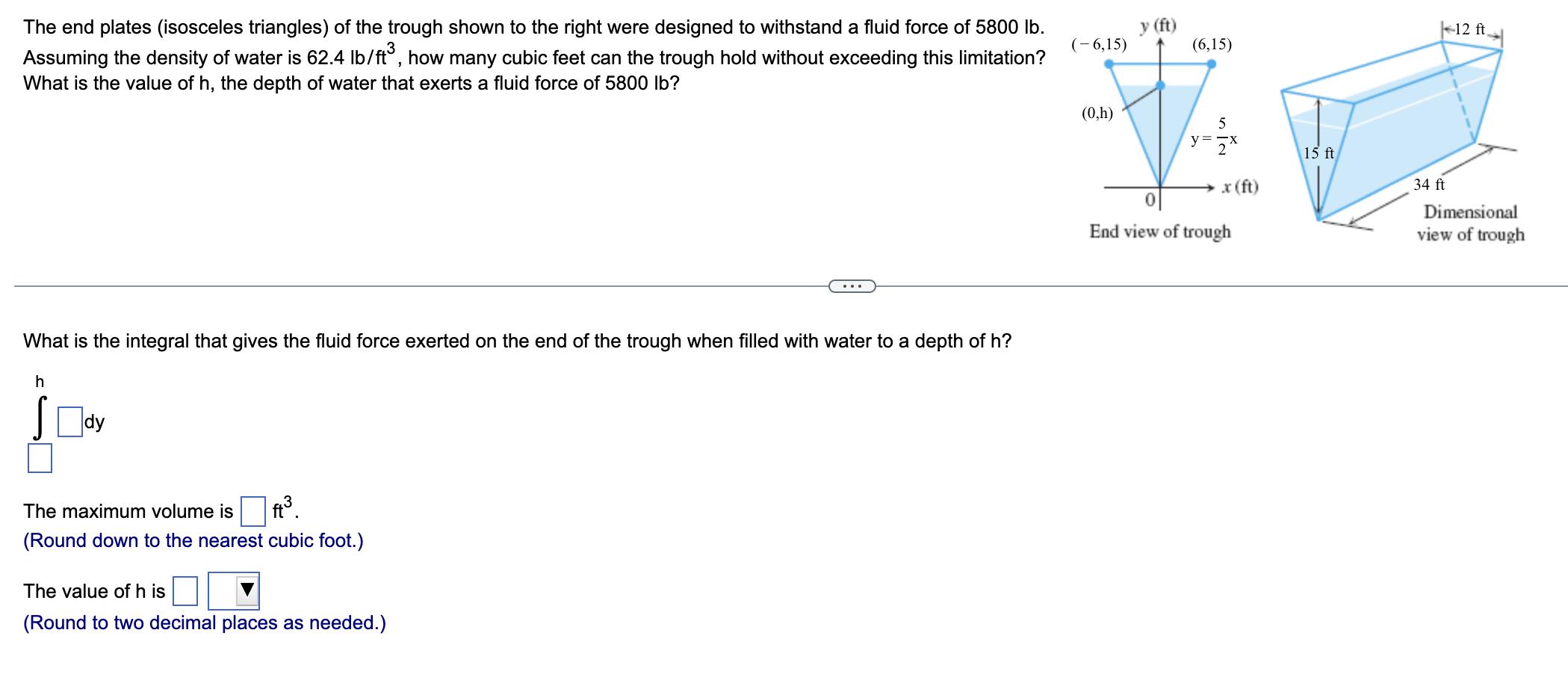
The end plates (isosceles triangles) of the trough shown to the right were designed to withstand a fluid force of 5800 lb. Assuming the density of water is 62.4 lb/ft, how many cubic feet can the trough hold without exceeding this limitation? What is the value of h, the depth of water that exerts a fluid force of 5800 lb? What is the integral that gives the fluid force exerted on the end of the trough when filled with water to a depth of h? h S dy The maximum volume is ft. (Round down to the nearest cubic foot.) ... The value of h is (Round to two decimal places as needed.) (-6,15) (0,h) y (ft) (6,15) 5 y = -x x (ft) End view of trough 15 ft 34 ft 12 ft Dimensional view of trough
Step by Step Solution
3.35 Rating (161 Votes )
There are 3 Steps involved in it
lar Give... View full answer

Get step-by-step solutions from verified subject matter experts
 Study Help