







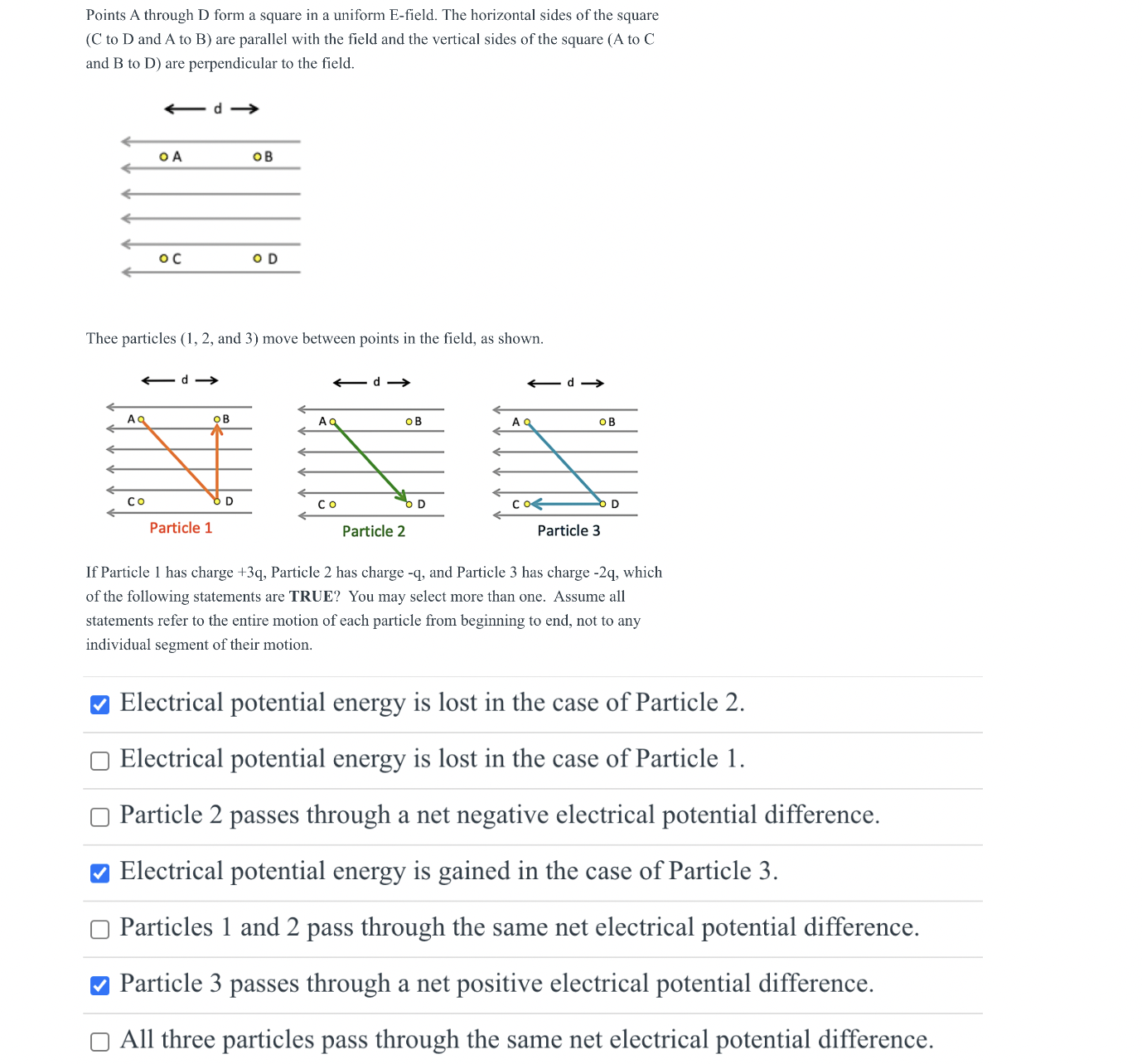
Question: Points A through D form a square in a uniform E - field. The horizontal sides of the Points A through D form a square
Points A through D form a square in a uniform Efield. The horizontal sides of the Points A through D form a square in a uniform Efield. The horizontal sides of the square
C to D and A to B are parallel with the field and the vertical sides of the square A to C
and to are perpendicular to the field.
Thee particles and move between points in the field, as shown.
If Particle has charge Particle has charge and Particle has charge which
of the following statements are TRUE? You may select more than one. Assume all
statements refer to the entire motion of each particle from beginning to end, not to any
individual segment of their motion.
Electrical potential energy is lost in the case of Particle
Electrical potential energy is lost in the case of Particle
Particle passes through a net negative electrical potential difference.
Electrical potential energy is gained in the case of Particle
Particles and pass through the same net electrical potential difference.
Particle passes through a net positive electrical potential difference.
All three particles pass through the same net electrical potential difference.square C to D and A to B are parallel with the field and the vertical sides of the square A to C and B to D are perpendicular to the field.
particle in Efield just field.png
Thee particles and move between points in the field, as shown.
Step by Step Solution
There are 3 Steps involved in it
1 Expert Approved Answer
Step: 1 Unlock

Question Has Been Solved by an Expert!
Get step-by-step solutions from verified subject matter experts
Step: 2 Unlock
Step: 3 Unlock
 Study Help