







Question: Population sizes can often be modeled by a Logistic Function. This is given by a composition of an exponential and rational function, [f(t)=frac{Kt}{t+A},text{ and }g(t)=e^{rt},,1]
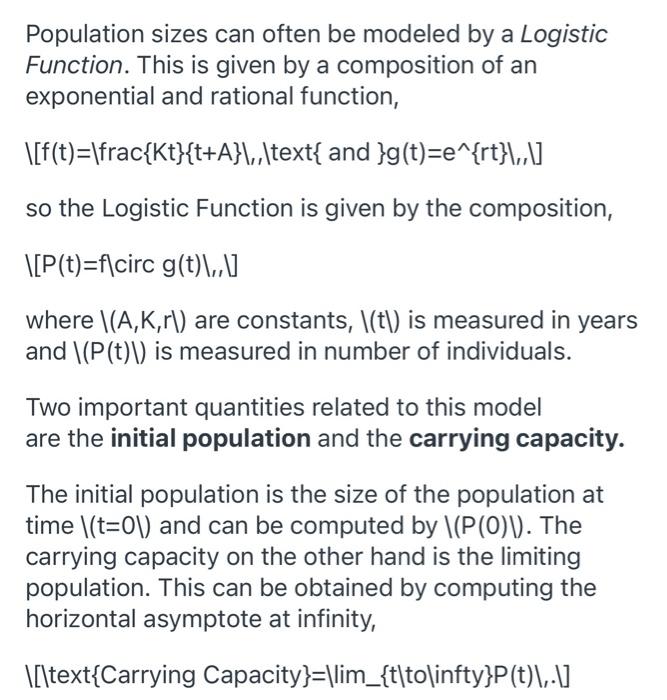
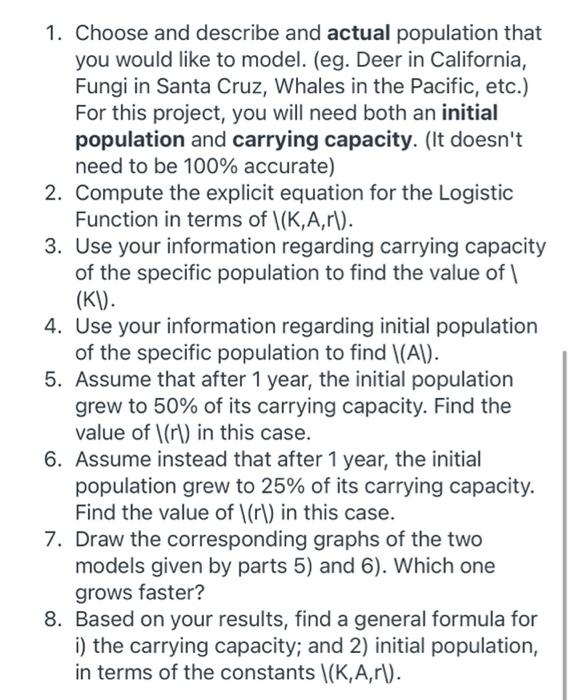
Population sizes can often be modeled by a Logistic Function. This is given by a composition of an exponential and rational function, \[f(t)=\frac{Kt}{t+A}\,\text{ and }g(t)=e^{rt}\,,1] so the Logistic Function is given by the composition, \[P(t)=f\circ g(t)\,,1] where \(A,K,r\) are constants, t is measured in years and P(t) is measured in number of individuals. Two important quantities related to this model are the initial population and the carrying capacity. The initial population is the size of the population at time t=0 and can be computed by \(POV). The carrying capacity on the other hand is the limiting population. This can be obtained by computing the horizontal asymptote at infinity, \[\text{Carrying Capacity}=\lim_{t\to\infty}P(t)\,:] 1. Choose and describe and actual population that you would like to model. (eg. Deer in California, Fungi in Santa Cruz, Whales in the Pacific, etc.) For this project, you will need both an initial population and carrying capacity. (It doesn't need to be 100% accurate) 2. Compute the explicit equation for the Logistic Function in terms of K,Ar).3.Useyourinformationregardingcarryingcapacityofthespecificpopulationtofindthevalueof(KV).4.Useyourinformationregardinginitialpopulationofthespecificpopulationtofind(Al).5.Assumethatafter1year,theinitialpopulationgrewto50 in this case. 6. Assume instead that after 1 year, the initial population grew to 25% of its carrying capacity. Find the value of r in this case. 7. Draw the corresponding graphs of the two models given by parts 5) and 6). Which one grows faster? 8. Based on your results, find a general formula for i) the carrying capacity; and 2) initial population, in terms of the constants \(K,A,PV). Population sizes can often be modeled by a Logistic Function. This is given by a composition of an exponential and rational function, \[f(t)=\frac{Kt}{t+A}\,\text{ and }g(t)=e^{rt}\,,1] so the Logistic Function is given by the composition, \[P(t)=f\circ g(t)\,,1] where \(A,K,r\) are constants, t is measured in years and P(t) is measured in number of individuals. Two important quantities related to this model are the initial population and the carrying capacity. The initial population is the size of the population at time t=0 and can be computed by \(POV). The carrying capacity on the other hand is the limiting population. This can be obtained by computing the horizontal asymptote at infinity, \[\text{Carrying Capacity}=\lim_{t\to\infty}P(t)\,:] 1. Choose and describe and actual population that you would like to model. (eg. Deer in California, Fungi in Santa Cruz, Whales in the Pacific, etc.) For this project, you will need both an initial population and carrying capacity. (It doesn't need to be 100% accurate) 2. Compute the explicit equation for the Logistic Function in terms of K,Ar).3.Useyourinformationregardingcarryingcapacityofthespecificpopulationtofindthevalueof(KV).4.Useyourinformationregardinginitialpopulationofthespecificpopulationtofind(Al).5.Assumethatafter1year,theinitialpopulationgrewto50 in this case. 6. Assume instead that after 1 year, the initial population grew to 25% of its carrying capacity. Find the value of r in this case. 7. Draw the corresponding graphs of the two models given by parts 5) and 6). Which one grows faster? 8. Based on your results, find a general formula for i) the carrying capacity; and 2) initial population, in terms of the constants \(K,A,PV)
Step by Step Solution
There are 3 Steps involved in it

Get step-by-step solutions from verified subject matter experts
 Study Help