







Question: possible race conditions on various structures. Most scheduling algorithms maintain a run lists processes eligible to run on a processor. On are two general options:
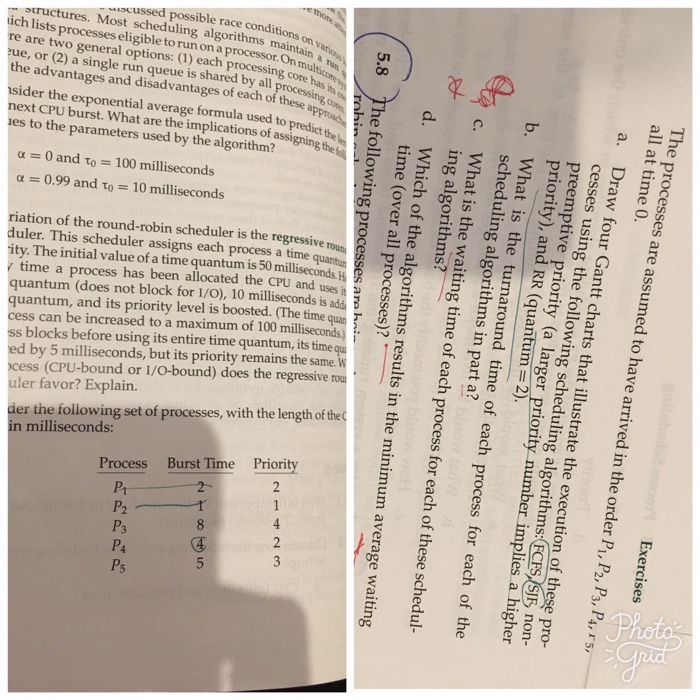
possible race conditions on various structures. Most scheduling algorithms maintain a run lists processes eligible to run on a processor. On are two general options: (1) each processing core has its or (2) a single run queue is shared by all processing the advantages and disadvantages of each of these the exponential average formula used to predict next CPU burst. What are the implications of assigning the to the parameters used by the algorithm? alpha = 0 and tau_0 = 100 milliseconds alpha = 0.99 and tau_0 = 10 milliseconds of the round-robin scheduler is the regressive round This scheduler assigns each process a time The initial value of a time quantum is 50 milliseconds. time a process has been allocated the CPU and uses quantum (does not block for I/O), 10 milliseconds is quantum, and its priority level is boosted. (The time can be increased to a maximum of 100 milliseconds.) blocks before using its entire time quantum, its time by 5 milliseconds, but its priority remains the same. (CPU-bound or I/O-bound) does the regressive favor? Explain. the following set of processes, with the length of the milliseconds: The processes are assumed to have arrived in the order P_1, P_2, P_3, P_4, P_5, all at time 0. a. Draw four Gantt charts that illustrate the execution of these processes using the following scheduling algorithms: FCFS, SJF, non-preemptive priority (a larger priority number implies a higher priority), and RR (quantum = 2). b. What is the turnaround time of each process for each of the scheduling algorithms in part a? c. What is the waiting time of each process for each of these scheduling algorithms? D. Which of the algorithms results in the minimum average waiting time (over all processes)
Step by Step Solution
There are 3 Steps involved in it

Get step-by-step solutions from verified subject matter experts
 Study Help