







Question: Post 1: Initial Post This posting should be a minimum of one short paragraph and a maximum of two paragraphs. Word totals for this post
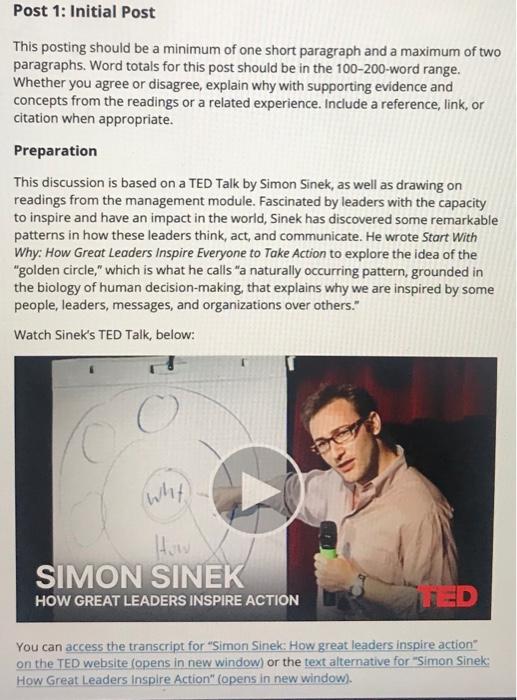
Post 1: Initial Post This posting should be a minimum of one short paragraph and a maximum of two paragraphs. Word totals for this post should be in the 100-200-word range. Whether you agree or disagree, explain why with supporting evidence and concepts from the readings or a related experience. Include a reference, link, or citation when appropriate. Preparation This discussion is based on a TED Talk by Simon Sinek, as well as drawing on readings from the management module. Fascinated by leaders with the capacity to inspire and have an impact in the world, Sinek has discovered some remarkable patterns in how these leaders think, act, and communicate. He wrote Start With Why: How Great Leaders Inspire Everyone to Take Action to explore the idea of the "golden circle," which is what he calls "a naturally occurring pattern, grounded in the biology of human decision-making, that explains why we are inspired by some people, leaders, messages, and organizations over others." Watch Sinek's TED Talk, below: SIMON SINEK HOW GREAT LEADERS INSPIRE ACTION TED You can access the transcript for "Simon Sinek: How great leaders inspire action" on the TED website (opens in new window) or the text alternative for "Simon Sinek: How Great Leaders Inspire Action" (opens in new window) For Discussion 1. Select the portion of Sinek's TED Talk that made the greatest impact on you personally as you listened. You can read the transcript to find his exact words and make sure you capture his message. Why did you select this portion? 2. Thinking about what you learned from the readings in this module, answer the following question: How important is it for managers and leaders in business to understand Sinek's concluding statement, below? Because there are leaders and there are those who lead. Leaders hold a position of power or authority, but those who lead inspire us. Whether they're individuals or organizations, we follow those who lead, not because we have to, but because we want to. We follow those who lead, not for them, but for ourselves. Post 1: Initial Post This posting should be a minimum of one short paragraph and a maximum of two paragraphs. Word totals for this post should be in the 100-200-word range. Whether you agree or disagree, explain why with supporting evidence and concepts from the readings or a related experience. Include a reference, link, or citation when appropriate. Preparation This discussion is based on a TED Talk by Simon Sinek, as well as drawing on readings from the management module. Fascinated by leaders with the capacity to inspire and have an impact in the world, Sinek has discovered some remarkable patterns in how these leaders think, act, and communicate. He wrote Start With Why: How Great Leaders Inspire Everyone to Take Action to explore the idea of the "golden circle," which is what he calls "a naturally occurring pattern, grounded in the biology of human decision-making, that explains why we are inspired by some people, leaders, messages, and organizations over others." Watch Sinek's TED Talk, below: SIMON SINEK HOW GREAT LEADERS INSPIRE ACTION TED You can access the transcript for "Simon Sinek: How great leaders inspire action" on the TED website (opens in new window) or the text alternative for "Simon Sinek: How Great Leaders Inspire Action" (opens in new window) For Discussion 1. Select the portion of Sinek's TED Talk that made the greatest impact on you personally as you listened. You can read the transcript to find his exact words and make sure you capture his message. Why did you select this portion? 2. Thinking about what you learned from the readings in this module, answer the following question: How important is it for managers and leaders in business to understand Sinek's concluding statement, below? Because there are leaders and there are those who lead. Leaders hold a position of power or authority, but those who lead inspire us. Whether they're individuals or organizations, we follow those who lead, not because we have to, but because we want to. We follow those who lead, not for them, but for ourselves
Step by Step Solution
There are 3 Steps involved in it

Get step-by-step solutions from verified subject matter experts
 Study Help