







Question: Post Office Simulation -A Post Office is simulated by using threads to model customer and employee behavior. -This project is similar to the barbershop example
Post Office Simulation
-A Post Office is simulated by using threads to model customer and employee behavior.
-This project is similar to the barbershop example in the textbook. The following rules apply:
Customer:
1)50 customers visit the Post Office (1 thread per customer up to 50), all created initially.
2)Only 10 customers can be inside the Post Office at a time.
3)Each customer upon creation is randomly assigned one of the following tasks:
a)buy stamps
b)mail a letter
c)mail a package
4)Times for each task are defined in the task table.
Postal Worker:
1)3 created initially, one thread each.
2)Serves next customer in line.
3)Service time varies depending on customer task.
Scales:
1)Used by the postal worker when mailing a package.
2)There is only one, which can only be used one at a time.
3)The scales are not a thread. They are just a resource the postal worker threads use.
Other rules:
1)A thread should sleep 1 second in the program for each 60 seconds listed in the table.
2)All mutual exclusion and coordination must be achieved with semaphores.
3)A thread may not use sleeping as a means of coordination.
4)Busy waiting (polling) is not allowed.
5)Mutual exclusion should be kept to a minimum to allow the most concurrency.
6)Each thread should print when it is created and when it is joined.
7)Each thread should only print its own activities. The customer threads prints customer actions and the postal worker threads prints postal worker actions.
8)Your output must include the same information and the same set of steps as the sample output.
Output:
1)Each step of each task of each thread should be printed to the screen with identifying numbers so it is clear which threads are involved.
2)Thread output sample. The wording in your output should exactly match the sample.
Simulating Post Office with 50 customers and 3 postal workers
Postal worker 0 created
Postal worker 2 created
Postal worker 1 created
Customer 0 created
Customer 0 enters post office
Customer 9 created
Customer 9 enters post office
Customer 10 created
Postal worker 0 serving customer 0
Customer 11 created
Postal worker 2 serving customer 1
Postal worker 1 serving customer 2
Customer 0 asks postal worker 0 to buy stamps
Customer 2 asks postal worker 1 to mail a package
Customer 1 asks postal worker 2 to mail a package
Scales in use by postal worker 1
Postal worker 0 finished serving customer 0
Customer 0 finished buying stamps
Postal worker 0 serving customer 3
Customer 3 asks postal worker 0 to mail a letter
Customer 0 leaves post office
Customer 10 enters post office
Joined customer 0
Scales released by postal worker 1
Postal worker 1 finished serving customer 2
Customer 5 asks postal worker 1 to mail a package
Scales in use by postal worker 2
Customer 2 finished mailing a package
Postal worker 1 serving customer 5
Customer 2 leaves post office
Postal worker 0 finished serving customer 3
Customer 3 finished mailing a letter
Postal worker 0 serving customer 4
Customer 4 asks postal worker 0 to mail a letter
Customer 3 leaves post office
Scales released by postal worker 2
Postal worker 2 finished serving customer 1
Scales in use by postal worker 1
Customer 1 finished mailing a package
Customer 1 leaves post office
Joined customer 1
Joined customer 2
Joined customer 3
TABLE TASK:
buy stamp: 60 sec
mail a letter : 90 sec
mail a package: 120 sec (sclases are used entire time)
***DESIGN NEED TO BE SIMILAR TO THE FOLLOWING BARBER SHOP PSEUDOCODE USING WAIT AND SIGNAL CALL
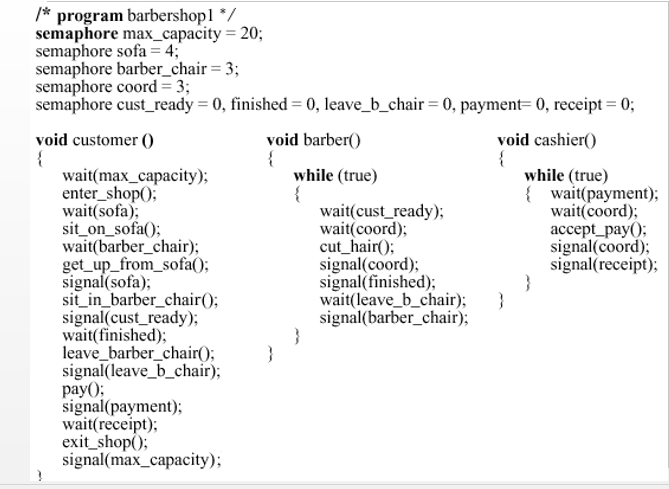
program barbershop1 semaphore sofa*4; semaphore barber chair semaphore coord -3; semaphore cust ready 0, finished-0, eave b chair 0, paymen 0, receipt 0 void barber void cashier 0 void customer o while (true) while (true) wait(max capacity); enter shop0, wait payment); wait (cust ready); wait(sofa); wait (coord); sit on sofa0; wait(coord); accept payo; cut hairo; wait(barber chair); signal (coord); get up from sofa0; signal (coord); signal (receipt); signal(sofa), signal(finished); sit in barber chairo; wait leave b chair); signal (cust ready); signal barber chair); wait(finished); leave barber chairo; signal(leave b chair); pay0; signal (payment); wait(receipt). exit shop signal(max capacity)
Step by Step Solution
There are 3 Steps involved in it

Get step-by-step solutions from verified subject matter experts
 Study Help