Question: POST TEST 1. This involves the developing of an overall strategy for the expected conduct and scope of the examination; the nature, extent and timing.
POST TEST 1. This involves the developing of anPOST TEST 1. This involves the developing of anPOST TEST 1. This involves the developing of anPOST TEST 1. This involves the developing of an
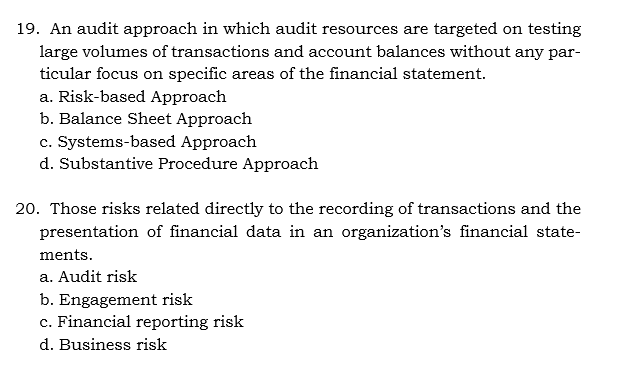
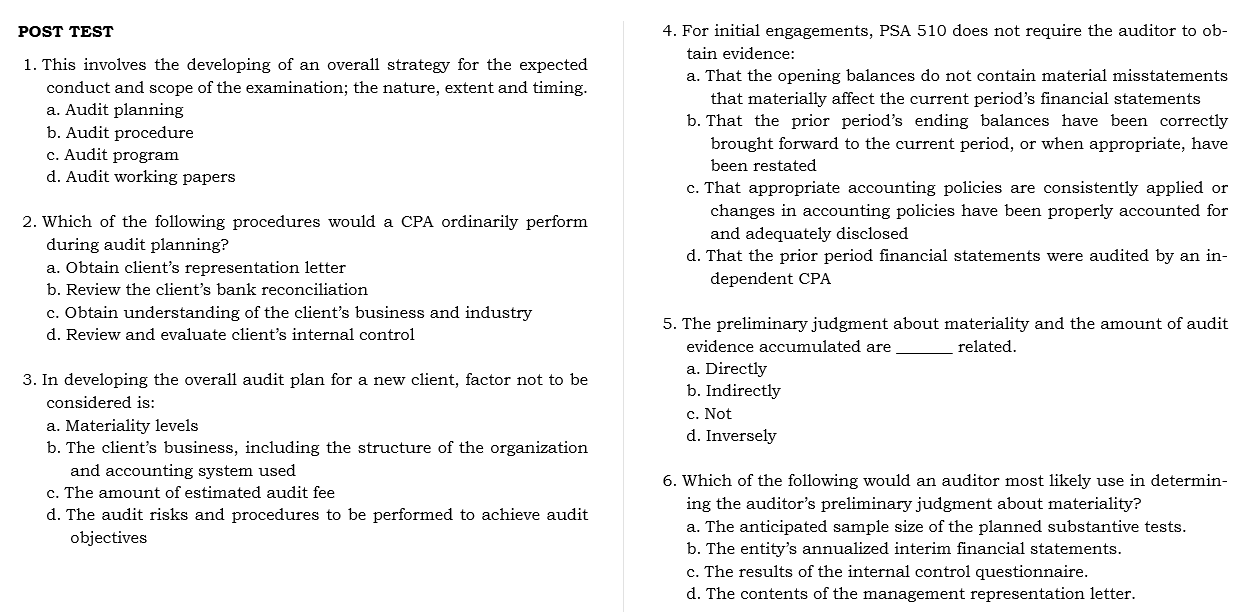
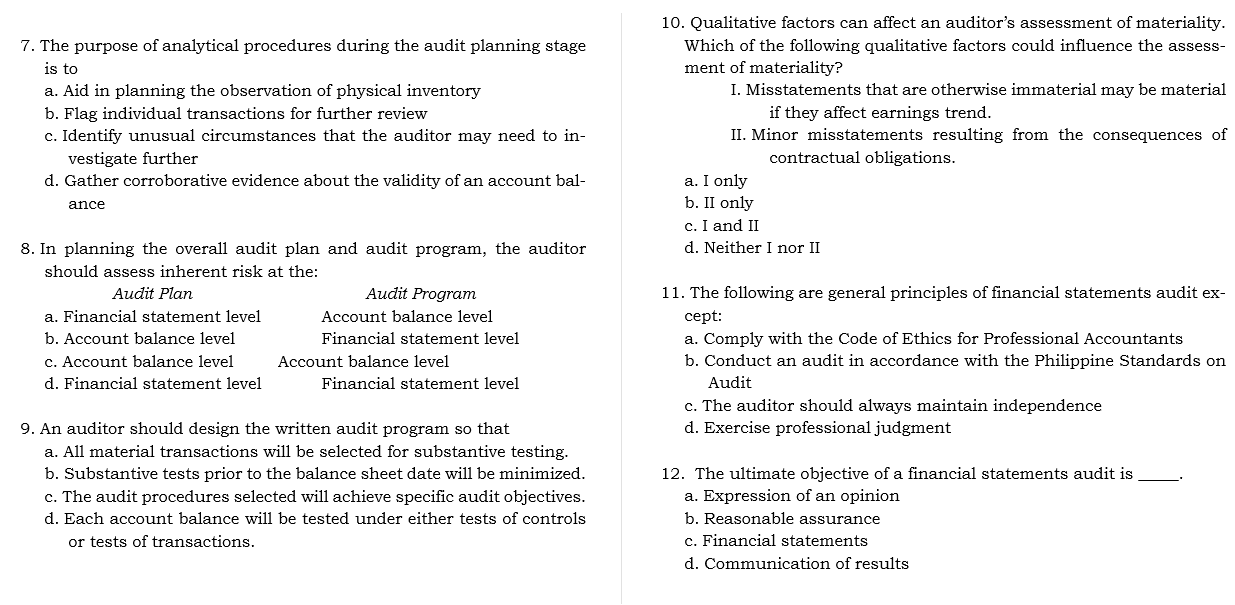
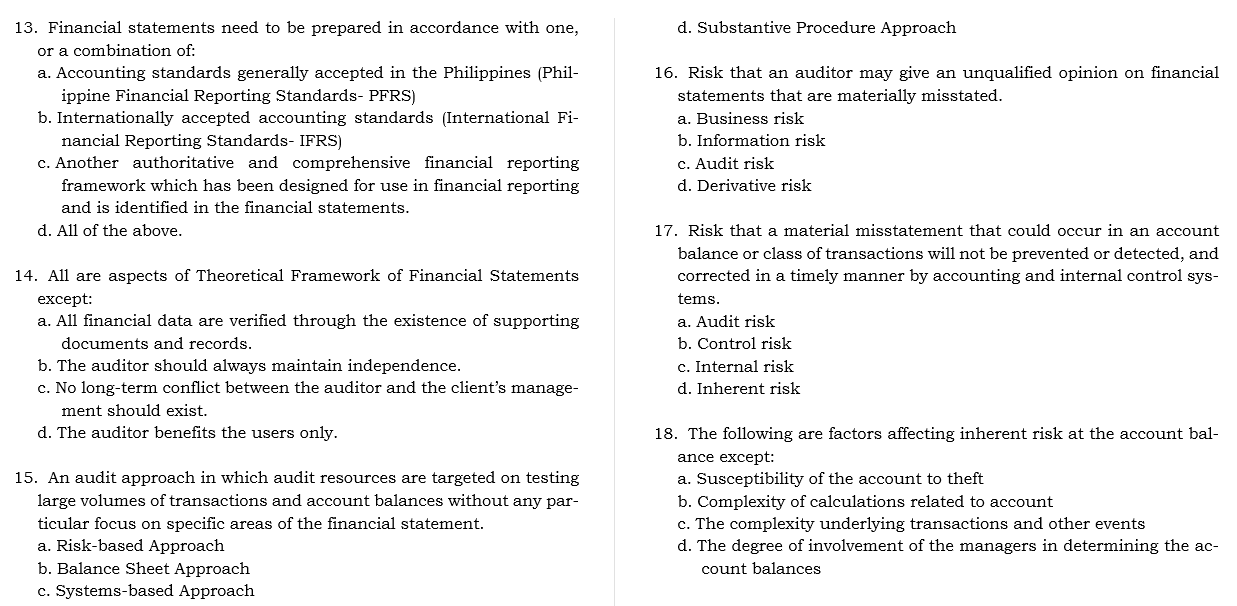
POST TEST 1. This involves the developing of an overall strategy for the expected conduct and scope of the examination; the nature, extent and timing. a. Audit planning b. Audit procedure c. Audit program d. Audit working papers 2. Which of the following procedures would a CPA ordinarily perform during audit planning? a. Obtain client's representation letter b. Review the client's bank reconciliation c. Obtain understanding of the client's business and industry d. Review and evaluate client's internal control 3. [n developing the overall audit plan for a new client, factor not to be considered is: a. Materiality levels b. The client's business, including the structure of the organization and accounting system used c. The amount of estimated audit fee d. The audit risks and procedures to be performed to achieve audit objectives 4. For initial engagements, PSA 510 does not require the auditor to ob tain evidence: a. That the opening balances do not contain material misstatements that materially affect the current period's nancial statements b. That the prior period's ending balances have been correctly brought forward to the current period, or when appropriate, have been restated c. That appropriate accounting policies are consistently applied or changes in accounting policies have been properly accounted for and adequately disclosed d. That the prior period nancial statements were audited by an in dependent CPA 5. The preliminary judgment about materiality and the amount of audit evidence accumulated are related. a. Directly b. Indirectly c. Not d. Inversely 6. Which of the following would an auditor most likely use in determin ing le auditor's preliminary judgment about materiality? a. The anticipated sample size of the planned substantive tests. b. The entity's annualized interim nancial statements. c. The results of the internal control questionnaire. d. The contents of the management representation letter. 10. Qualitative factors can affect an auditor's assessment of materiality. 7. The purpose of analytical procedures during the audit planning stage Which of the following qualitative factors could influence the assess- is to ment of materiality? a. Aid in planning the observation of physical inventory I. Misstatements that are otherwise immaterial may be material b. Flag individual transactions for further review if they affect earnings trend. c. Identify unusual circumstances that the auditor may need to in- II. Minor misstatements resulting from the consequences of vestigate further contractual obligations. d. Gather corroborative evidence about the validity of an account bal- a. I only ance b. II only c. I and II 8. In planning the overall audit plan and audit program, the auditor d. Neither I nor II should assess inherent risk at the: Audit Plan Audit Program 11. The following are general principles of financial statements audit ex- a. Financial statement level Account balance level cept: b. Account balance level Financial statement level a. Comply with the Code of Ethics for Professional Accountants c. Account balance level Account balance level b. Conduct an audit in accordance with the Philippine Standards on d. Financial statement level Financial statement level Audit c. The auditor should always maintain independence 9. An auditor should design the written audit program so that d. Exercise professional judgment a. All material transactions will be selected for substantive testing. b. Substantive tests prior to the balance sheet date will be minimized. 12. The ultimate objective of a financial statements audit is c. The audit procedures selected will achieve specific audit objectives. a. Expression of an opinion d. Each account balance will be tested under either tests of controls b. Reasonable assurance or tests of transactions. c. Financial statements d. Communication of results13. Financial statements need to be prepared in accordance with one, d. Substantive Procedure Approach or a combination of: a. Accounting standards generally accepted in the Philippines (Phil- 16. Risk that an auditor may give an unqualified opinion on financial ippine Financial Reporting Standards- PFRS) statements that are materially misstated. b. Internationally accepted accounting standards (International Fi- a. Business risk nancial Reporting Standards- IFRS) b. Information risk c. Another authoritative and comprehensive financial reporting c. Audit risk framework which has been designed for use in financial reporting d. Derivative risk and is identified in the financial statements. d. All of the above. 17. Risk that a material misstatement that could occur in an account balance or class of transactions will not be prevented or detected, and 14. All are aspects of Theoretical Framework of Financial Statements corrected in a timely manner by accounting and internal control sys- except: tems. a. All financial data are verified through the existence of supporting a. Audit risk documents and records. b. Control risk b. The auditor should always maintain independence. c. Internal risk c. No long-term conflict between the auditor and the client's manage- d. Inherent risk ment should exist. d. The auditor benefits the users only. 18. The following are factors affecting inherent risk at the account bal- ance except: 15. An audit approach in which audit resources are targeted on testing a. Susceptibility of the account to theft large volumes of transactions and account balances without any par- b. Complexity of calculations related to account ticular focus on specific areas of the financial statement. c. The complexity underlying transactions and other events a. Risk-based Approach d. The degree of involvement of the managers in determining the ac- b. Balance Sheet Approach count balances c. Systems-based Approach19. An audit approach in which audit resources are targeted on testing large volumes of transactions and account balances without any par- ticular focus on specific areas of the financial statement. a. Risk-based Approach b. Balance Sheet Approach c. Systems-based Approach d. Substantive Procedure Approach 20. Those risks related directly to the recording of transactions and the presentation of financial data in an organization's financial state- ments. a. Audit risk b. Engagement risk c. Financial reporting risk d. Business risk
Step by Step Solution

There are 3 Steps involved in it

1 Expert Approved Answer
Step: 1 Unlock blur-text-image

Question Has Been Solved by an Expert!

Get step-by-step solutions from verified subject matter experts

Step: 2 Unlock
Step: 3 Unlock

Students Have Also Explored These Related Accounting Questions!