







Question: Posted the same information on the Image right below, so it is clear to see. Please use MATLAB (a) Write equation (1) as a system
Posted the same information on the Image right below, so it is clear to see.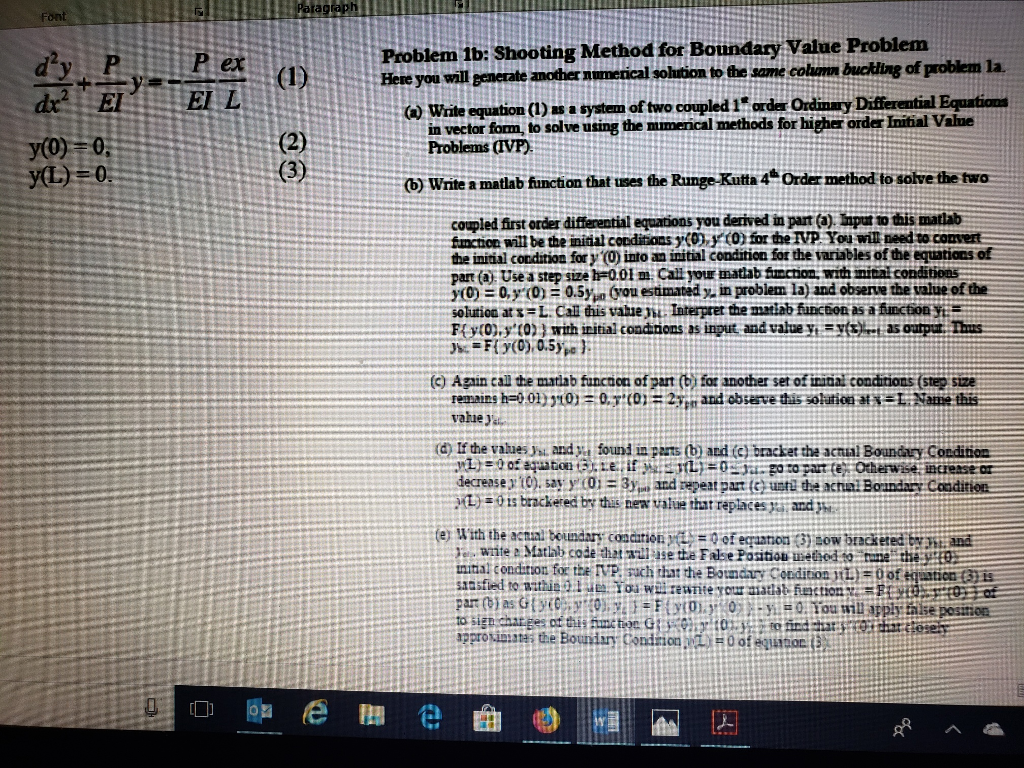 Please use MATLAB
(a) Write equation (1) as a system of two coupled 1st order Ordinary Differential Equations in vector form, to solve using the numerical methods for higher order Initial Value Problems (IVP).
(b) Write a matlab function that uses the Runge-Kutta 4th Order method to solve the twocoupled first order differential equations you derived in part (a). Input to this matlab function will be the initial conditions ?? 0 , ??! 0 for the IVP. You will need to convert the initial condition for y(0) into an initial condition for the variables of the equations of part (a). Use a step size h=0.01 m. Call your matlab function, with initial conditions ?? 0 = 0, ??! 0 = 0.5??!" (you estimated yp0 in problem 1a) and observe the value of the solution at x = L. Call this value ybL. Interpret the matlab function as a function yL = F{ ?? 0 , ??! 0 } with initial conditions as input, and value yL = y(x)|x=L as output. Thus ybL = F{ ?? 0 , 0.5??!" }.
(c) Again call the matlab function of part (b) for another set of initial conditions (step size remains h=0.01) ?? 0 = 0, ??! 0 = 2??!" and observe this solution at x = L. Name this value ycL.
(d) If the values ybL and ycL found in parts (b) and (c) bracket the actual Boundary Condition y(L) = 0 of equation (3), i.e., if ybL ? y(L) = 0 ? ycL, go to part (e). Otherwise, increase or decrease y(0), say ??! 0 = 3??!" and repeat part (c) until the actual Boundary Condition y(L) = 0 is bracketed by this new value that replaces ycL and ybL.
(e) With the actual boundary condition y(L) = 0 of equation (3) now bracketed by ybL and ycL, write a Matlab code that will use the False Position method to tune the ??! 0 initial condition for the IVP, such that the Boundary Condition y(L) = 0 of equation (3) is satisfied to within 0.1 ?m. You will rewrite your matlab function yL = F{ ?? 0 , ??! 0 } of part (b) as G{ ?? 0 , ??! 0 , ??! } = F{ ?? 0 , ??! 0 } - yL = 0. You will apply false position to sign changes of this function G{ ?? 0 , ??! 0 , ??! } to find that ??! 0 that closely approximates the Boundary Condition y(L) = 0 of equation (3).
Hint: Find an equivalent initial condition Y1 on y(a)such that after solving the ODE for y(x) your solution agrees with the boundary condition at x = b. Using a second order Taylor series y(b) = y(a) + y(a) (b-a) + 1/2 y(a) (b-a)2 and the ODE y(x) + p(x) y(x) q(x) + y(x) = r(x) evaluated at x = a for y(a) in the Taylor series leads to a first estimate y(a) = Y1. Define F{y(a)} = y(b) B, where B is the value of the boundary condition at x = b and the estimate y(b) is obtained via shooting y(x) from the numerical solver to x = b. Note if y(b) exactly equals B, F = 0, otherwise F > 0 or F aph ont Problem 1b: Shooting Method for Boundary Value Problem Heae you will penerate another sonetical soluion to the some colann buckting of problem la. o Wrile equation (1) s a eystem of two coupled 1 order Ordimay Differential Equatio in vector form, to solve using the mmerical methods for higher order Initial Value y(0) yL) Problems (aVP ) Write a matlab function that ueses the Runge -Katt 4 Order method to solve the coupled first order diffaential equations you derived m part (a)?Input to this matlab function win be the initial condit ons y(E,y (0) forthe TVP You wil need to convert ? the initial condinion for y (0) into an initial condition for the variables of the equations of part(a Use a step size 0.01 m Call your matlab tumcion,wih nicalconditions y(0)-0. ? (0)-0.5y , (you estimated xin problem la) and observe the value of the solution at x L Call this valtue 3s: Iaterpret the matlab function as a funcion y E( y(0)?(0) } with nitial condinons as ingut and value yt-y(s tret as output Thus. ecodtrem sye (c) Again call the matlab funcnon of part (t fot another set of initial condirions (ste vahue ) (d) If the values i andfound in pans (b) and (c) bracket the acnial Bounary Condition decrease 3 10 say y0i-3yand repeat part ic) ust the achal Boandary Condition L)s backeted brt this new value that replaces p an nital Condition for the NP such that the Botnay Condition Jt 0of pation 3) 1S aph ont Problem 1b: Shooting Method for Boundary Value Problem Heae you will penerate another sonetical soluion to the some colann buckting of problem la. o Wrile equation (1) s a eystem of two coupled 1 order Ordimay Differential Equatio in vector form, to solve using the mmerical methods for higher order Initial Value y(0) yL) Problems (aVP ) Write a matlab function that ueses the Runge -Katt 4 Order method to solve the coupled first order diffaential equations you derived m part (a)?Input to this matlab function win be the initial condit ons y(E,y (0) forthe TVP You wil need to convert ? the initial condinion for y (0) into an initial condition for the variables of the equations of part(a Use a step size 0.01 m Call your matlab tumcion,wih nicalconditions y(0)-0. ? (0)-0.5y , (you estimated xin problem la) and observe the value of the solution at x L Call this valtue 3s: Iaterpret the matlab function as a funcion y E( y(0)?(0) } with nitial condinons as ingut and value yt-y(s tret as output Thus. ecodtrem sye (c) Again call the matlab funcnon of part (t fot another set of initial condirions (ste vahue ) (d) If the values i andfound in pans (b) and (c) bracket the acnial Bounary Condition decrease 3 10 say y0i-3yand repeat part ic) ust the achal Boandary Condition L)s backeted brt this new value that replaces p an nital Condition for the NP such that the Botnay Condition Jt 0of pation 3) 1S
Step by Step Solution
There are 3 Steps involved in it

Get step-by-step solutions from verified subject matter experts
 Study Help