







Question: Potential Outcomes 1. Consider the simple hypothetical example in Table 1. This example involves eleven patients each of whom is infected with coronavirus. There are
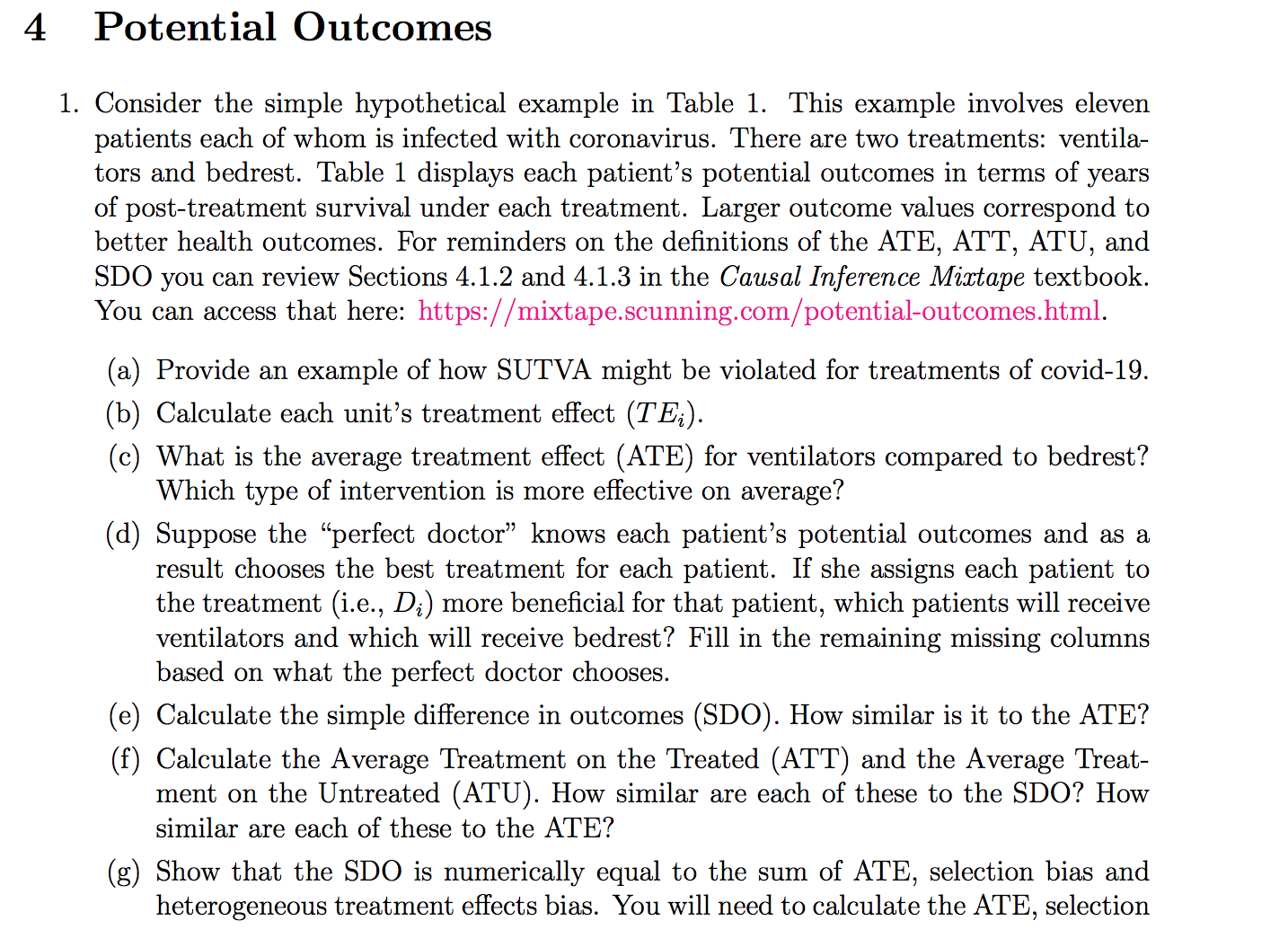
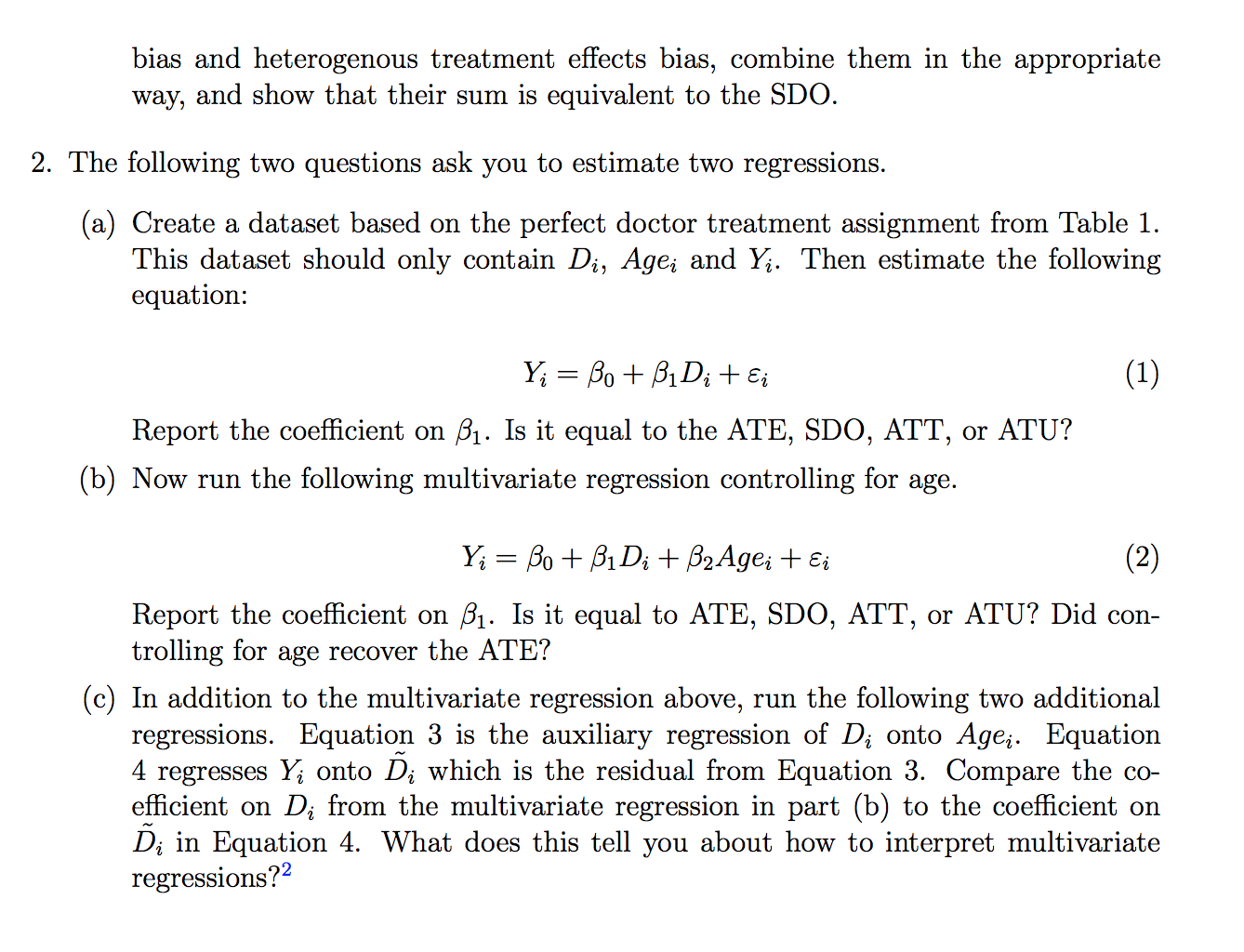

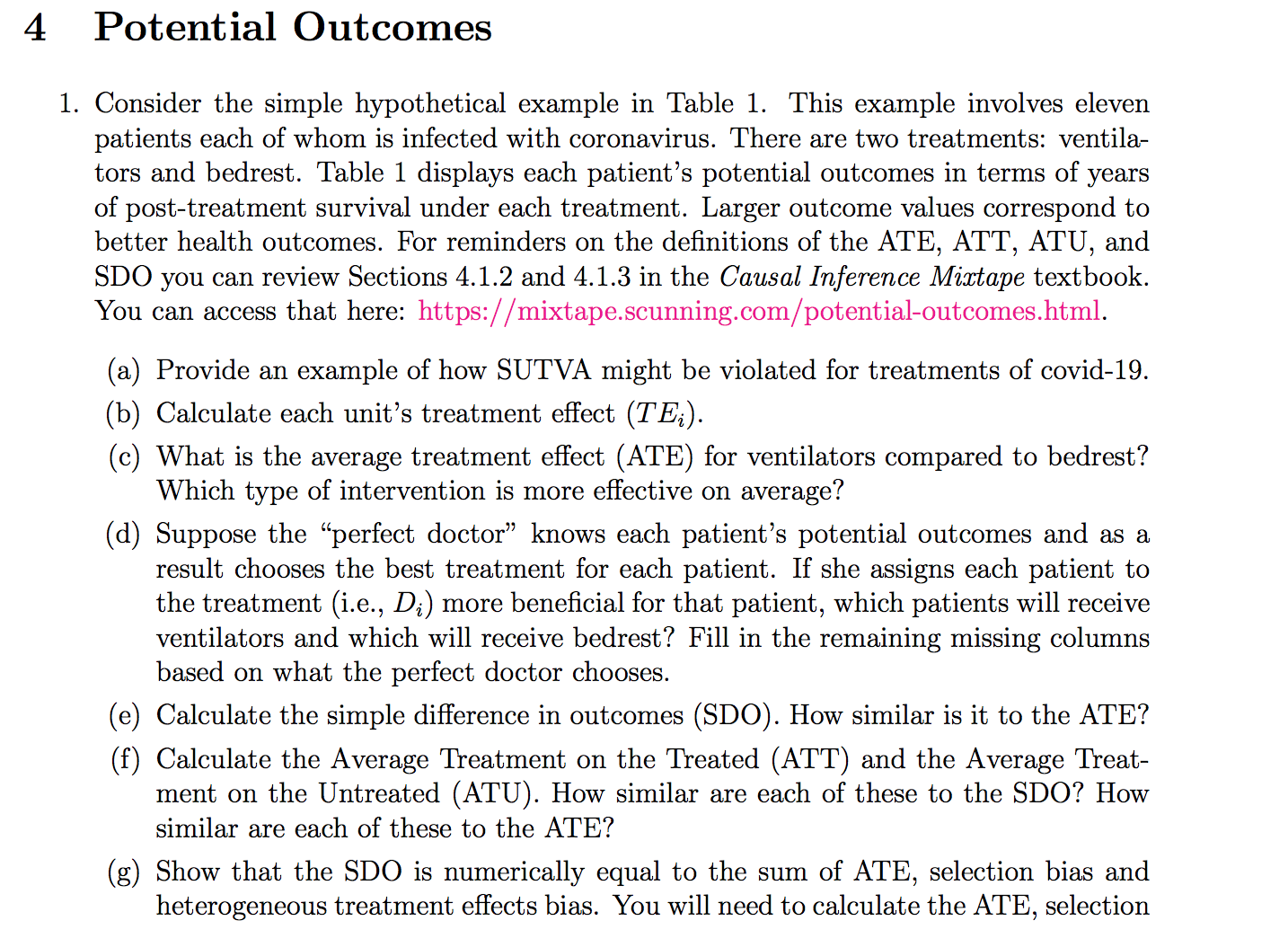
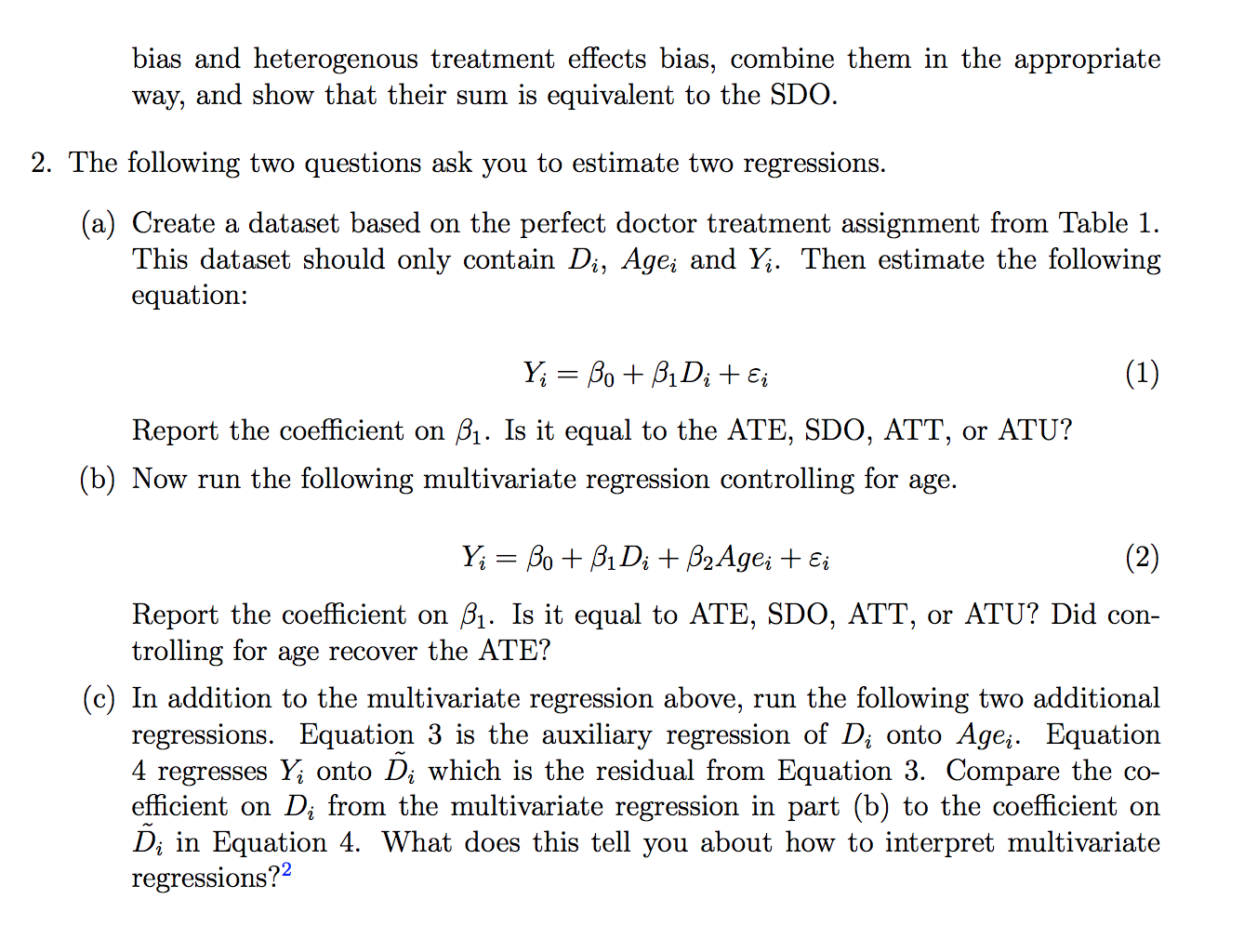

Potential Outcomes 1. Consider the simple hypothetical example in Table 1. This example involves eleven patients each of whom is infected with coronavirus. There are two treatments: ventila tors and bedrest. Table 1 displays each patient's potential outcomes in terms of years of post-treatment survival under each treatment. Larger outcome values correspond to better health outcomes. For reminders on the definitions of the ATE, ATT, ATU, and SDO you can review Sections 4.1.2 and 4.1.3 in the Causal Inference Mirtapc textbook. You can access that here: https://mixtape.scunning.com/potentialoutcomes.html. (a) Provide an example of how SUTVA might be violated for treatments of covid19. (b) Calculate each unit's treatment effect (TEi). (c) What is the average treatment effect (ATE) for ventilators compared to bedrest? Which type of intervention is more effective on average? (d) Suppose the \"perfect doctor\" knows each patient's potential outcomes and as a result chooses the best treatment for each patient. If she assigns each patient to the treatment (i.e., D,) more beneficial for that patient, which patients will receive ventilators and which will receive bedrest? Fill in the remaining missing columns based on what the perfect doctor chooses. (e) Calculate the simple difference in outcomes (SDO). How similar is it to the ATE? (f) Calculate the Average Treatment on the Treated (ATT) and the Average Treat ment on the Untreated (ATU). How similar are each of these to the SDO? How similar are each of these to the ATE? (g) Show that the SDO is numerically equal to the sum of ATE, selection bias and heterogeneous treatment effects bias. You will need to calculate the ATE, selection bias and heterogenous treatment effects bias, combine them in the appropriate way, and show that their sum is equivalent to the SDO. 2. The following two questions ask you to estimate two regressions. (3) Create a dataset based on the perfect doctor treatment assignment from Table 1. This dataset should only contain Di, Age,; and Y}. Then estimate the following equation: Y; =30+51Di+i (1) Report the coefficient on 31. Is it equal to the ATE, SDO, ATT, or ATU? Now run the following multivariate regression controlling for age. Y2- = {30 + 51171: + 25214932' + 82' (2) Report the coefcient on 31. Is it equal to ATE, SDO, ATT, or ATU? Did con trolling for age recover the ATE? In addition to the multivariate regression above, run the following two additional regressions. Equation 3 is the auxiliary regression of D3- onto Agei. Equation 4 regresses Ya- onto [31- which is the residual from Equation 3. Compare the co efficient on D;- from the multivariate regression in part (b) to the coefficient on D; in Equation 4. What does this tell you about how to interpret multivariate regressions'.P2
Step by Step Solution
There are 3 Steps involved in it

Get step-by-step solutions from verified subject matter experts
 Study Help