







Question: Power system stability may be broadly defined as that property of a power system that enables it to remain in a state of operating equilibrium
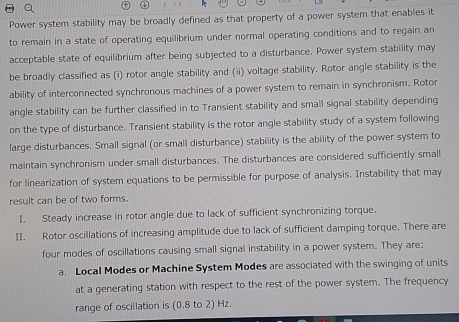
Power system stability may be broadly defined as that property of a power system that enables it to remain in a state of operating equilibrium under normal operating conditions and to regain an acceptable state of equilibrium after being subjected to a disturbance. Power system stablity may be broadly classified as i rotor angle stability and ii voltage stability. Rotor angle stability is the ability of interconnected synchronous machines of a power system to remain in synchronism. Rotor angle stability can be further classified in to Transient stability and small signal stability depending on the type of disturbance. Transient stability is the rotor angle stability study of a system following large disturbances. Small signal or small disturbance stability is the ability of the power system to maintain synchronism under small disturbances. The disturbances are considered sufficiently small for linearization of system equations to be permissible for purpose of analysis. Instability that may result can be of two forms.
Steady increase in rotor angle due to lack of sufficient synchronizing torque.
II Rotor oscillations of increasing amplitude due to lack of sufficient damping torque. There are four modes of oscillations causing small signal instability in a power system. They are:
a Local Modes or Machine System Modes are associated with the swinging of units at a generating station with respect to the rest of the power system. The frequency range of oscillation is to
Step by Step Solution
There are 3 Steps involved in it
1 Expert Approved Answer
Step: 1 Unlock

Question Has Been Solved by an Expert!
Get step-by-step solutions from verified subject matter experts
Step: 2 Unlock
Step: 3 Unlock
 Study Help