







Question: Practice (be sure to include sketches wherefwhen possible) 5. In a ripple tank, the second nodal line makes an angle of 25 with the right
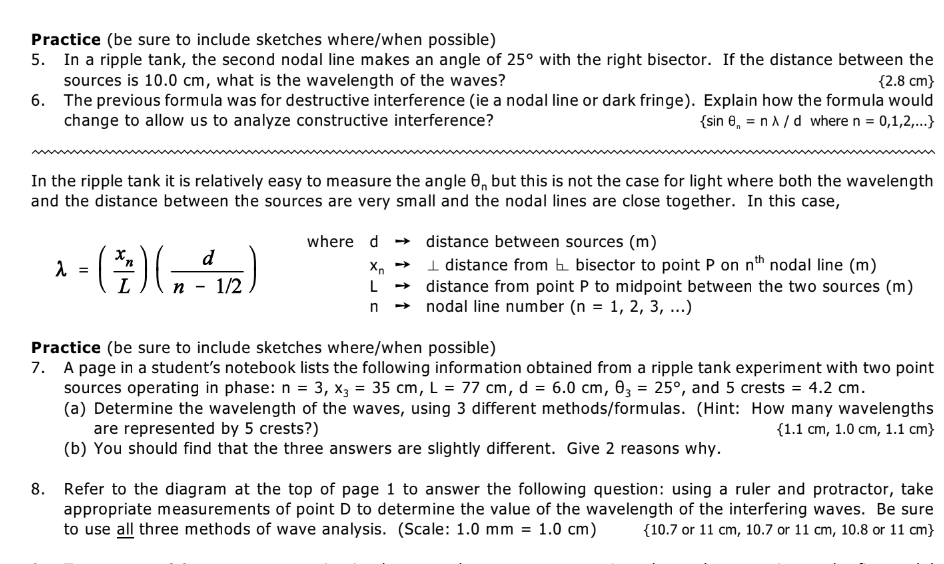
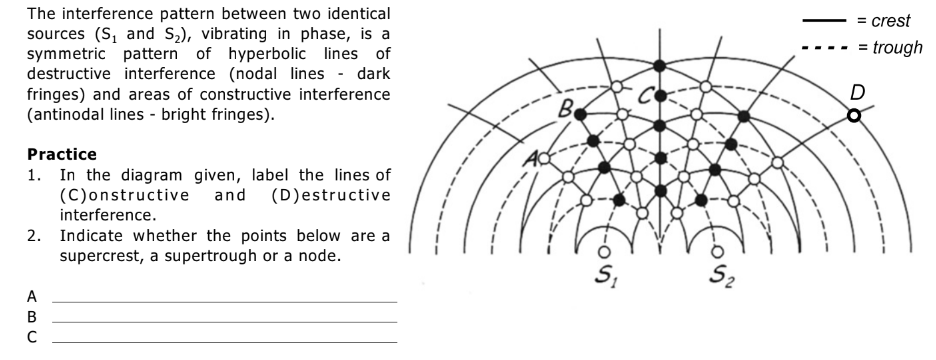
Practice (be sure to include sketches wherefwhen possible) 5. In a ripple tank, the second nodal line makes an angle of 25 with the right bisector. If the distance between the sources is 10.0 cm, what is the wavelength of the waves? {2.8 cm} 6. The previous formula was for destructive interference (ie a nodal line or dark fringe). Explain how the formula would change to allow us to analyze constructive interference? {sin e, = n A i d where n = 0,1,2,...} In the ripple tank it is relatively easy to measure the angle 8,, but this is not the case for light where both the wavelength and the distance between the sources are very small and the nodal lines are close together. In this case, where d - distance between sources (m) l = () ( L] x,, a l distance from h bisector to point P on nth nodal line (m) L n - U2 L -> distance from point P to midpoint between the two sources (m) n -> nodal line number [n = 1, 2, 3, ...) Practice (be sure to include sketches wherefwhen possible) If. A page in a student's notebook lists the following information obtained from a ripple tank experiment with two point sources operating in phase: n = 3, x3 = 35 cm, L = W cm, d = 6.0 cm, 03 = 25, and 5 crests = 4.2 cm. (a) Determine the wavelength of the waves, using 3 different methodsfformulas. (Hint: How many wavelengths are represented by 5 crests?) {1.1 cm, 1.0 cm, 1.1 cm} (in) You should find that the three answers are slightly different. Give 2 reasons why. 8. Refer to the diagram at the top of page 1 to answer the following question: using a ruler and protractor, take appropriate measurements of point D to determine the value of the wavelength of the interfering waves. Be sure to use a_||three methods of wave analysis. (Scale: 1.0 mm = 1.0 cm) {10.7 or 11 cm, 10.? or 11 cm, 10.8 or 11 cm} The interference pattern between two identical sources (51 and 52), vibrating in phase, is a symmetric pattern of hyperbolic lines of destructive interference (nodal lines - dark fringes) and areas of constructive interference [antinodal lines - bright fringes). Practice 1. In the diagram given, label the lines of (C)on5tructive and (Djestructive interference. 2. Indicate whether the points below are a supercrest, a supertrough or a node. (10333
Step by Step Solution
There are 3 Steps involved in it

Get step-by-step solutions from verified subject matter experts
 Study Help