







Question: PRACTICE IT Use the worked example above to help you solve this problem. A car with mass 1.49 x 10 kg traveling east at a
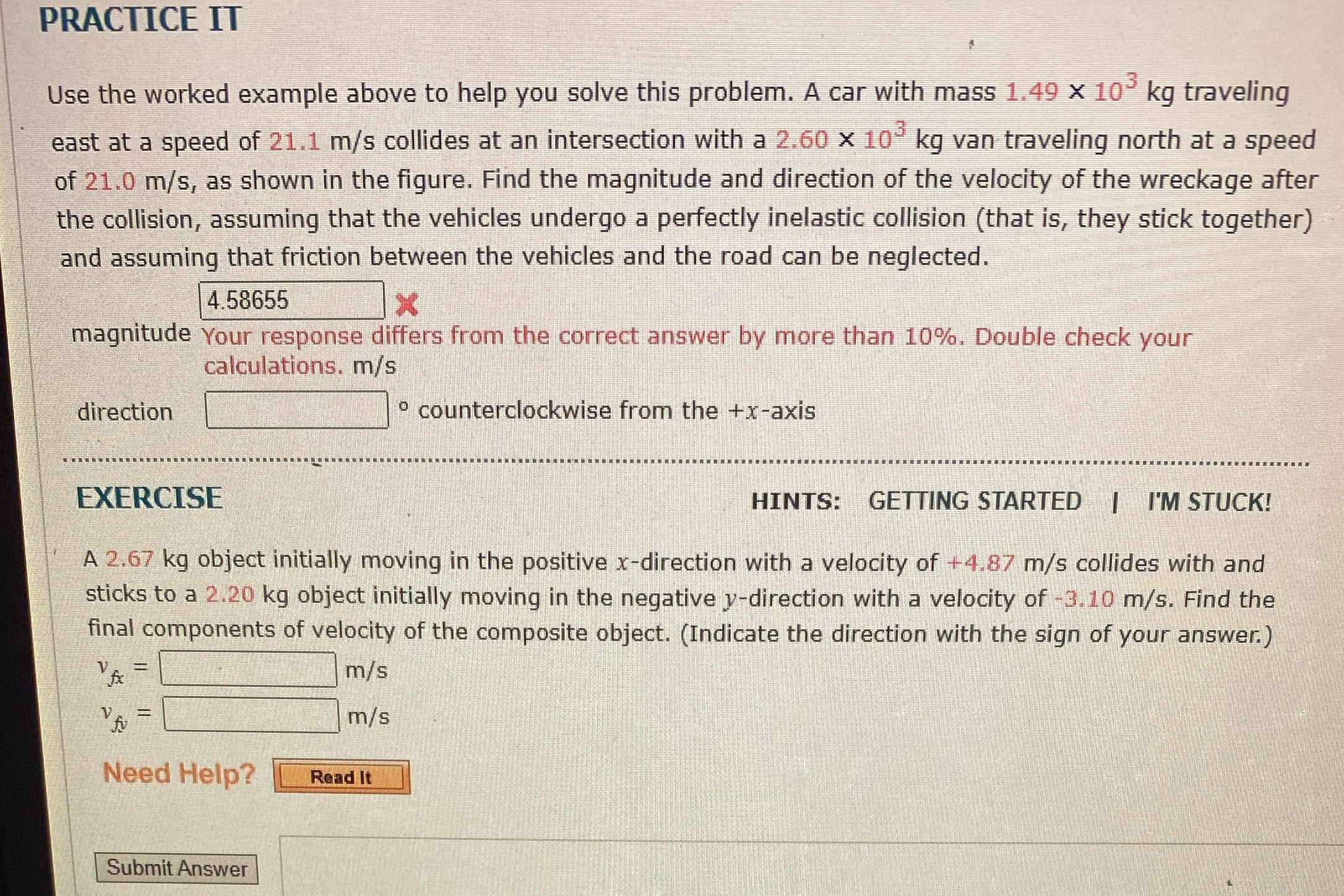
PRACTICE IT Use the worked example above to help you solve this problem. A car with mass 1.49 x 10" kg traveling east at a speed of 21.1 m/s collides at an intersection with a 2.60 x 10" kg van traveling north at a speed of 21.0 m/s, as shown in the figure. Find the magnitude and direction of the velocity of the wreckage after the collision, assuming that the vehicles undergo a perfectly inelastic collision (that is, they stick together) and assuming that friction between the vehicles and the road can be neglected. 4.58655 magnitude Your response differs from the correct answer by more than 10%. Double check your calculations. m/s direction counterclockwise from the +x-axis EXERCISE HINTS: GETTING STARTED | I'M STUCK! A 2.67 kg object initially moving in the positive x-direction with a velocity of +4.87 m/s collides with and sticks to a 2.20 kg object initially moving in the negative y-direction with a velocity of -3.10 m/s. Find the final components of velocity of the composite object. (Indicate the direction with the sign of your answer.) m/s m/s Need Help? Read It Submit
Step by Step Solution
There are 3 Steps involved in it

Get step-by-step solutions from verified subject matter experts
 Study Help