







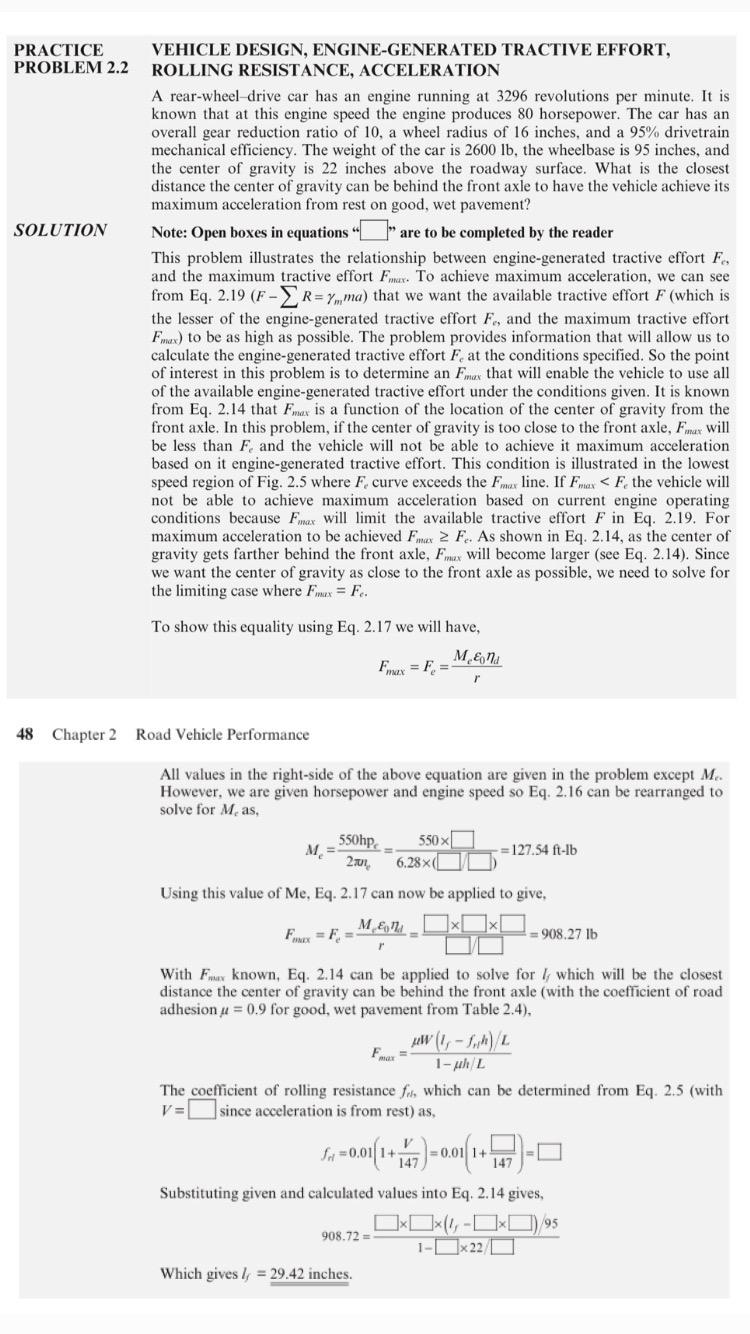
Question: PRACTICE PROBLEM 2 . 2 SOLUTION VEHICLE DESIGN, ENGINE - GENERATED TRACTIVE EFFORT, ROLLING RESISTANCE, ACCELERATION A rear - wheel - drive car has an
PRACTICE PROBLEM
SOLUTION
VEHICLE DESIGN, ENGINEGENERATED TRACTIVE EFFORT, ROLLING RESISTANCE, ACCELERATION
A rearwheeldrive car has an engine running at revolutions per minute. It is known that at this engine speed the engine produces horsepower. The car has an overall gear reduction ratio of a wheel radius of inches, and a drivetrain mechanical efficiency. The weight of the car is the wheelbase is inches, and the center of gravity is inches above the roadway surface. What is the closest distance the center of gravity can be behind the front axle to have the vehicle achieve its maximum acceleration from rest on good, wet pavement?
Note: Open boxes in equations are to be completed by the reader
This problem illustrates the relationship between enginegenerated tractive effort and the maximum tractive effort To achieve maximum acceleration, we can see from Eq that we want the available tractive effort which is the lesser of the enginegenerated tractive effort and the maximum tractive effort : to be as high as possible. The problem provides information that will allow us to calculate the enginegenerated tractive effort at the conditions specified. So the point of interest in this problem is to determine an that will enable the vehicle to use all of the available enginegenerated tractive effort under the conditions given. It is known from Eq that is a function of the location of the center of gravity from the front axle. In this problem, if the center of gravity is too close to the front axle, will be less than and the vehicle will not be able to achieve it maximum acceleration based on it enginegenerated tractive effort. This condition is illustrated in the lowest speed region of Fig. where curve exceeds the line. If
Step by Step Solution
There are 3 Steps involved in it
1 Expert Approved Answer
Step: 1 Unlock

Question Has Been Solved by an Expert!
Get step-by-step solutions from verified subject matter experts
Step: 2 Unlock
Step: 3 Unlock
 Study Help