







Question: Practice Problem 4). Let's return to the LP problem we formulated in Final Prob1. We are going to solve the problem in Solver and consider
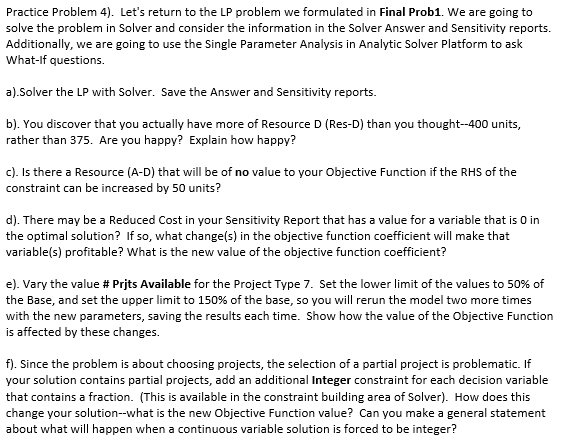
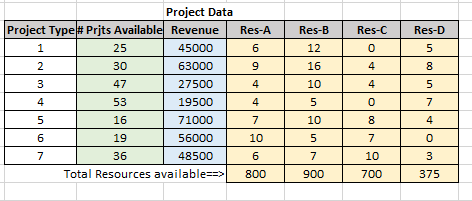
Practice Problem 4). Let's return to the LP problem we formulated in Final Prob1. We are going to solve the problem in Solver and consider the information in the Solver Answer and Sensitivity reports. Additionally, we are going to use the Single Parameter Analysis in Analytic Solver Platform to ask What-If questions. a).Solver the LP with Solver. Save the Answer and Sensitivity reports. b). You discover that you actually have more of Resource D (Res-D) than you thought--400 units, rather than 375. Are you happy? Explain how happy? c). Is there a Resource (A-D) that will be of no value to your objective Function if the RHS of the constraint can be increased by 50 units? d). There may be a Reduced Cost in your Sensitivity Report that has a value for a variable that is 0 in the optimal solution? If so, what change(s) in the objective function coefficient will make that variable(s) profitable? What is the new value of the objective function coefficient? e). Vary the value # Prjts Available for the Project Type 7. Set the lower limit of the values to 50% of the Base, and set the upper limit to 150% of the base, so you will rerun the model two more times with the new parameters, saving the results each time. Show how the value of the Objective Function is affected by these changes. f). Since the problem is about choosing projects, the selection of a partial project is problematic. If your solution contains partial projects, add an additional Integer constraint for each decision variable that contains a fraction. (This is available in the constraint building area of Solver). How does this change your solution--what is the new Objective Function value? Can you make a general statement about what will happen when a continuous variable solution is forced to be integer? Project Data Project Type# Prjts Available Revenue 45000 63000 27500 19500 71000 56000 48500 available==> 1 2 3 195 W 4 6 7 25 30 47 53 16 19 36 Total Resources Res-A 6 9 4 4 7 10 6 800 Res-B 12 16 10 5 10 5 7 900 Res-C 0 4 4 0 8 7 10 700 Res-D 5 555 co 8 7 4 0 WO 3 375 Practice Problem 4). Let's return to the LP problem we formulated in Final Prob1. We are going to solve the problem in Solver and consider the information in the Solver Answer and Sensitivity reports. Additionally, we are going to use the Single Parameter Analysis in Analytic Solver Platform to ask What-If questions. a).Solver the LP with Solver. Save the Answer and Sensitivity reports. b). You discover that you actually have more of Resource D (Res-D) than you thought--400 units, rather than 375. Are you happy? Explain how happy? c). Is there a Resource (A-D) that will be of no value to your objective Function if the RHS of the constraint can be increased by 50 units? d). There may be a Reduced Cost in your Sensitivity Report that has a value for a variable that is 0 in the optimal solution? If so, what change(s) in the objective function coefficient will make that variable(s) profitable? What is the new value of the objective function coefficient? e). Vary the value # Prjts Available for the Project Type 7. Set the lower limit of the values to 50% of the Base, and set the upper limit to 150% of the base, so you will rerun the model two more times with the new parameters, saving the results each time. Show how the value of the Objective Function is affected by these changes. f). Since the problem is about choosing projects, the selection of a partial project is problematic. If your solution contains partial projects, add an additional Integer constraint for each decision variable that contains a fraction. (This is available in the constraint building area of Solver). How does this change your solution--what is the new Objective Function value? Can you make a general statement about what will happen when a continuous variable solution is forced to be integer? Project Data Project Type# Prjts Available Revenue 45000 63000 27500 19500 71000 56000 48500 available==> 1 2 3 195 W 4 6 7 25 30 47 53 16 19 36 Total Resources Res-A 6 9 4 4 7 10 6 800 Res-B 12 16 10 5 10 5 7 900 Res-C 0 4 4 0 8 7 10 700 Res-D 5 555 co 8 7 4 0 WO 3 375
Step by Step Solution
There are 3 Steps involved in it

Get step-by-step solutions from verified subject matter experts
 Study Help