







Question: Practice Problems on Correlation and Regression (Chapter 6) and Using the Normal Curve, Part I (Chapter 7) 1. The idea of using tests to predict
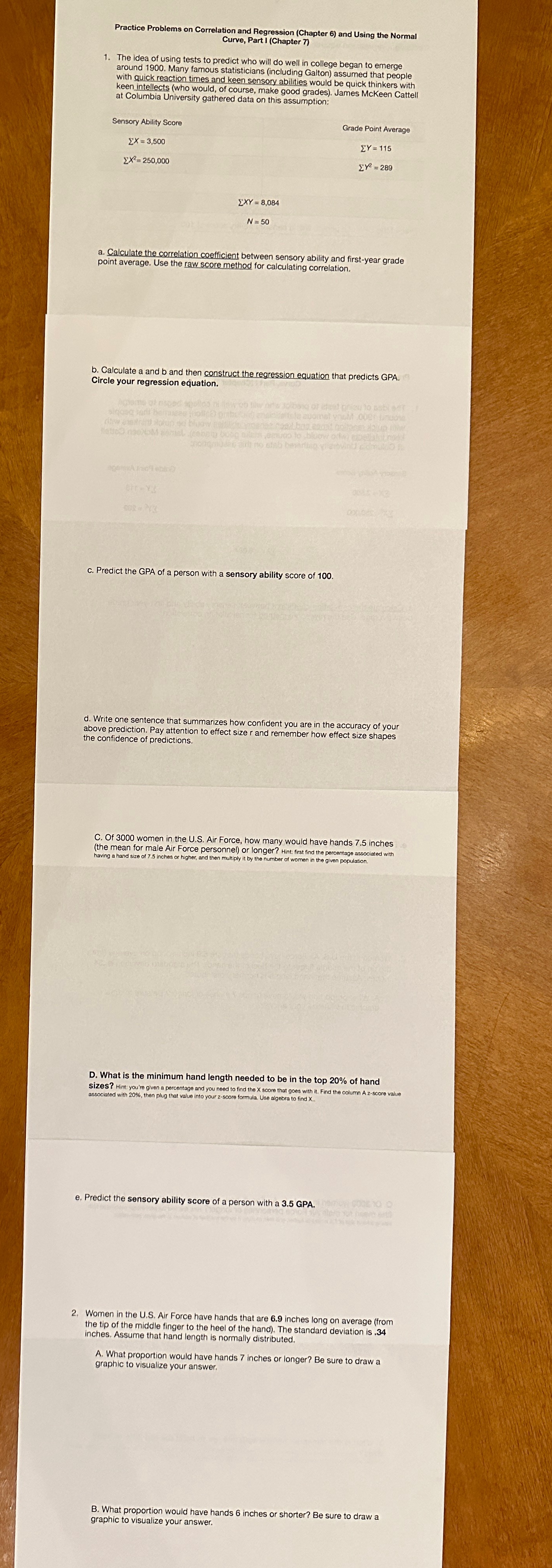
Practice Problems on Correlation and Regression (Chapter 6) and Using the Normal Curve, Part I (Chapter 7) 1. The idea of using tests to predict who will do well in college began to emerge around 1900. Many famous statisticians (including Galton) assumed that people with quick reaction times and keen sensory abilities would be quick thinkers with keen intellects (who would, of course, make good grades). James Mckeen Cattell at Columbia University gathered data on this assumption: Sensory Ability Score Grade Point Average EX = 3,500 EY = 115 EX = 250,000 EY = 289 EXY = 8,084 N = 50 a. Calculate the correlation coefficient between sensory ability and first-year grade point average. Use the raw score method for calculating correlation. b. Calculate a and b and then construct the regression equation that predicts GPA. Circle your regression equation. le agomet youM over tinudie c. Predict the GPA of a person with a sensory ability score of 100. d. Write one sentence that summarizes how confident you are in the accuracy of your above prediction. Pay attention to effect size r and remember how effect size shapes the confidence of predictions. C. Of 3000 women in the U.S. Air Force, how many would have hands 7.5 inches (the mean for male Air Force personnel) or longer? Hint: first find the percentage associated with having a hand size of 7.5 inches or higher, and then multiply it by the number of women in the given population. D. What is the minimum hand length needed to be in the top 20% of hand ogg manpercentage and you need to find the X score that goes with it. Find the column A z-score value associated with 20%, then plug that value into your z-score formula. Use algebra to find X. e. Predict the sensory ability score of a person with a 3.5 GPA. 2. Women in the U.S. Air Force have hands that are 6.9 inches long on average (from the tip of the middle finger to the heel of the hand). The standard deviation is .34 inches. Assume that hand length is normally distributed. A. What proportion would have hands 7 inches or longer? Be sure to draw a graphic to visualize your answer. B. What proportion would have hands 6 inches or shorter? Be sure to draw a graphic to visualize your
Step by Step Solution
There are 3 Steps involved in it

Get step-by-step solutions from verified subject matter experts
 Study Help