







Question: PRACTICE What Would You Include in the Performance Evaluation? Objective Supportive communication and reflective listening are useful tools during the performance review, but managers need
PRACTICE What Would You Include in the Performance Evaluation?
Objective Supportive communication and reflective listening are useful tools during the performance review, but managers need to remember that the performance review is only useful if it is part of a larger performance evaluation process. This exercise gives you an opportunity to think about the role of the performance review in planning the next cycle of performance evaluation.
Directions Review the guidelines for developing an effective performance evaluation system. Then think about the suggestions you had for redesigning Max's midyear review of Sue.
What elements would you include in a performance review of Sue? What kind of feedback should you give her? What skills will you suggest that she develop? What other issues will you raise?
In dyads, roleplay the conversation that occurs in Max's midyear performance evaluation review of Sue.
Discussion Questions Answer the following questions:
During the roleplay, how successful were you at conducting a successful performance evaluation? Do you feel that you achieved a successful outcome? Why or why not?
Which of the guidelines for giving and receiving feedback did you follow? Which did you forget? What were the outcomes?
To what degree did your performance review focus on Sue's technical skills, and to what degree did it focus on her role as a member of the process design group? To what degree was Max's role in helping Sue develop as an employee in the process design group part of the performance review?
What did you learn from this roleplay?
Reflection Evaluating employees' performance is a complex task that is made more complicated when we see it as having conflicting objectives. We want to motivate our employees by giving them "positive" feedback. On the other hand, we often need to give them "negative" feedback that they may not agree with and will not be happy to hear. Similarly, we want to be supportive and provide employees with the opportunity to raise concerns. However, we also want them to take responsibility for problems or issues that arise. Instead of seeing these as conflicting objectives, emphasizing the goal of employee development helps us transcend this paradox. Employee development focuses our attention less on what has happened in the past and more on what we are working to achieve in the future. APPLICATION Developing Your Capacity to Develop Others
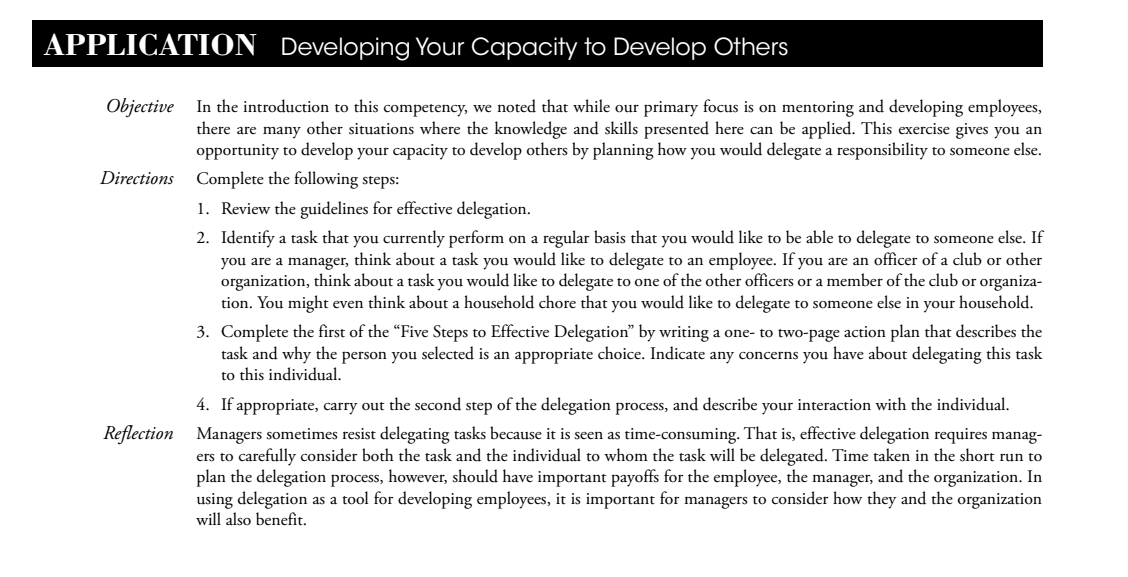
Objective In the introduction to this competency, we noted that while our primary focus is on mentoring and developing employees, there are many other situations where the knowledge and skills presented here can be applied. This exercise gives you an opportunity to develop your capacity to develop others by planning how you would delegate a responsibility to someone else.
Directions Complete the following steps:
Review the guidelines for effective delegation.
Identify a task that you currently perform on a regular basis that you would like to be able to delegate to someone else. If you are a manager, think about a task you would like to delegate to an employee. If you are an officer of a club or other organization, think about a task you would like to delegate to one of the other officers or a member of the club or organization. You might even think about a household chore that you would like to delegate to someone else in your household.
Complete the first of the "Five Steps to Effective Delegation" by writing a one to twopage action plan that describes the task and why the person you selected is an appropriate choice. Indicate any concerns you have about delegating this task to this individual.
If appropriate, carry out the second step of the delegation process, and describe your interaction with the individual.
Reflection Managers sometimes resist delegating tasks because it is seen as timeconsuming. That is effective delegation requires managers to carefully consider both the task and the individual to whom the task will be delegated. Time taken in the short run to plan the delegation process, however, should have important payoffs for the employee, the manager, and the organization. In using delegation as a tool for developing employees, it is important for managers to consider how they and the organization will also benefit.
Step by Step Solution
There are 3 Steps involved in it
1 Expert Approved Answer
Step: 1 Unlock

Question Has Been Solved by an Expert!
Get step-by-step solutions from verified subject matter experts
Step: 2 Unlock
Step: 3 Unlock
 Study Help