Question: Practicing Paragraphing and Transitions Directions: This is a section from an essay, Ten Ways to Think about Writing: Metaphoric Musings for College Writing Students,
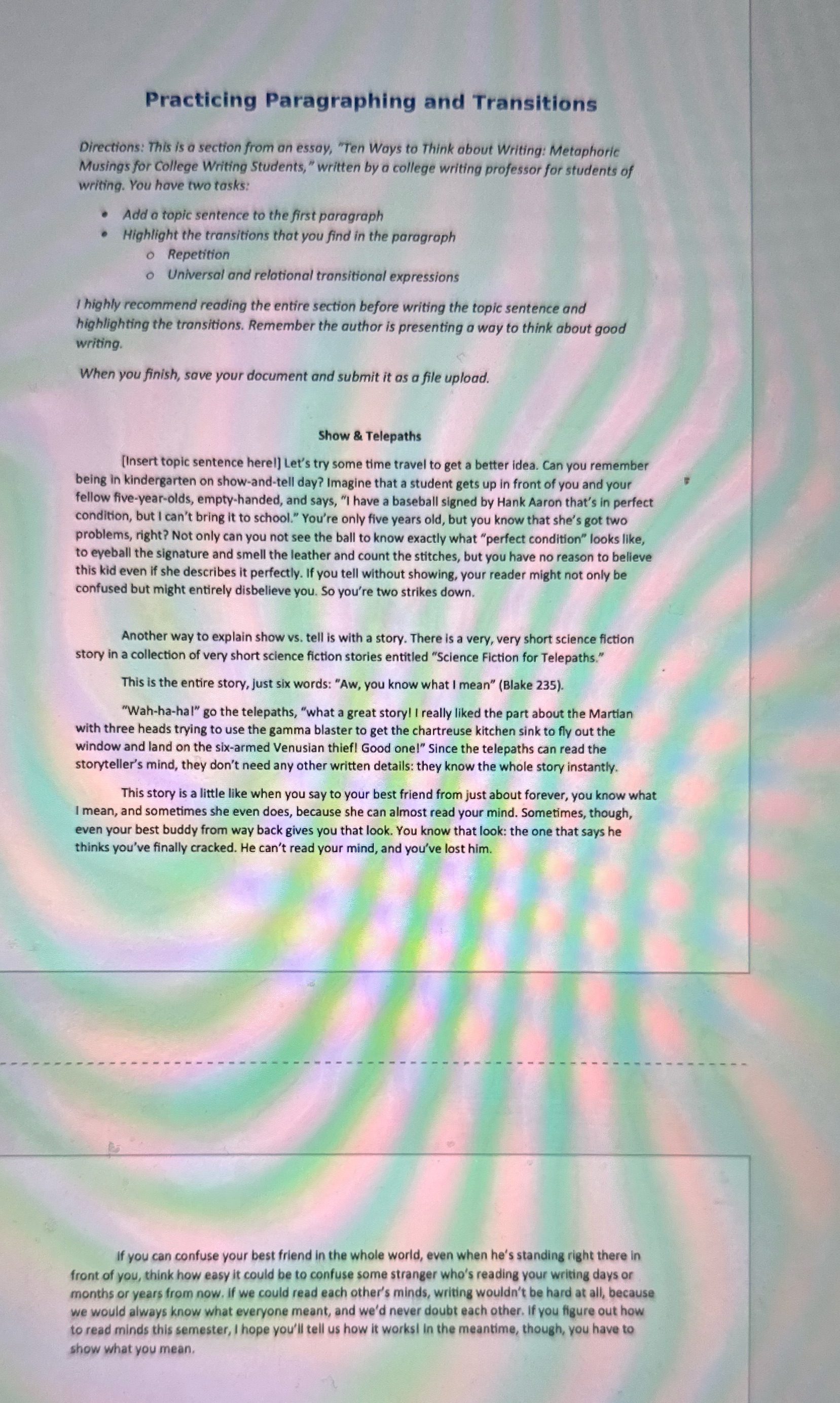
Practicing Paragraphing and Transitions Directions: This is a section from an essay, "Ten Ways to Think about Writing: Metaphoric Musings for College Writing Students, " written by a college writing professor for students of writing. You have two tasks: Add a topic sentence to the first paragraph Highlight the transitions that you find in the paragraph o Repetition o Universal and relational transitional expressions I highly recommend reading the entire section before writing the topic sentence and highlighting the transitions. Remember the author is presenting a way to think about good writing. When you finish, save your document and submit it as a file upload. Show & Telepaths [Insert topic sentence herel] Let's try some time travel to get a better idea. Can you remember being in kindergarten on show-and-tell day? Imagine that a student gets up in front of you and your fellow five-year-olds, empty-handed, and says, "I have a baseball signed by Hank Aaron that's in perfect condition, but I can't bring it to school." You're only five years old, but you know that she's got two problems, right? Not only can you not see the ball to know exactly what "perfect condition" looks like, to eyeball the signature and smell the leather and count the stitches, but you have no reason to believe this kid even if she describes it perfectly. If you tell without showing, your reader might not only be confused but might entirely disbelieve you. So you're two strikes down. Another way to explain show vs. tell is with a story. There is a very, very short science fiction story in a collection of very short science fiction stories entitled "Science Fiction for Telepaths." This is the entire story, just six words: "Aw, you know what I mean" (Blake 235). "Wah-ha-hal" go the telepaths, "what a great story! I really liked the part about the Martian with three heads trying to use the gamma blaster to get the chartreuse kitchen sink to fly out the window and land on the six-armed Venusian thief! Good one!" Since the telepaths can read the storyteller's mind, they don't need any other written details: they know the whole story instantly. This story is a little like when you say to your best friend from just about forever, you know what I mean, and sometimes she even does, because she can almost read your mind. Sometimes, though, even your best buddy from way back gives you that look. You know that look: the one that says he thinks you've finally cracked. He can't read your mind, and you've lost him. If you can confuse your best friend in the whole world, even when he's standing right there In front of you, think how easy it could be to confuse some stranger who's reading your writing days or months or years from now. If we could read each other's minds, writing wouldn't be hard at all, because we would always know what everyone meant, and we'd never doubt each other. If you figure out how to read minds this semester, I hope you'll tell us how it works! in the meantime, though, you have to show what you mean









 Study Help